
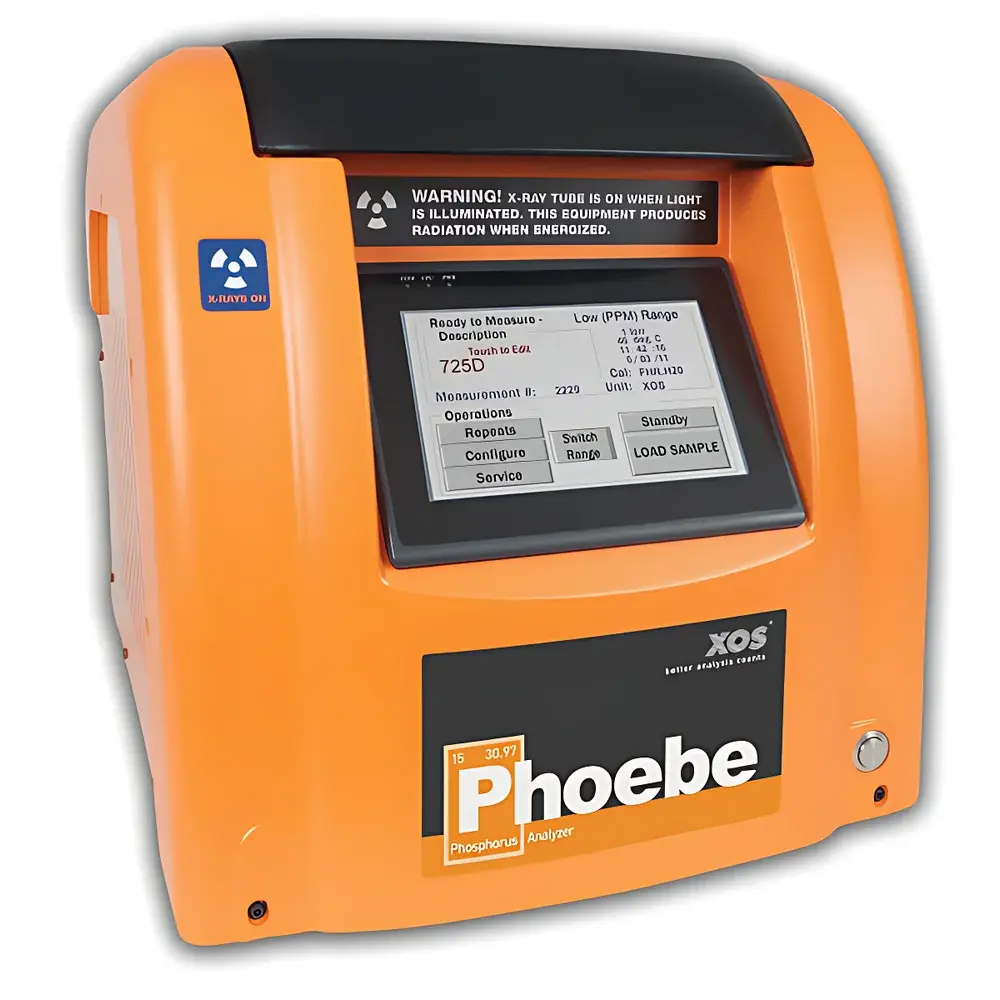
XOS Phoebe Benchtop Monochromatic Wavelength-Dispersive X-Ray Fluorescence (MWD-XRF) Phosphorus Analyzer
| Brand | XOS |
|---|---|
| Model | Phoebe |
| Instrument Type | Benchtop |
| Excitation Principle | Monochromatic Wavelength-Dispersive XRF |
| Target Element | Phosphorus (P) |
| X-ray Tube Power | 75 W |
| Detection Limit (LOD) | 0.4 ppm (at 600 s) |
| Quantification Range | 0.4 – 3000 ppm |
| Sample Volume | ≤10 mL |
| Sample Containment | Prolene film |
| Measurement Time | 30–900 s (user-selectable) |
| Calibration | Multi-curve storage |
| Motion Components | None |
| Gas/Combustion Required | No |
| Operating Environment | Standard laboratory AC power only |
Overview
The XOS Phoebe is a dedicated benchtop monochromatic wavelength-dispersive X-ray fluorescence (MWD-XRF) analyzer engineered for the precise, interference-free quantification of total phosphorus in liquid hydrocarbon and biofuel matrices. Unlike conventional energy-dispersive XRF (ED-XRF) or combustion-based methods, the Phoebe employs a highly collimated monochromatic excitation beam—generated via crystal monochromator optics—to selectively excite phosphorus Kα radiation while suppressing bremsstrahlung background and spectral overlaps from sulfur, chlorine, calcium, and transition metals commonly present in fuels. This physical selectivity enables sub-part-per-trillion effective background-equivalent concentration (BEC), delivering robust LODs of 0.4 ppm at 600-second counting time without chemical derivatization or matrix digestion. Designed in accordance with ASTM D7881–22 (Standard Test Method for Determination of Phosphorus in Liquid Fuels by Monochromatic WDXRF) and aligned with ISO 8217 Annex D and EN 14214 requirements for biodiesel purity, the Phoebe serves as a primary compliance tool for laboratories validating fuel phosphorus against regulatory thresholds—including China’s GB 17930–2016 limit of ≤1.3 mg/L (1.3 ppm) for gasoline and EPA 40 CFR Part 1090 mandates.
Key Features
- Monochromatic excitation architecture eliminates spectral interferences from S, Cl, Ca, and Fe—critical for complex fuel matrices with variable heteroatom content
- No consumables: operates solely on standard 100–240 V AC power; no high-purity gases, plasma sources, or furnace heating required
- AccuFlow sample chamber design mitigates particle settling effects through laminar flow stabilization—ensuring representative measurement of heterogeneous or suspended-phase samples
- Fixed-optics configuration with zero moving parts in the optical path enhances long-term stability and reduces recalibration frequency to ≤1x per quarter under routine QC protocols
- Benchtop footprint (W×D×H: 32 × 45 × 38 cm) enables deployment in constrained QC labs, mobile testing units, or refinery-side analytical cabins without structural modification
- Prolene film-supported liquid sampling eliminates solvent evaporation artifacts and enables trace-level analysis without pre-concentration or ashing steps
Sample Compatibility & Compliance
The Phoebe is validated for direct analysis of undiluted liquid samples including gasoline, diesel, jet fuel (ASTM D1655), biodiesel (FAME, ASTM D6751), hydrotreated vegetable oil (HVO), ethanol-gasoline blends (E10, E85), naphtha, crude oil emulsions, lube base stocks, and aqueous fuel additives. It meets the sample preparation minimalism criteria defined in USP for elemental impurities and supports GLP-compliant audit trails when integrated with LIMS via RS-232/USB-serial emulation. All calibration curves are traceable to NIST SRM 2721 (Phosphorus in Fuel Oil) and certified reference materials from Accustandard and Conostan. Instrument firmware complies with IEC 61000-6-3 (EMC) and IEC 61010-1 (safety), and data integrity conforms to FDA 21 CFR Part 11 requirements when paired with XOS’ optional secure software package.
Software & Data Management
The Phoebe Control Suite provides intuitive method setup, real-time spectrum visualization, and automated peak deconvolution using iterative least-squares fitting optimized for P Kα (2.013 keV). Each analysis generates a full metadata-rich report—including acquisition parameters, background-subtracted net intensity, statistical uncertainty (k=2), and curve-fit residuals—exportable as CSV, PDF, or XML. Up to 24 independent calibration models (e.g., one per fuel class) can be stored onboard with password-protected access levels for operators, supervisors, and QA auditors. Audit logs record all user actions, method modifications, and calibration events with timestamps and operator IDs. Optional integration with LabWare LIMS or Thermo Fisher SampleManager enables automated result routing and electronic signature workflows compliant with ISO/IEC 17025:2017 Clause 7.7.
Applications
- Regulatory compliance testing for phosphorus in finished gasoline per GB 17930, ASTM D3231, and JIS K 2280
- Monitoring catalyst poisoning risk in refinery FCC and hydrotreating units via feedstock phosphorus screening
- Verification of phosphorus removal efficiency in amine treating, clay adsorption, and metal oxide filtration systems
- Quality control of biodiesel esterification catalysts and post-process wash water
- Investigation of phosphorus leaching from elastomeric seals and lubricant additives into fuel streams
- Supporting R&D of low-phosphorus detergent packages and alternative fuel formulations
FAQ
Does the Phoebe require daily standardization or drift correction?
No—monochromatic excitation and fixed geometry yield intrinsic instrumental stability. A single daily check standard (e.g., 5 ppm P in iso-octane) suffices for routine verification; full recalibration is recommended only after tube replacement or major environmental relocation.
Can the Phoebe analyze solid or viscous samples such as used engine oil or asphaltene fractions?
It is designed exclusively for homogeneous liquids or stable suspensions ≤10 cSt viscosity. Solid samples require dissolution in compatible solvents (e.g., xylene, chloroform) prior to Prolene film loading; particulate matter must be filtered to ≤0.45 µm.
Is spectral interference from sulfur a concern in high-sulfur diesel matrices?
No—monochromatic excitation at the P K-edge (2.15 keV) avoids S Kα (2.307 keV) entirely, and the Bragg-angle-resolved detection isolates only the P Kα line with >10⁴ peak-to-background ratio.
What is the typical maintenance interval for the X-ray tube?
The 75 W microfocus tube has a rated lifetime of ≥15,000 hours under continuous operation; no scheduled maintenance is required beyond annual vacuum system inspection and detector window cleaning.
How does the Phoebe handle sample-to-sample carryover?
The disposable Prolene film and sealed sample chamber eliminate cross-contamination; rinse cycles are unnecessary. Carryover validation per ASTM D7881 shows <0.02 ppm residual signal after high-concentration (3000 ppm) sample measurement.





