
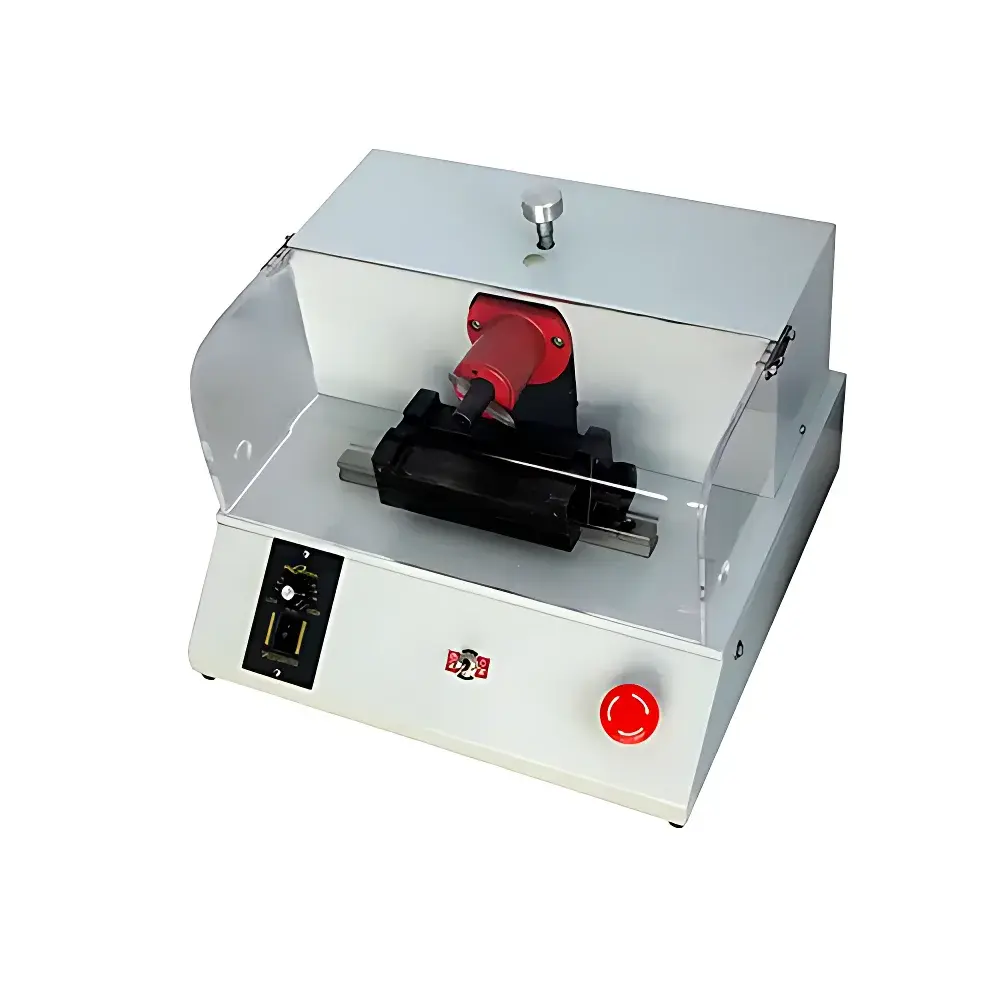
XQZH-2 Electric Notching Machine
| Brand | Tuofeng |
|---|---|
| Origin | Shanghai, China |
| Manufacturer Type | Direct Manufacturer |
| Country of Origin | China |
| Model | XQZH-2 |
| Price | Upon Request |
| Working Table Stroke | >90 mm |
| Feed Speed | 30 mm/min |
| Notching Throughput | >100 specimens per 10 minutes |
| Adjustable Feed Depth | 0–2.5 mm |
| Feed Stroke | 10 mm |
| Notch Type | Customizable per standard-compliant cutting tool geometry |
| Dimensions (L×W×H) | 450 × 390 × 360 mm |
| Power Supply | 220 V AC, Single-phase, Three-wire |
Overview
The XQZH-2 Electric Notching Machine is an industrial-grade, precision-engineered specimen preparation system designed exclusively for standardized impact testing of non-metallic materials. It operates on a controlled linear feed principle, utilizing a motor-driven carriage and rigidly mounted carbide-tipped notching tools to produce geometrically consistent, high-reproducibility notches in standardized rectangular bars—primarily for Izod (cantilever beam) and Charpy (simply supported beam) impact test configurations. Engineered for compliance with ISO 179:2000 (Izod), ISO 180:2001 (Charpy), GB/T 1043–2008, and GB/T 1843–2008, the XQZH-2 ensures dimensional fidelity of notch root radius, depth, and angle across all processed specimens—critical parameters directly influencing fracture energy measurement accuracy and inter-laboratory data comparability.
Key Features
- High-throughput batch processing: Accommodates up to 20 specimens in a single clamping cycle; achieves ≥100 notches per 10-minute operational interval under standard load conditions.
- Precision linear motion control: Motorized feed mechanism delivers repeatable feed speed of 30 mm/min and adjustable feed depth (0–2.5 mm) with mechanical stop limit at 10 mm stroke—enabling precise notch depth calibration per material thickness and standard requirement.
- Robust mechanical architecture: Cast-iron base and hardened steel guide rails ensure minimal deflection during cutting, maintaining perpendicularity between tool path and specimen surface across extended operation cycles.
- Integrated safety system: Includes emergency stop button, transparent polycarbonate guard with interlocked circuit cutoff, and automatic tool retraction upon cycle completion—meeting CE machinery directive principles for operator protection.
- Ergonomic design: Front-access clamping vise with quick-release lever, intuitive manual jog controls, and compact footprint (450 × 390 × 360 mm) facilitate integration into QC laboratories with space constraints.
Sample Compatibility & Compliance
The XQZH-2 accepts standardized rectangular test bars conforming to ISO 180/179 and GB/T 1043/1843 geometries—including common dimensions of 80 × 10 × 4 mm (Izod) and 55 × 10 × 4 mm (Charpy). Specimen materials include thermoplastics (e.g., ABS, PC, PP), thermosets (e.g., epoxy, phenolic), fiber-reinforced composites, and rigid elastomers. All notch profiles—V-notch (60° or 45° included angle, 0.25 mm or 1.0 mm root radius) or U-notch—are realized via interchangeable, metrologically certified tool holders. Each machine undergoes factory verification using NIST-traceable gauge blocks and optical profilometry to confirm notch depth deviation ≤ ±0.02 mm and root radius tolerance within ±0.05 mm—fully aligned with ISO/IEC 17025 requirements for test equipment validation.
Software & Data Management
The XQZH-2 operates as a standalone electromechanical system without embedded software or digital interface. However, its deterministic mechanical sequencing supports full traceability in regulated environments: each notching cycle is logged manually or via external lab management systems (LIMS) with operator ID, date/time stamp, specimen batch number, and tool change history. For GLP/GMP compliance, users may integrate the machine into audit-ready workflows by documenting maintenance records (per ISO 9001 clause 7.5.3), calibration logs (tool wear verification every 500 cycles), and preventive service schedules. No firmware or data export capability is present—eliminating cybersecurity concerns while ensuring deterministic, non-modifiable operation.
Applications
- Quality control laboratories performing routine impact resistance verification on injection-molded plastic components per automotive (SAE J444), electrical insulation (IEC 60695), or construction material (EN 13116) specifications.
- Research institutions conducting comparative fracture mechanics studies across polymer formulations, aging conditions, or additive incorporation (e.g., flame retardants, fillers).
- Third-party testing labs accredited to ISO/IEC 17025—where reproducible specimen geometry is prerequisite for uncertainty budgeting in impact energy reporting (k = 2).
- Manufacturing sites implementing PPAP or APQP protocols requiring documented specimen preparation consistency across shift changes and operator rotations.
FAQ
What standards does the XQZH-2 explicitly support?
ISO 179:2000 (Izod), ISO 180:2001 (Charpy), GB/T 1043–2008, and GB/T 1843–2008.
Can the machine produce both V-notches and U-notches?
Yes—via user-supplied, standard-compliant cutting tools mounted in the interchangeable tool holder assembly.
Is tool calibration required before use?
Yes; initial tool verification must be performed using optical measurement or certified radius gauges to confirm notch geometry prior to first-use qualification.
Does the unit comply with electrical safety directives for export?
It meets IEC 60204-1 (electrical equipment of machines) and carries CE marking for machinery safety when installed with proper grounding per 220 V AC, single-phase, three-wire supply.
What maintenance intervals are recommended?
Lubrication of linear guides every 200 operating hours; tool inspection and replacement after 500 notches or visible edge degradation; annual verification of feed speed and stroke repeatability using dial indicator.



