Xunshu Z8 Zone of Inhibition (Antibiotic Potency) Analyzer
| Brand | Xunshu |
|---|---|
| Origin | Zhejiang, China |
| Manufacturer Type | Direct Manufacturer |
| Region Classification | Domestic (China) |
| Model | Xunshu Z8 |
| Price Range | USD 7,000 – 11,200 |
| Imaging Sensor | 10 MP True-Color CMOS |
| Lens | 8 mm F/1.4, Distortion < 1% |
| Enclosure | Fully Enclosed Dark Chamber with Auto-Centering |
| Illumination | Tri-LED Mixed Soft Light + Patented Suspended Dark-Field System |
| Measurement Modes | Auto-Edge Detection, Circular Approximation Fitting, Manual Three-Point Circle Definition |
| Assay Methods | USP Single-Dose Method (Type I & II), ChP 2010 Two-Dose & Three-Dose Methods, Combined Calculation Validation |
| Repeatability | ≤0.01% (Relative Error), ≤0.002 mm (Absolute Precision) |
| Uniformity | ≤0.1% (Relative Error) |
| Potency Reproducibility | ≤0.3% (CV) |
| Inter-Instrument Variation | ≤0.2% |
| Calibration | Factory Default + User-Adjustable (Agar Height & Petri Dish Geometry) |
| Edge Correction | Adaptive Edge Refinement for Low-Contrast Zones |
| Image Processing | RGB/Greyscale/Negative Conversion, Adaptive Enhancement, Sobel/Roberts/Laplacian Edge Detection, Gaussian/Median/High-Low Pass Filtering, Morphological Operations (Erosion/Dilation/Opening/Closing), Annotation Tools (Text/Graphics) |
| Dimensions | 330 × 340 × 460 mm |
| Weight | 6 kg |
| Software | Integrated Potency Analysis Suite with Audit-Trail Capable Data Export (Excel), Dual-Password Security (Operator/Admin Roles), Database Indexing by Date/ID/Name |
Overview
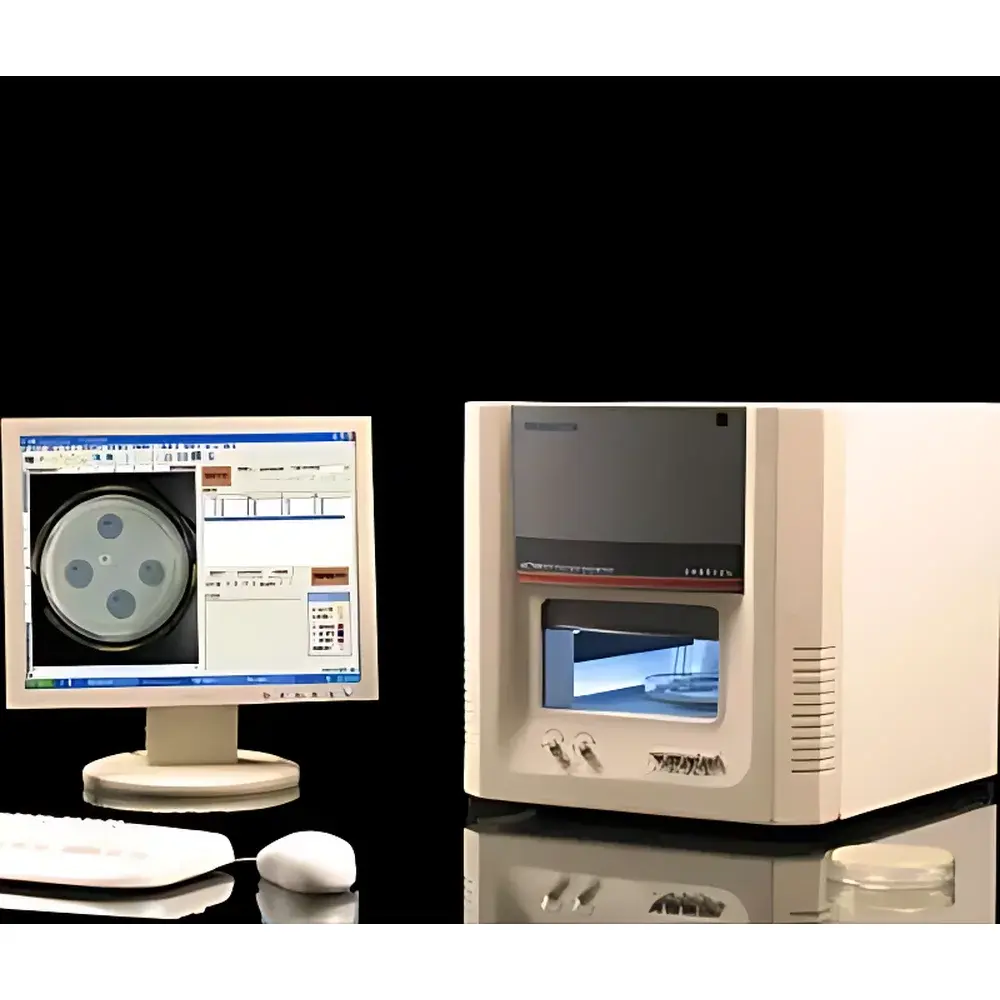
The Xunshu Z8 Zone of Inhibition (Antibiotic Potency) Analyzer is a dedicated digital imaging system engineered for quantitative microbiological assay compliance in pharmaceutical quality control and antibiotic potency testing. It operates on the principle of high-resolution digital image acquisition followed by algorithmic segmentation and geometric measurement of inhibition zones formed around antibiotic-impregnated discs or wells on agar-based culture plates. The instrument implements standardized bioassay methodologies defined in major pharmacopoeias—including the United States Pharmacopeia (USP) and the Chinese Pharmacopoeia (ChP) 2010 edition—to derive accurate, traceable, and statistically valid potency estimates. Its core architecture integrates optical, mechanical, and computational subsystems calibrated to meet the reproducibility and linearity requirements of regulatory-grade antimicrobial susceptibility testing under Good Laboratory Practice (GLP) and current Good Manufacturing Practice (cGMP) environments.
Key Features
- 10-megapixel true-color CMOS sensor with 8 mm F/1.4 lens ensures sub-pixel spatial resolution and minimal optical distortion (<1%), critical for accurate zone diameter quantification across standard 90–100 mm Petri dishes.
- Patented suspended dark-field illumination system utilizes tri-LED mixed soft light to generate high-contrast differentiation between translucent inhibition zones and opaque microbial lawns—eliminating reliance on fluorescent lamps, reducing energy consumption by 80%, and removing mercury content and electromagnetic interference.
- Three-tiered measurement logic accommodates real-world assay variability: automatic edge detection for crisp circular zones; iterative circular approximation for irregular or fragmented zones; and manual three-point circle definition for low-contrast or diffused boundaries.
- Multi-method potency calculation engine supports USP single-dose assays (Types I and II), ChP 2010 two-dose and three-dose parallel-line assays, and combined statistical validation per pharmacopoeial guidelines.
- Comprehensive image preprocessing toolkit includes adaptive contrast enhancement, background flattening, Sobel/Laplacian edge operators, morphological filtering (erosion/dilation), and spectral-domain noise suppression—enabling robust segmentation even under suboptimal plating conditions.
Sample Compatibility & Compliance
The Z8 analyzer is validated for use with standard Mueller-Hinton, nutrient, and other ISO 20776-1–compliant agar media. It accepts all commercially available antibiotic discs (6 mm and 8 mm diameters) and custom-prepared wells. Instrument performance meets the precision criteria outlined in USP Antimicrobial Effectiveness Testing and ChP Volume IV Section 9201 Microbiological Assay of Antibiotics. All measurements are traceable to NIST-traceable calibrators via user-adjustable geometric scaling. The system supports audit-ready documentation workflows compliant with FDA 21 CFR Part 11 requirements through dual-role password protection, immutable data logging, and timestamped export records.
Software & Data Management
The embedded analysis software provides a secure, role-based interface for assay execution, result review, and report generation. Data—including raw images, annotated zone maps, calibration logs, and potency outputs—is stored in an indexed relational database searchable by date, sample ID, operator name, or assay type. Results are exportable to Excel-compatible files with full metadata (dilution series, standard curve parameters, confidence intervals, and residual error metrics). All software operations maintain an electronic audit trail recording user actions, parameter changes, and data modifications—facilitating GLP/GMP inspections and internal quality audits.
Applications
- Routine QC release testing of bulk antibiotics and finished dosage forms (e.g., injectables, ointments, tablets).
- Stability-indicating potency monitoring during accelerated and long-term storage studies.
- Comparative bioequivalence assessment of generic antibiotic formulations against reference standards.
- Method validation and transfer activities supporting regulatory submissions (e.g., ANDA, NDA, MAA).
- Academic and contract research laboratory support for antimicrobial resistance profiling and novel compound screening.
FAQ
Does the Z8 support FDA 21 CFR Part 11 compliance?
Yes—the software enforces electronic signature controls, audit-trail logging, and role-based access restrictions aligned with Part 11 technical and procedural requirements.
Can the system be calibrated for non-standard agar depths or dish sizes?
Yes—users may perform custom geometric calibration using provided reference targets to account for variations in agar thickness (2–5 mm) and dish diameter (85–105 mm).
Is raw image data preserved alongside processed results?
Yes—every assay session saves the original TIFF/JPEG image, annotated overlay, and intermediate processing layers in the database for full traceability and reanalysis.
What statistical outputs does the potency module generate?
The software computes slope, intercept, correlation coefficient (r), standard error of estimate, confidence intervals for potency ratios, and validity checks per USP/ChP linearity and parallelism criteria.
How is inter-instrument consistency verified?
Inter-unit variation is maintained at ≤0.2% via factory-aligned optical calibration, standardized LED intensity profiles, and firmware-controlled exposure timing—validated during ISO 17025-accredited installation qualification (IQ).