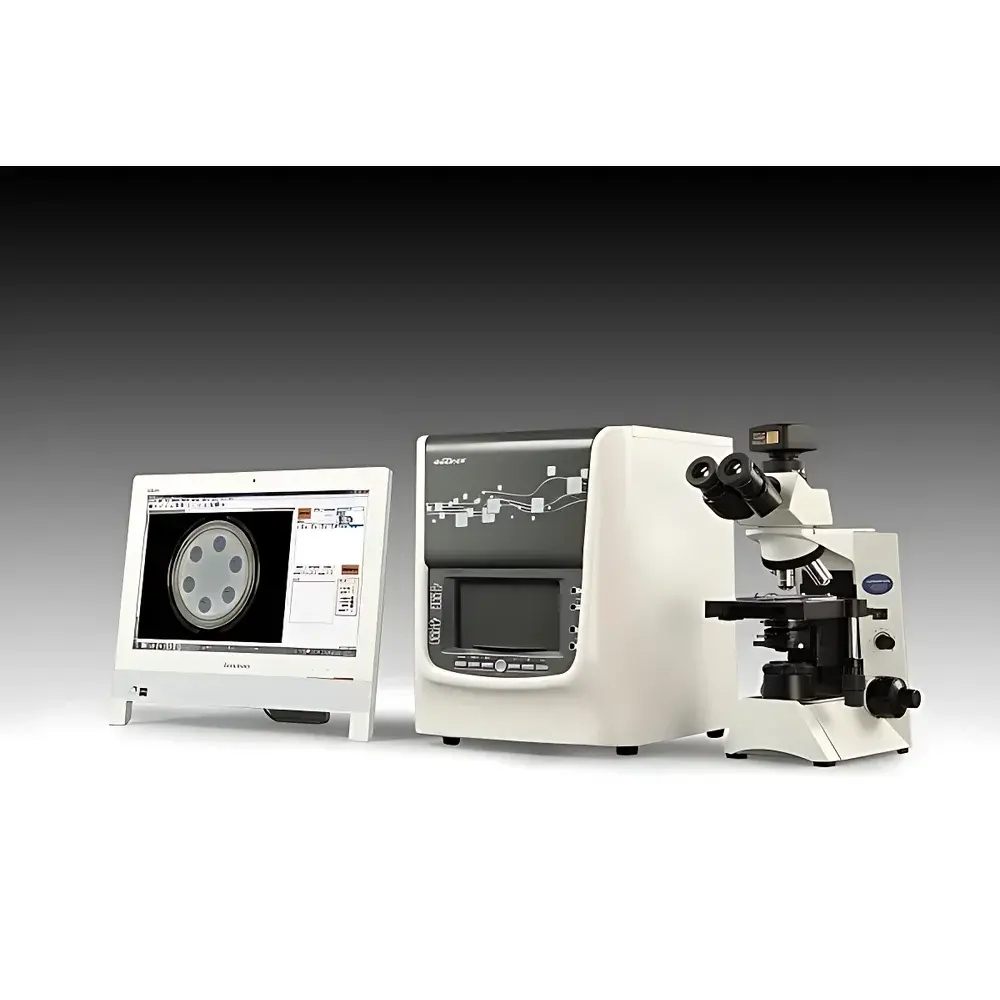
Xunso New MF3 Multifunctional Microbial Analysis System: Colony Counter, Antibiotic Zone-of-Inhibition Analyzer & Microscopic Imaging Workstation
| Brand | Xunso |
|---|---|
| Origin | Zhejiang, China |
| Manufacturer Type | OEM Manufacturer |
| Product Origin | Domestic (China) |
| Model | New MF3 |
| Price Range | USD 14,000 – 28,000 |
| Instrument Type | Fully Automated Colony Counter & Integrated Microbial Imaging Platform |
| Counting Speed | <1 second for up to 500 colonies |
Overview
The Xunso New MF3 Multifunctional Microbial Analysis System is an integrated, laboratory-grade imaging and analysis platform engineered for precision microbiology workflows. It combines three core modalities—digital colony enumeration, zone-of-inhibition (ZOI) measurement for antimicrobial susceptibility and potency assessment, and high-fidelity optical microscopy—within a single, unified hardware architecture. The system operates on dual-path digital imaging: a top-down macro-scale imaging module optimized for Petri dish and membrane filter analysis, and a side-coupled Olympus CX31 upright microscope with 5 MP CMOS sensor for cellular-level observation. Measurement principles include pixel-based morphometric segmentation (for colony/zone boundary detection), calibrated geometric modeling (for diameter, area, and ratio calculations), and spectral-aware RGB-constrained active contour algorithms (for chromogenic medium analysis). Designed for GLP-compliant environments, the MF3 supports audit-trail-enabled operation, user-access control, and data integrity features aligned with FDA 21 CFR Part 11 readiness requirements.
Key Features
- Fully enclosed dark-box imaging chamber with dual-axis illumination: top-mounted 360° flexible diffuse white light (3500–8500 K adjustable color temperature) and bottom-mounted crystal-sharp dark-field suspension lighting for optimal contrast in both opaque and translucent colonies.
- Integrated dual-wavelength UV illumination: 254 nm for sterilization and UV mutagenesis; dual-side 366 nm for fluorescence excitation of E. coli, GFP-expressing strains, and coliform-specific chromogenic substrates.
- Olympus CX31 trinocular microscope with motorized focus coupling, enabling synchronized image capture and real-time dynamic cell observation via parallel static/dynamic dual-channel acquisition.
- Advanced image processing suite with 27 built-in algorithms—including adaptive enhancement, morphological operations (erosion/dilation), multi-scale edge detection (Sobel, Canny), Gaussian/median filtering, and background flattening—optimized for low-contrast or heterogeneous microbial samples.
- Multi-model segmentation engine supporting “inverse statistics” for mixed-culture plates (e.g., bacteria + yeast + mold), RGB-constrained level-set modeling for chromogenic media, and multi-phase active contours for halo-affected colonies (e.g., hemolysis zones, pigment diffusion).
- Automated impurity rejection using morphology-based filters (size, circularity, intensity gradient), exposure-controlled suppression of fine debris, and background-switching logic for challenging matrices (e.g., herbal powder suspensions, turbid agar).
Sample Compatibility & Compliance
The MF3 accommodates standard and non-standard microbiological sample formats including pour plates, spread plates, membrane filters (black-grid and plain), 3M™ Petrifilm™ sheets (Total Aerobic Count, S. aureus, Coliform/E. coli), spiral plates, and multi-well microtiter plates. It complies with pharmacopoeial standards for quantitative microbiological testing: Chinese Pharmacopoeia (ChP) 2010 Edition for antibiotic potency assays (two-dose and three-dose methods), USP / for microbial limits testing, and ISO 4833-1:2013 for colony enumeration. All software modules—including SZone ZOI measurement, β-lactamase screening (using sulbactam-sensitive assay logic), and mold growth quantification—generate traceable, timestamped reports with operator ID, instrument calibration logs, and raw image archives suitable for regulatory review.
Software & Data Management
The MF3 runs on a dedicated Windows-based workstation preloaded with five validated application modules: Colony Analysis Suite, SZone Zone-of-Inhibition Analyzer, Antibiotic Potency Calculator (ChP/USP compliant), Sulbactam-Sensitive β-Lactamase Detection Module, and Microscopic Image Analysis Workbench. Each module enforces role-based access control, electronic signatures, and immutable audit trails for all parameter changes, measurements, and manual corrections. Raw images are stored in lossless TIFF format with embedded EXIF metadata (exposure time, gain, lens focal length, calibration stamp). Statistical outputs export directly to Excel (.xlsx) with formula-locked cells; database queries support Boolean logic, date-range filtering, and batch ID cross-referencing. Software validation documentation (IQ/OQ/PQ templates) and 21 CFR Part 11 configuration guides are provided with installation.
Applications
The MF3 serves as a central analytical node across quality control, R&D, and clinical microbiology laboratories. Key use cases include: rapid enumeration of total viable counts in food and beverage safety testing; quantitative assessment of antibiotic efficacy and resistance profiling via disk-diffusion assays; high-throughput screening of enzyme-producing or organic acid-secreting strains using transparent/colored halo analysis; morphological phenotyping of mutant isolates (e.g., filamentous fungi, actinomycetes); fluorescence-based detection of genetically modified organisms (GMOs) expressing GFP or other reporter proteins; and standardized β-lactamase screening in dairy product surveillance programs. Its modular design allows sequential or concurrent execution of colony counting, ZOI measurement, and microscopic verification—eliminating inter-instrument transfer errors and reducing turnaround time by >60% compared to standalone systems.
FAQ
Does the MF3 support regulatory submissions under FDA or EMA guidelines?
Yes—the system’s software architecture, audit trail implementation, and electronic signature functionality meet baseline requirements for FDA 21 CFR Part 11 and EU Annex 11 compliance. Full validation support packages are available upon request.
Can the MF3 distinguish between colonies of similar color but different morphology (e.g., Candida albicans vs. Aspergillus niger)?
Yes—via combined RGB-constrained level-set segmentation and multi-parameter morphometric classification (circularity, convexity, texture entropy, edge sharpness), enabling species-level discrimination on chromogenic or non-selective media.
Is external calibration required before each session?
No—the system includes onboard reference calibration targets and supports one-click auto-calibration using pre-defined petri dish or stage micrometer standards. Manual correction is optional and logged.
What microscope objectives are compatible with the CX31 integration?
All standard Olympus UIS2 objectives (4×, 10×, 40×, 100× oil) are supported; the system includes automated magnification scaling and pixel-size mapping for accurate µm-level measurement across objectives.
How does the MF3 handle overlapping colonies in high-density plates?
It applies adaptive watershed segmentation enhanced by user-definable split thresholds, chain-length constraints, and optional manual intervention points—validated for >95% accuracy at densities up to 1,200 CFU per 90 mm plate.