
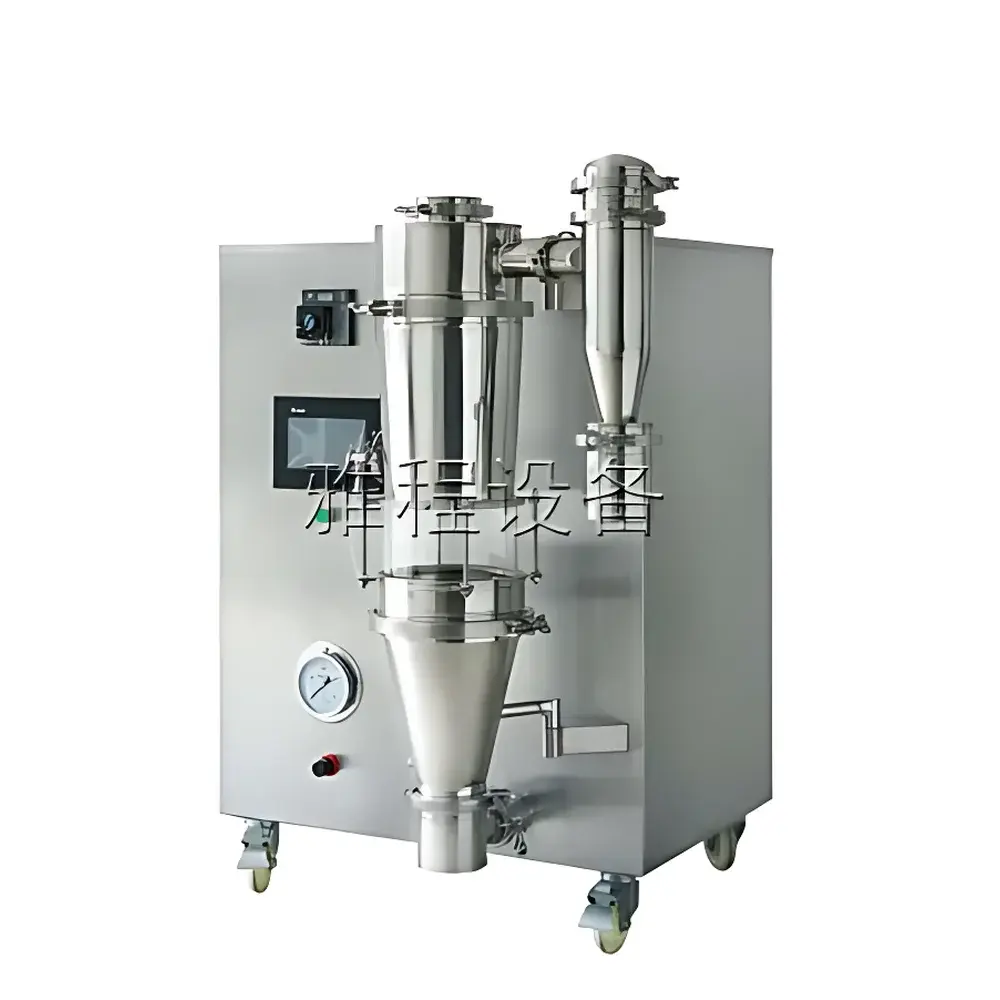
Yacheng / PILOTECH YC-1800 Low-Temperature Laboratory Spray Dryer for Juice and Thermosensitive Extracts
| Brand | Yacheng / PILOTECH |
|---|---|
| Origin | Shanghai, China |
| Manufacturer Type | Direct Manufacturer |
| Model | YC-1800 |
| Heating Temperature Range | 110–150 °C |
| Max. Feed Rate | 1500 mL/h |
| Minimum Sample Volume | 50 mL (varies with solids content) |
| Nozzle Orifice Options | 0.5, 0.7, 1.0, 1.5, 2.0 mm |
| Temperature Control Accuracy | ±1 °C (PID-regulated) |
| Power Supply | 4 kW / 380 V |
| Construction | Full Stainless Steel (AISI 304) |
| Atomization | Two-Fluid Pneumatic Nozzle System |
| Integrated Cleaning Function | Automatic Needle Cleaner (Adjustable Frequency) |
Overview
The Yacheng / PILOTECH YC-1800 Low-Temperature Laboratory Spray Dryer is an engineered solution for the gentle, reproducible conversion of heat-labile liquid feeds—including fruit juices, herbal extracts, natural product concentrates, and biopolymer solutions—into free-flowing, amorphous powders. Unlike conventional lab-scale spray dryers operating at inlet temperatures ≥160 °C, the YC-1800 achieves complete drying at a controlled inlet temperature as low as 110 °C. This capability is critical for preserving thermolabile compounds (e.g., anthocyanins, flavonoids, enzymes, volatile aromatics, and labile glycosides) that degrade rapidly above 120 °C. The system employs two-fluid pneumatic atomization, where compressed air shears the feed stream into fine droplets (typically 10–50 µm Sauter mean diameter), enabling rapid solvent evaporation within milliseconds inside the stainless-steel drying chamber. Its compact, self-contained architecture eliminates dependency on external chillers, vacuum pumps, or compressed air dryers—making it suitable for standard laboratory environments with standard 380 V three-phase power.
Key Features
- Low-temperature operation (110–150 °C inlet air) optimized for oxidation- and thermal-degradation-sensitive materials
- Full-color LCD touchscreen interface with intuitive Chinese/English bilingual navigation and real-time parameter visualization
- PID-controlled heating system ensuring ±1 °C temperature stability across the full operating range
- Adjustable peristaltic feed pump (0–1500 mL/h) with calibrated flow display and programmable ramp profiles
- Interchangeable stainless-steel two-fluid nozzles (0.5–2.0 mm orifice) to match viscosity, solids content, and target particle size distribution
- Automated needle cleaner (‘通针’) with user-adjustable activation frequency to prevent nozzle clogging during high-sugar or high-viscosity runs
- Stainless-steel construction (AISI 304) compliant with ISO 8573-1 Class 4 compressed air requirements and compatible with GMP-aligned cleaning protocols
- Acoustically damped enclosure meeting ISO 7779 noise emission standards (<65 dB(A) at 1 m)
Sample Compatibility & Compliance
The YC-1800 is validated for aqueous and ethanol-based solutions containing up to 65% total solids (w/w), including citrus juice concentrates, berry purees, green tea polyphenol extracts, polysaccharide gels, and protein hydrolysates. Its low-thermal-load process minimizes Maillard reactions and caramelization in sucrose-, fructose-, or maltodextrin-rich feeds—enabling production of non-hygroscopic, spherical, and highly dispersible powders without mandatory bulking agents. From a regulatory standpoint, the instrument supports GLP and GMP workflows: audit trails are recordable via optional USB data export; temperature and feed rate logs comply with FDA 21 CFR Part 11 metadata requirements when paired with validated third-party software; and surface finish (Ra ≤ 0.8 µm) meets ASME BPE-2022 hygienic design criteria for pharmaceutical pilot studies.
Software & Data Management
The embedded control firmware provides real-time monitoring of inlet/outlet temperature, feed rate, chamber pressure differential, and nozzle air pressure. All parameters are timestamped and exportable as CSV files via USB port. Optional Ethernet connectivity enables integration with LIMS or ELN platforms using Modbus TCP protocol. For advanced process analytics, the system supports external data acquisition via analog 4–20 mA outputs (temperature, feed rate) and digital I/O triggers (start/stop, alarm). Firmware updates are delivered via secure HTTPS portal, with version history and change logs traceable per ICH Q9 guidelines.
Applications
- Rapid formulation screening of functional food powders (e.g., probiotic-encapsulated juices, vitamin-fortified smoothie bases)
- Preparative-scale drying of botanical actives for pharmacokinetic and stability testing (ASTM D7483, USP <1151>)
- Production of inhalable dry powder aerosols from plant-derived terpenes and essential oil emulsions
- Stabilization of lactic acid bacteria cultures in fruit matrix carriers for shelf-life validation studies
- Development of cold-dried reference standards for HPLC and LC-MS quantification of labile phytochemicals
FAQ
What is the minimum sample volume required for a valid run?
A minimum of 50 mL is recommended; however, achievable yield and powder morphology depend on dissolved solids concentration (typically 10–40% w/w for optimal atomization and drying kinetics).
Can the YC-1800 handle feeds with >50% sugar content?
Yes—its 110 °C inlet temperature significantly reduces surface tackiness during droplet flight, while the adjustable nozzle orifice and optimized air-to-liquid ratio mitigate wall deposition common in high-Brix systems.
Is the system compliant with ISO 22000 or FDA food-grade requirements?
The unit’s AISI 304 wetted parts, smooth internal welds, and absence of crevices meet prerequisite program criteria for food-grade equipment validation; final compliance depends on site-specific sanitation SOPs and third-party verification.
Does the instrument support remote monitoring or automation integration?
Standard USB data logging is included; optional Ethernet + Modbus TCP enables PLC-level integration and SCADA compatibility for automated batch reporting.
What maintenance intervals are recommended for long-term reliability?
Daily nozzle inspection and cleaning; quarterly calibration of temperature sensors per ISO/IEC 17025; annual verification of peristaltic pump accuracy against gravimetric standards.



