
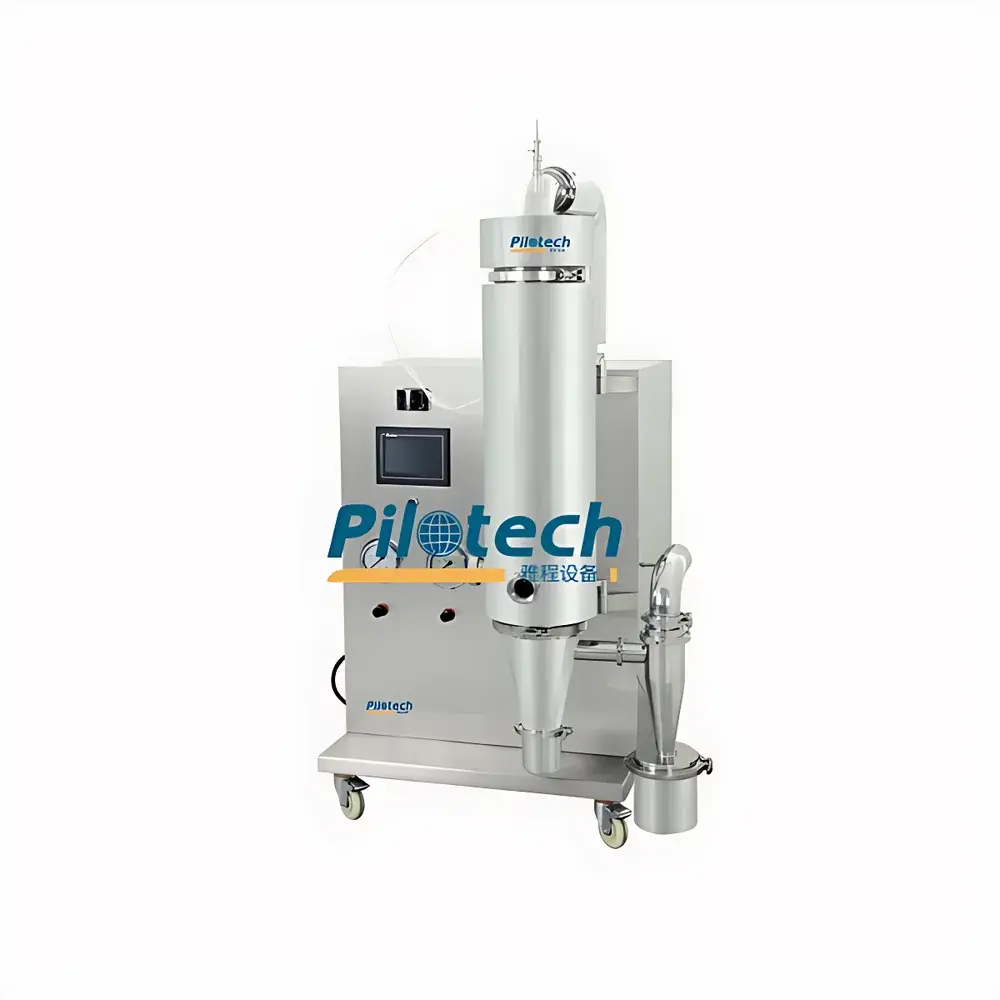
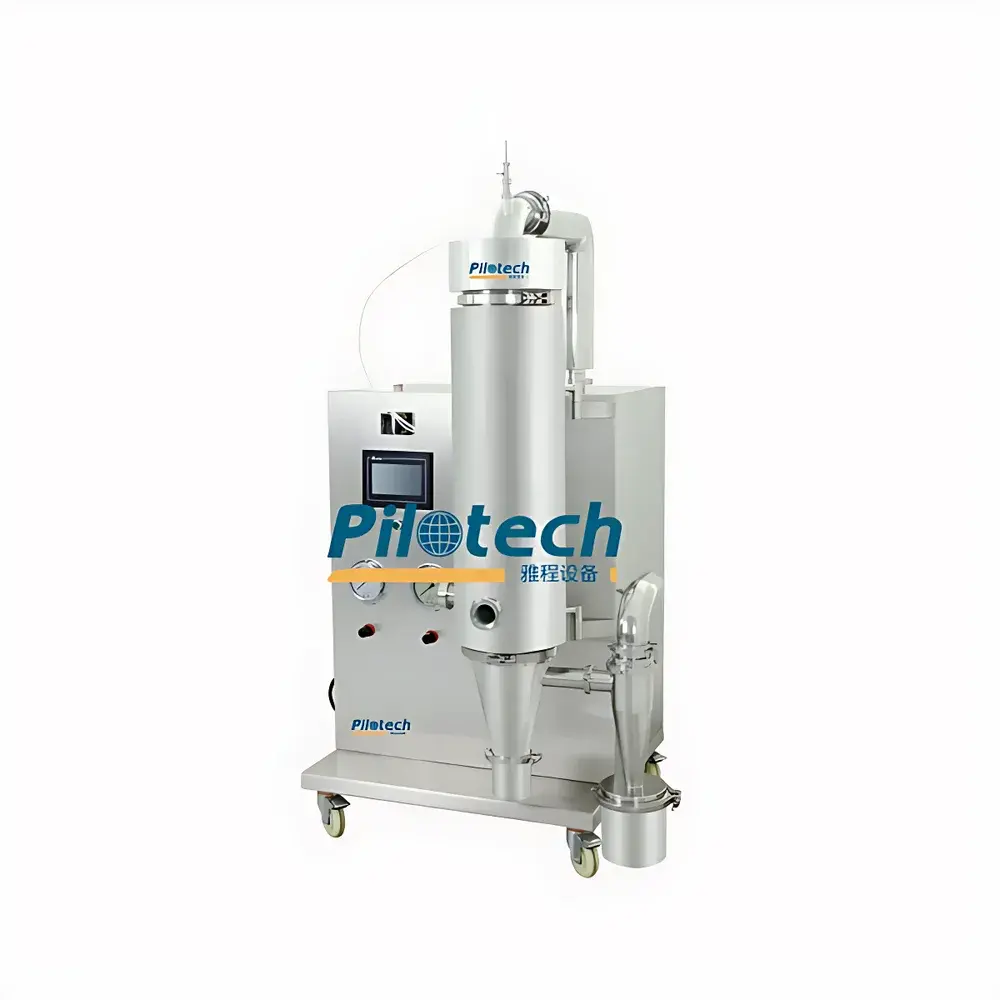
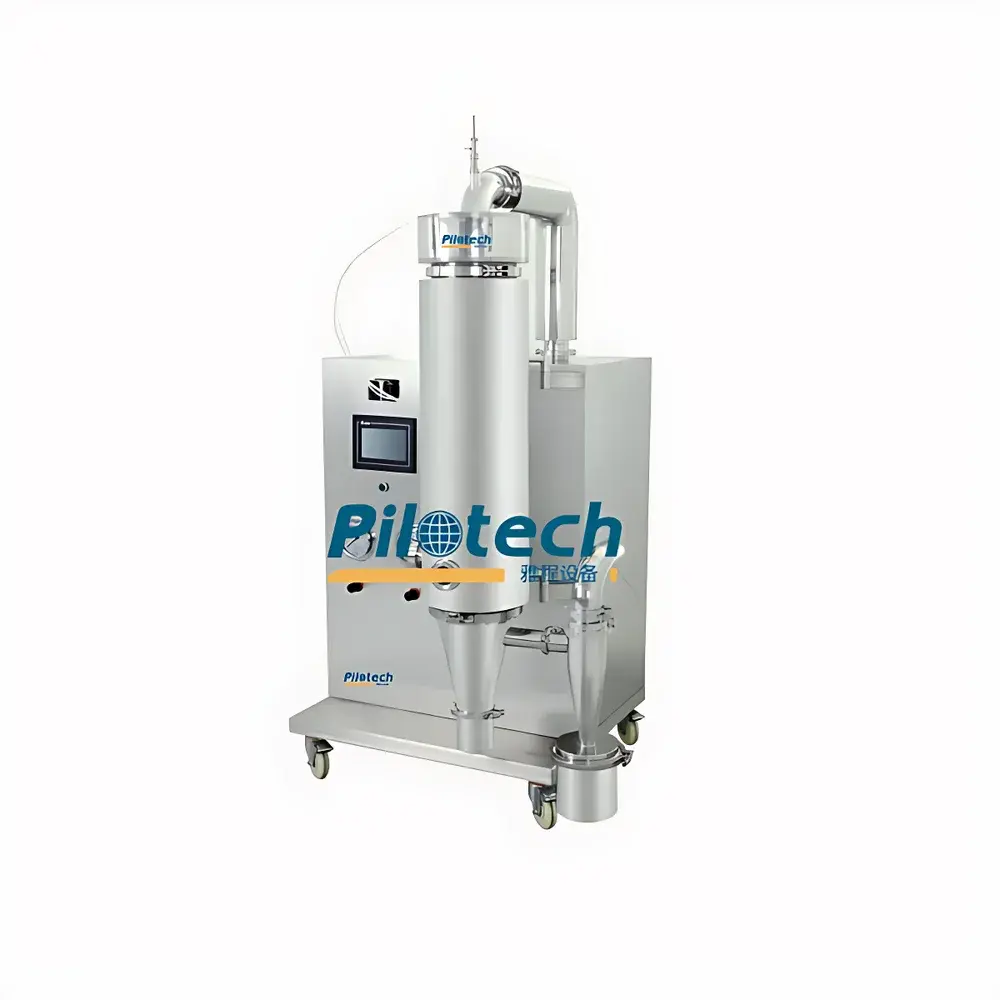
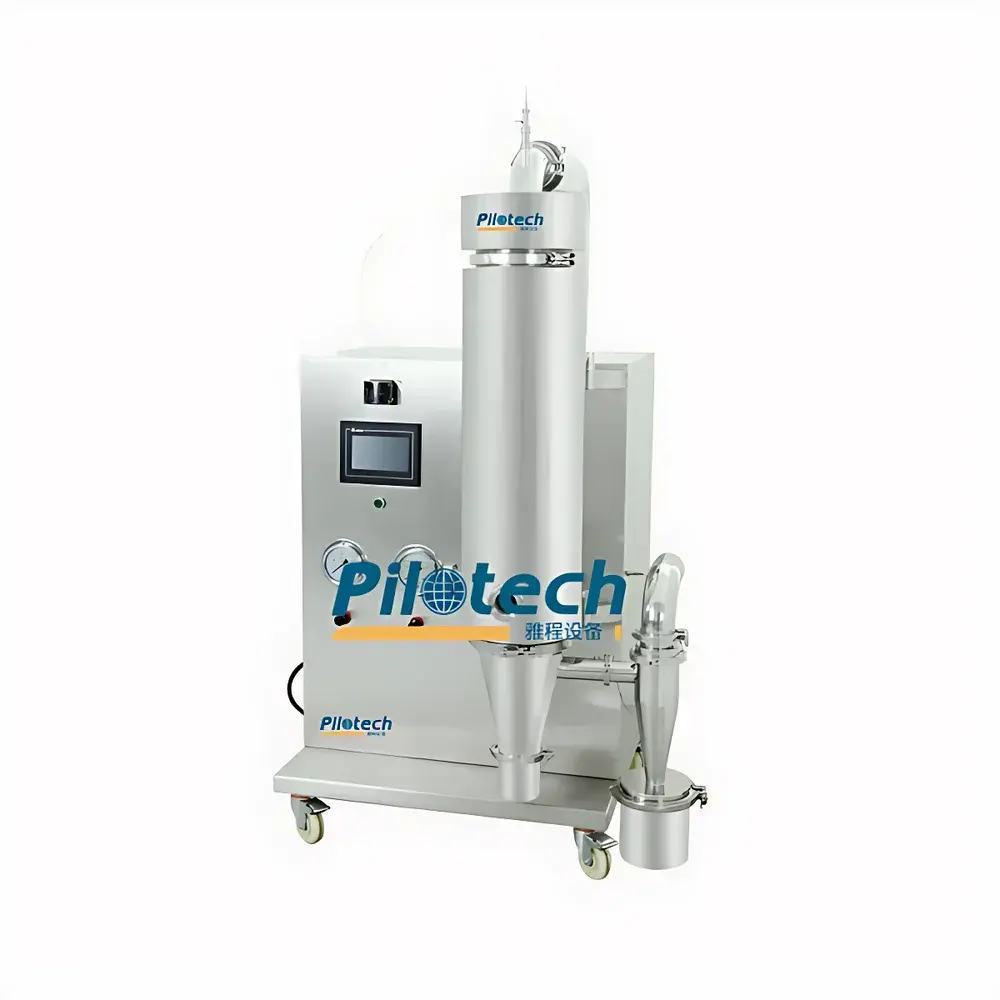
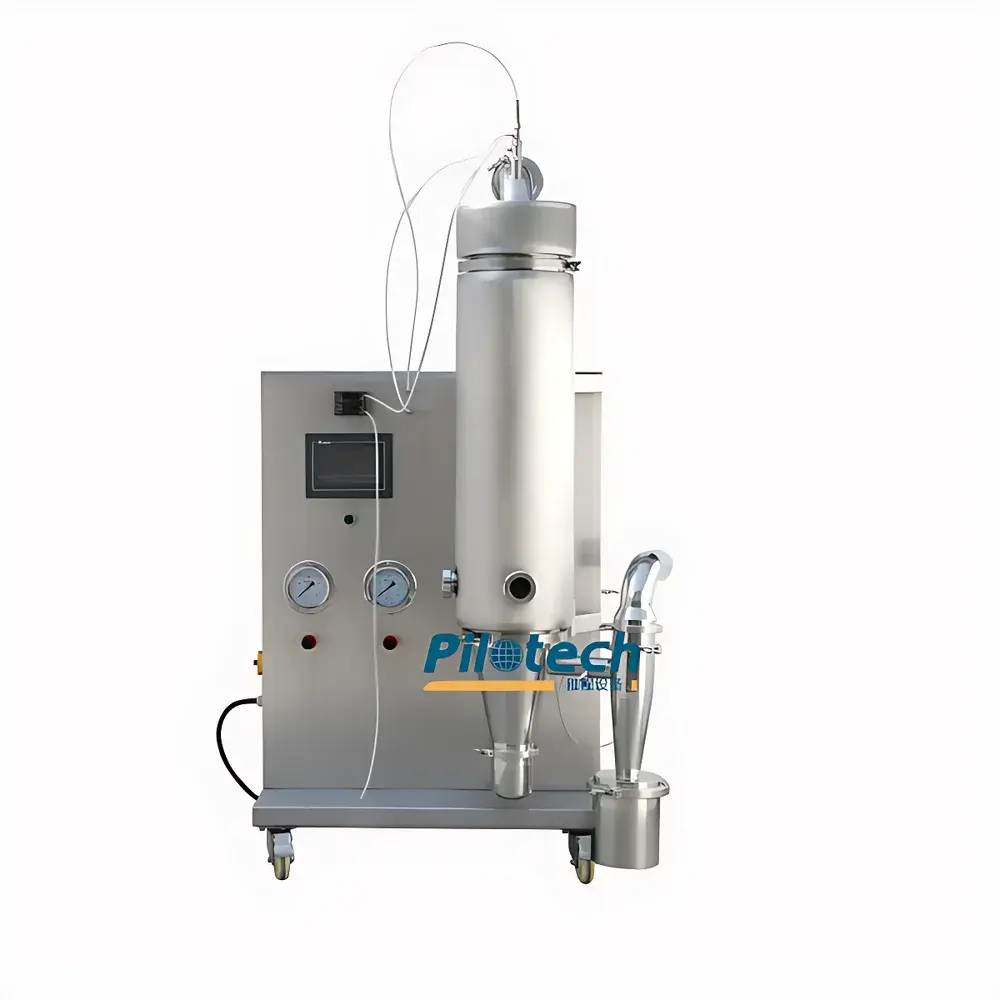
Yacheng YC-018 Pilot-Scale Spray Dryer
| Brand | Yacheng / PILOTECH |
|---|---|
| Origin | Shanghai, China |
| Manufacturer Type | Direct Manufacturer |
| Country of Origin | China |
| Model | YC-018 |
| Sample Type Compatibility | Aqueous solutions only |
| Maximum Feed Rate | 3000 mL/h |
| Inlet Air Temperature Range | 105–280 °C |
| Outlet Air Temperature Range | 30–140 °C |
| Particle Size Range | 1–80 µm |
| Drying Residence Time | 1.0–1.5 s |
| Heating Control Accuracy | ±1 °C (PID) |
| Nozzle Orifice | Standard 1.5 mm (optional: 0.5 / 0.8 / 1.0 / 2.0 mm) |
| Collection Efficiency | Up to 92% |
| Construction Material | 304 Stainless Steel (drying chamber, cyclone, collection vessel, tubing) |
| Air Supply | Oil-free compressed air system |
Overview
The Yacheng YC-018 Pilot-Scale Spray Dryer is an engineered solution for laboratory-scale process development and transitional scale-up from benchtop formulation to pilot production. It operates on the principle of single-stage, concurrent-flow spray drying—atomizing liquid feed into fine droplets within a heated air stream, enabling rapid solvent evaporation and solid particle formation in 1.0–1.5 seconds. Designed specifically for aqueous-based formulations—including natural extracts, biopolymer suspensions, pharmaceutical emulsions, and catalyst precursors—the system delivers precise thermal control across a wide inlet temperature range (105–280 °C), supporting both thermolabile compound preservation and high-temperature ceramic precursor drying. Its compact footprint (<1 m² floor space) and integrated oil-free air compression system meet ISO 8573-1 Class 0 air purity requirements while complying with ambient noise limits per ISO 7779 and ANSI S12.55 for academic and regulated laboratory environments.
Key Features
- Dual-mode operation: Fully automated touchscreen control with real-time dynamic process animation, plus manual override for method optimization and troubleshooting.
- High-fidelity thermal management: PID-controlled inlet air heating with ±1 °C stability; independent outlet temperature monitoring ensures consistent product moisture content and morphology.
- Adaptive atomization system: Interchangeable stainless-steel nozzles (standard 1.5 mm; optional 0.5–2.0 mm) paired with programmable needle-cleaning (‘needle purge’) frequency to prevent nozzle clogging during viscous or particulate-laden feed processing.
- Enhanced particle recovery architecture: Redesigned cyclonic separation geometry combined with optimized airflow dynamics achieves up to 92% collection efficiency—significantly exceeding industry-standard single-cyclone systems—reducing material loss and improving batch-to-batch reproducibility.
- Scalable feed handling: Programmable peristaltic pump supports continuous feeding from 100 mL (low-volume screening) to 3000 mL/h (pilot-representative throughput), accommodating both early-stage formulation trials and process validation runs.
- Thermal safety protocol: Intelligent shutdown sequence halts heating elements and atomization immediately upon stop command, maintaining fan operation for safe cooldown—preventing thermal damage due to abrupt power interruption.
Sample Compatibility & Compliance
The YC-018 is validated for use with aqueous solutions, colloidal suspensions, and low-viscosity emulsions containing solids concentrations typical of herbal extracts, enzyme solutions, protein hydrolysates, metal salt precursors, and polymer dispersions. It is not designed for organic solvents or high-solids (>35% w/w) feeds requiring inert atmosphere operation. All wetted parts are fabricated from electropolished 304 stainless steel, compliant with FDA 21 CFR Part 117 (for food-grade applications) and USP material compatibility guidelines. The system supports GLP-compliant documentation via timestamped parameter logging (inlet/outlet temperature, pump speed, fan frequency, needle purge interval) and meets audit readiness requirements for ISO/IEC 17025-accredited laboratories.
Software & Data Management
A 7-inch color LCD touchscreen interface provides intuitive access to all operational parameters—including real-time trend graphs for inlet/outlet temperature, pump RPM, and cyclone pressure drop. System firmware stores up to 100 user-defined drying protocols with version-stamped metadata (date, operator ID, batch ID). Data export is supported via USB 2.0 to CSV format for integration with LIMS or statistical process control platforms. Optional Ethernet connectivity enables remote monitoring and centralized fleet management in multi-instrument lab environments. Audit trails record all parameter modifications, user logins, and system events—fully aligned with FDA 21 CFR Part 11 electronic record requirements when paired with institutional identity management infrastructure.
Applications
- Pharmaceutical R&D: Production of inhalable dry powders, excipient-coated APIs, and sustained-release microparticles (1–80 µm) under controlled thermal history.
- Natural product stabilization: Low-temperature drying (105–130 °C) of polysaccharide-rich botanical extracts, preserving glycosidic bond integrity and antioxidant activity.
- Catalyst synthesis: High-temperature (220–280 °C) conversion of metal nitrate solutions into spherical, flowable catalyst precursors with narrow PSD (D90 ≤ 80 µm).
- Food ingredient engineering: Encapsulation of probiotics, vitamins, or flavor oils using maltodextrin or gum arabic matrices without Maillard browning artifacts.
- Materials science: Preparation of ceramic nanoparticle agglomerates (e.g., TiO₂, SiO₂, ZnO) with defined crystallinity and surface area for battery or photocatalytic studies.
FAQ
What sample types are compatible with the YC-018?
Aqueous solutions, aqueous suspensions, and low-viscosity emulsions only. Organic solvents, flammable liquids, or high-solids slurries (>35% w/w) are not supported.
Can the YC-018 be used for GMP-compliant process development?
Yes—when operated with documented SOPs, calibrated sensors, and enabled audit-trail functionality, it meets foundational requirements for Stage 1–2 process development under ICH Q5C and Q8(R2) frameworks.
How is particle size distribution controlled?
Primary control variables include nozzle orifice diameter, feed concentration, inlet temperature, and atomization air pressure. Narrower nozzles (0.5–0.8 mm) and lower solids content favor sub-10 µm particles; wider nozzles (1.5–2.0 mm) and higher feed rates promote 40–80 µm output.
Is third-party calibration support available?
Yes—Yacheng provides NIST-traceable calibration certificates for temperature sensors and flow meters; field service engineers can perform on-site verification per ASTM E2251-22 and ISO 17025 standards.
What maintenance intervals are recommended?
Daily: Visual inspection of nozzle, cyclone seal, and collection vessel gaskets. Quarterly: Full calibration of PID loops and verification of peristaltic pump accuracy per ISO 80000-5. Annual: Bearing inspection of fan motor and replacement of desiccant in air dryer unit.



