
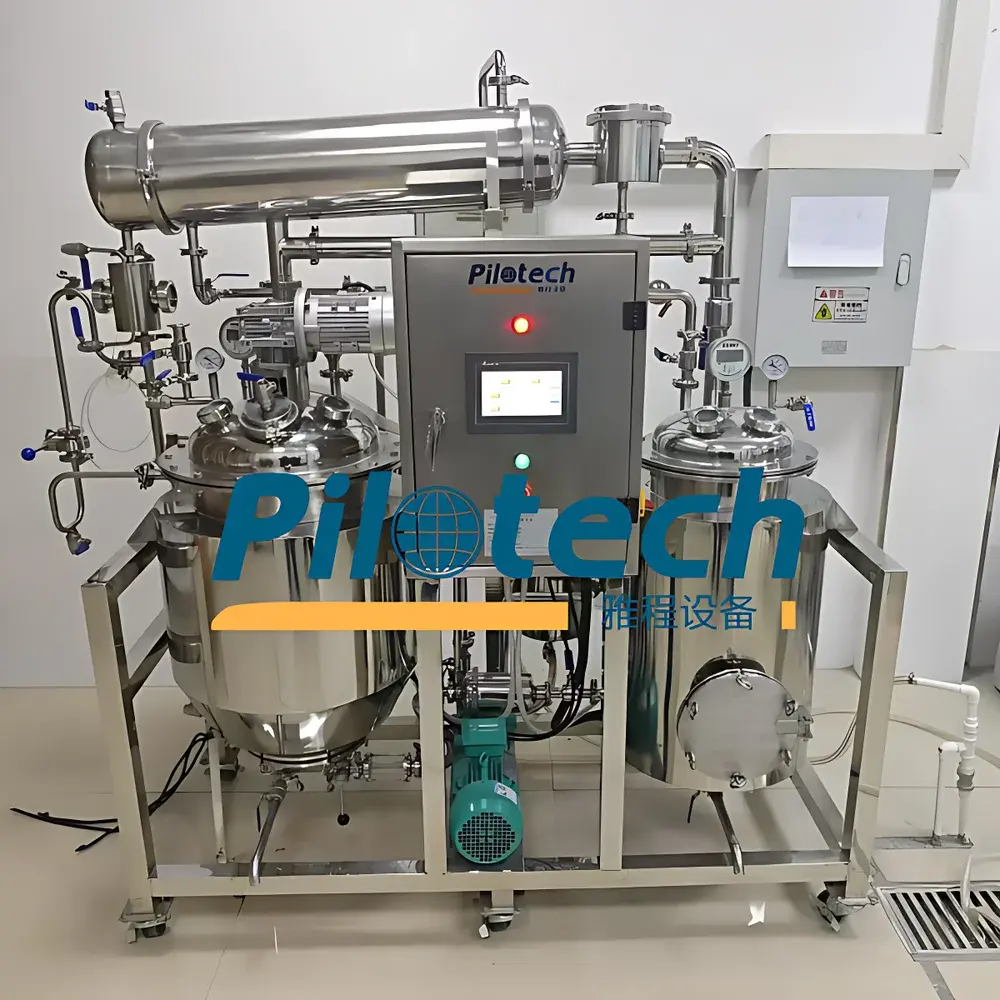
Yacheng YC-050 Multifunctional Extraction and Concentration System
| Brand | Yacheng / PILOTECH |
|---|---|
| Origin | Shanghai, China |
| Manufacturer Type | OEM Manufacturer |
| Model | YC-050 |
| Extraction Vessel Capacity | 50 L |
| Batch Feed Range | 0.3–10 kg |
| Heating Method | Jacketed Thermal Oil Circulation (Pressure-Free) |
| Condenser Area | 2 m² |
| Vacuum Range | 0 to −0.08 MPa |
| Temperature Control Accuracy | ±2 °C |
| Heating Power | 18 kW (380 V) |
| Cooling Water Consumption | 2 t/h at <0.3 MPa |
| Material of Construction | SUS304 Stainless Steel (Contact Parts) |
| Concentration Density Range | 1.10–1.38 (w/w, herbal extract) |
| Optional Ultrasound Module | 15–60 kHz, focused transducer configuration |
Overview
The Yacheng YC-050 Multifunctional Extraction and Concentration System is an integrated pilot-scale unit engineered for laboratory and small-batch production environments requiring precise, repeatable, and GMP-aligned processing of botanical matrices. It operates on the principle of simultaneous solvent-based extraction and vacuum-assisted thin-film evaporation under controlled thermal conditions. The system combines jacketed thermal oil heating—eliminating pressure hazards in the heating zone—with dynamic reflux circulation, fractional condensation, and phase separation to enable water, ethanol, or other GRAS organic solvents (e.g., ethyl acetate, isopropanol) to be recovered and reused. Designed for closed-loop operation, it maintains full containment across all process stages: solid loading, percolation/extraction, vapor condensation, oil–water phase separation, and final concentrate thickening. This architecture ensures compliance with occupational safety standards (OSHA Process Safety Management), minimizes volatile organic compound (VOC) emissions, and supports adherence to ISO 22000 (food), ICH Q5C (biopharmaceutical excipients), and Chinese Pharmacopoeia (ChP) Chapter 2201 for herbal preparation validation.
Key Features
- Compact footprint (2–3 m²) with plug-and-play utility interface—only requires 380 V AC power and cooling water supply.
- Triple-layer stainless steel extraction vessel (SUS304): inner polished surface (Ra ≤ 0.4 µm), middle thermal oil jacket (pressure-free design), outer polyurethane insulation (50 mm thickness).
- Integrated tubular condenser (2 m² heat transfer area) and stainless steel oil–water separator for selective recovery of volatile aromatic oils (e.g., limonene, eucalyptol, linalool) from hydrodistillation or steam-assisted extraction streams.
- Dynamic circulation evaporator with forced convection flow path—maintains high heat transfer coefficients even at elevated viscosities (>200 cP), mitigating fouling and thermal degradation during final concentration.
- Full-process vacuum capability (0 to −0.08 MPa) enables low-temperature concentration (≤65 °C), preserving thermolabile compounds such as flavonoids, iridoids, and labile terpenes.
- Lift-type herb basket mechanism allows clean, residue-free discharge of spent biomass without manual vessel entry—reducing operator exposure and meeting ALARA principles.
- Optional focused ultrasonic module (15–60 kHz) with adjustable frequency and amplitude; utilizes cavitation-induced cell wall disruption to enhance mass transfer kinetics without thermal stress—validated for >25% yield increase in polyphenol and alkaloid extraction vs. conventional maceration.
Sample Compatibility & Compliance
The YC-050 accommodates dried or fresh plant materials—including roots, leaves, flowers, seeds, and fruit peels—with particle size ranges from coarse cut (5–10 mm) to granulated (0.5–2 mm). It supports aqueous, hydroalcoholic (10–95% v/v ethanol), and non-aqueous extractions (acetone, dichloromethane, hexane) when configured with compatible gasketing and solvent-rated instrumentation. All wetted surfaces meet ASME BPE-2022 surface finish requirements and are electropolished to ≤0.4 µm Ra. The system complies with PED 2014/68/EU for pressure equipment (non-pressurized jacket), CE machinery directive 2006/42/EC, and FDA 21 CFR Part 11 readiness via optional audit-trail-enabled control software. It has been deployed in GLP-compliant phytochemical screening labs and conforms to USP on process validation for herbal extracts.
Software & Data Management
Standard configuration includes Omron E5CC temperature controller with 0.1 °C resolution, analog vacuum gauge (−0.1 to 0 MPa), and PLC-based HMI panel supporting recipe storage (up to 50 protocols), real-time trend logging (temperature, vacuum, time), and CSV export. Optional upgrade provides Ethernet-connected SCADA interface with OPC UA server, electronic signature support, and 21 CFR Part 11–compliant data integrity features—including immutable audit trails, user role management, and encrypted backup to NAS or cloud archive. All process parameters are timestamped and traceable to batch ID, enabling full alignment with Annex 11 (EU GMP) and WHO TRS 986 Annex 7 for computerized system validation.
Applications
The YC-050 serves as a platform for method development and scale-up studies in natural product research, nutraceutical manufacturing, and traditional medicine modernization. Typical use cases include: isolation of curcuminoids from turmeric rhizomes using 70% ethanol; recovery of citral from lemongrass via steam distillation + oil–water separation; production of standardized green tea catechin extract (EGCG ≥ 45%) under sub-atmospheric evaporation; concentration of fermented soybean broth to ≥1.30 density while retaining viable bacillus spores; and recycling of acetone from spent ginger extraction slurry. Its modular architecture permits integration with inline UV-Vis analyzers (for real-time titer monitoring) or automated fraction collectors (for polarity-guided partitioning).
FAQ
What solvents are compatible with the YC-050 system?
Water, ethanol, methanol, isopropanol, acetone, ethyl acetate, and hexane—provided appropriate sealing materials (e.g., FKM or EPDM gaskets) and explosion-proof electrical ratings are specified.
Can the system operate under inert gas blanketing?
Yes—optional nitrogen purge ports and pressure-regulated gas inlet allow operation under N₂ or Ar atmosphere to prevent oxidation of sensitive compounds.
Is validation documentation available?
Factory acceptance test (FAT) reports, material certifications (EN 10204 3.1), and IQ/OQ templates are provided; PQ support is offered onsite or remotely by qualified validation engineers.
What maintenance intervals are recommended?
Thermal oil analysis every 1,000 operating hours; condenser tube inspection and cleaning every 6 months; vacuum pump oil replacement every 500 hours; gasket replacement per manufacturer schedule or after 50 cycles.
Does the ultrasound option affect regulatory filing pathways?
No—ultrasonic enhancement is considered a process intensification technique, not a novel manufacturing step; it does not alter final product specifications and is fully documented in process descriptions for regulatory submissions (e.g., NDA, EFSA dossier).



