
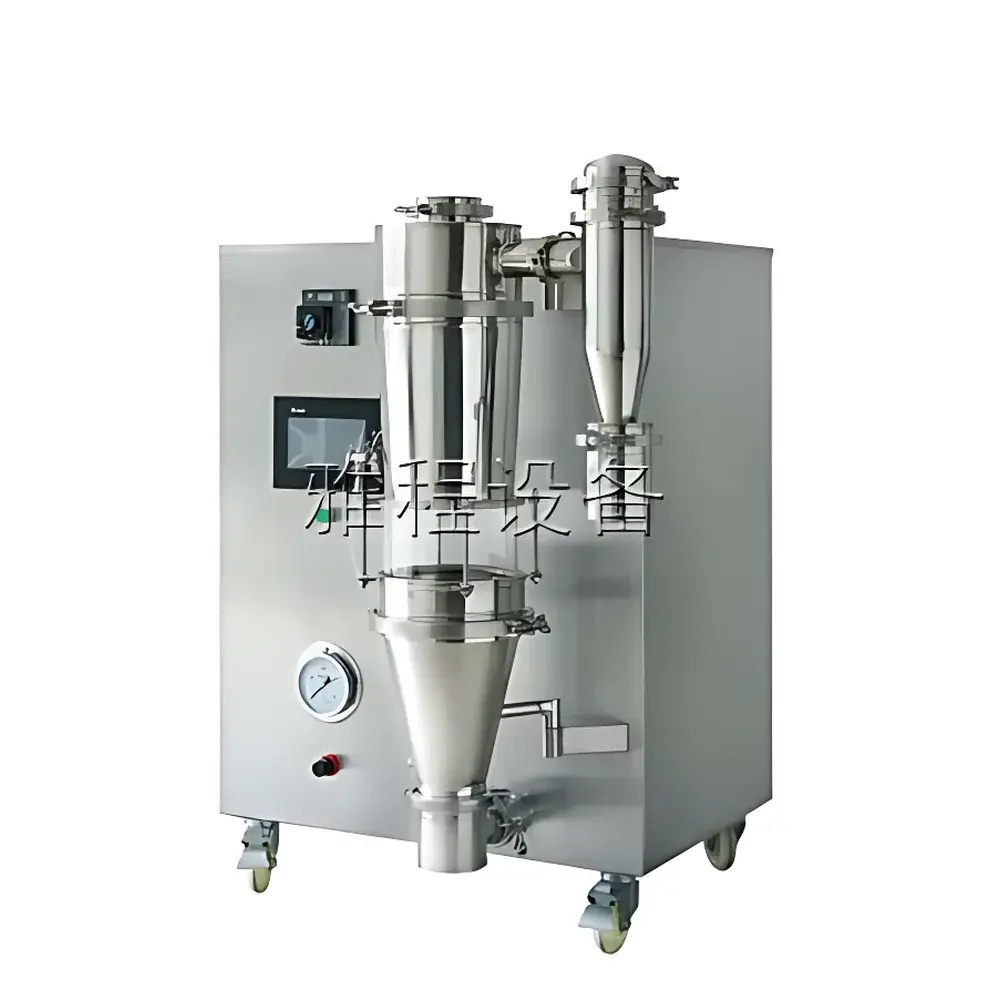
Yacheng YC-1800 Lab-Scale Low-Temperature Spray Dryer for Herbal Extracts and Thermosensitive Materials
| Brand | Yacheng / PILOTECH |
|---|---|
| Origin | Shanghai, China |
| Manufacturer | Yacheng Instrument Co., Ltd. |
| Model | YC-1800 |
| Heating Temperature Range | 110–150 °C |
| Max. Feed Rate | 1500 mL/h |
| Minimum Sample Volume | 50 mL |
| Temperature Control Accuracy | ±1 °C (PID) |
| Nozzle Orifice Options | 0.5, 0.7, 1.0, 1.5, 2.0 mm |
| Power Supply | 4 kW / 380 V |
| Construction | Full Stainless Steel (AISI 316L contact surfaces) |
| Atomization | Two-Fluid Pneumatic Nozzle |
| Touchscreen Interface | Color LCD with Real-Time Parameter Monitoring |
Overview
The Yacheng YC-1800 Lab-Scale Low-Temperature Spray Dryer is an engineered solution for the reliable, reproducible drying of thermolabile natural product extracts—particularly traditional Chinese herbal preparations, fruit juice concentrates, polysaccharide-rich botanicals, and biopolymer solutions. Unlike conventional laboratory spray dryers operating at inlet temperatures ≥150 °C, the YC-1800 achieves complete droplet-to-powder conversion at a controlled inlet temperature as low as 110 °C. This capability is grounded in optimized thermal mass transfer dynamics and precise two-fluid atomization, enabling rapid solvent evaporation before thermal degradation or sugar caramelization occurs. The system employs a coaxial air-assisted nozzle to generate fine, uniform droplets (<20 µm Sauter mean diameter), ensuring high surface-area-to-volume ratio and minimizing residence time in the hot zone (<2 s). Its self-contained architecture eliminates dependency on external compressed air regulators, chillers, or exhaust ducting—making it suitable for ISO Class 7 clean benches, fume hoods, and GLP-compliant lab environments.
Key Features
- Low-temperature operation (110–150 °C inlet) preserves heat-sensitive bioactives, glycosides, volatile oils, and enzyme integrity in herbal matrices.
- Full stainless steel construction (AISI 316L wetted parts) ensures corrosion resistance against acidic fruit extracts and alkaline plant alkaloid solutions.
- Two-fluid pneumatic nozzle with interchangeable orifices (0.5–2.0 mm) enables method development across viscosity ranges—from dilute tea infusions (1–2% w/w solids) to viscous polysaccharide gels (up to 15% w/w).
- Integrated automatic needle cleaner (‘通针’) with adjustable frequency prevents nozzle clogging during high-sugar feed processing—critical for *Lycium barbarum*, *Schisandra chinensis*, or *Citrus* peel extracts.
- PID-controlled heating system maintains ±1 °C stability across the full temperature range, validated per ASTM E2251-22 for thermal uniformity in laboratory-scale dryers.
- Variable-speed peristaltic feed pump (0.1–1500 mL/h range) allows precise control over droplet size distribution and powder morphology.
- Color LCD touchscreen interface supports both fully automated batch protocols and manual real-time parameter override—data logged internally with timestamped CSV export.
Sample Compatibility & Compliance
The YC-1800 is validated for use with aqueous and ethanol-based extracts containing >30% total soluble solids, including sucrose-, fructose-, and inulin-rich matrices. It complies with ISO 2954:2022 (vibration limits for lab equipment), IEC 61000-6-3 (EMC emission standards), and meets mechanical safety requirements per EN 61000-6-2. For regulated research, the system supports audit-ready operation: all temperature setpoints, feed rates, and run durations are recorded with electronic signatures (21 CFR Part 11–compatible when paired with optional Yacheng LabManager software). Powder recovery efficiency exceeds 85% for herbal extracts with <10% moisture content post-drying—verified via gravimetric analysis per USP .
Software & Data Management
The embedded control firmware records all operational parameters—including inlet/outlet temperature profiles, feed pump RPM, airflow rate (via calibrated mass flow sensor), and drying chamber pressure—at 1-second intervals. Data is stored locally on a removable SD card and exportable in CSV format for integration with LIMS or statistical process control platforms (e.g., JMP, MATLAB). Optional LabManager v3.2 software provides remote monitoring via Ethernet/Wi-Fi, trend analysis of powder yield vs. temperature gradient, and automated report generation compliant with GLP Annex 11 and WHO TRS 961 Annex 5 documentation standards.
Applications
- Drying of *Ginkgo biloba*, *Panax ginseng*, and *Salvia miltiorrhiza* extracts without degradation of ginkgolides, ginsenosides, or tanshinones.
- Stabilization of probiotic-loaded herbal microcapsules using maltodextrin or gum arabic carriers.
- Rapid formulation screening for amorphous solid dispersions of poorly water-soluble herbal flavonoids (e.g., quercetin, baicalein).
- Production of inhalable herbal nanopowders (Dv50 = 2–5 µm) for pulmonary delivery studies.
- Process development for scale-up to pilot-scale (e.g., Niro Minor or Buchi B-290) using dimensionless number correlation (Re, We, Pr).
FAQ
What is the minimum sample volume required for a valid drying run?
50 mL is the practical lower limit, assuming ≥5% total dissolved solids; lower volumes may be used with pre-concentrated samples but require calibration of residual moisture measurement.
Can the YC-1800 handle ethanol-water mixtures?
Yes—up to 60% v/v ethanol is supported; explosion-proof configuration (ATEX Zone 2 optional) is available upon request.
Is GMP documentation available for IQ/OQ/PQ validation?
Factory-issued DQ/IQ/OQ protocols compliant with EU Annex 15 and FDA Guidance for Industry are provided with each unit.
How is powder recovery optimized for sticky herbal extracts?
Chamber wall temperature is actively controlled via jacketed cooling; combined with anti-static glass collection vessel and cyclone geometry tuned for 1–10 µm particle recovery, typical yield is 85–92%.
Does the system support continuous feed mode for extended runs?
Yes—peristaltic pump duty cycle is rated for 8-hour uninterrupted operation; optional external feed reservoir (1 L) enables unattended overnight drying.



