
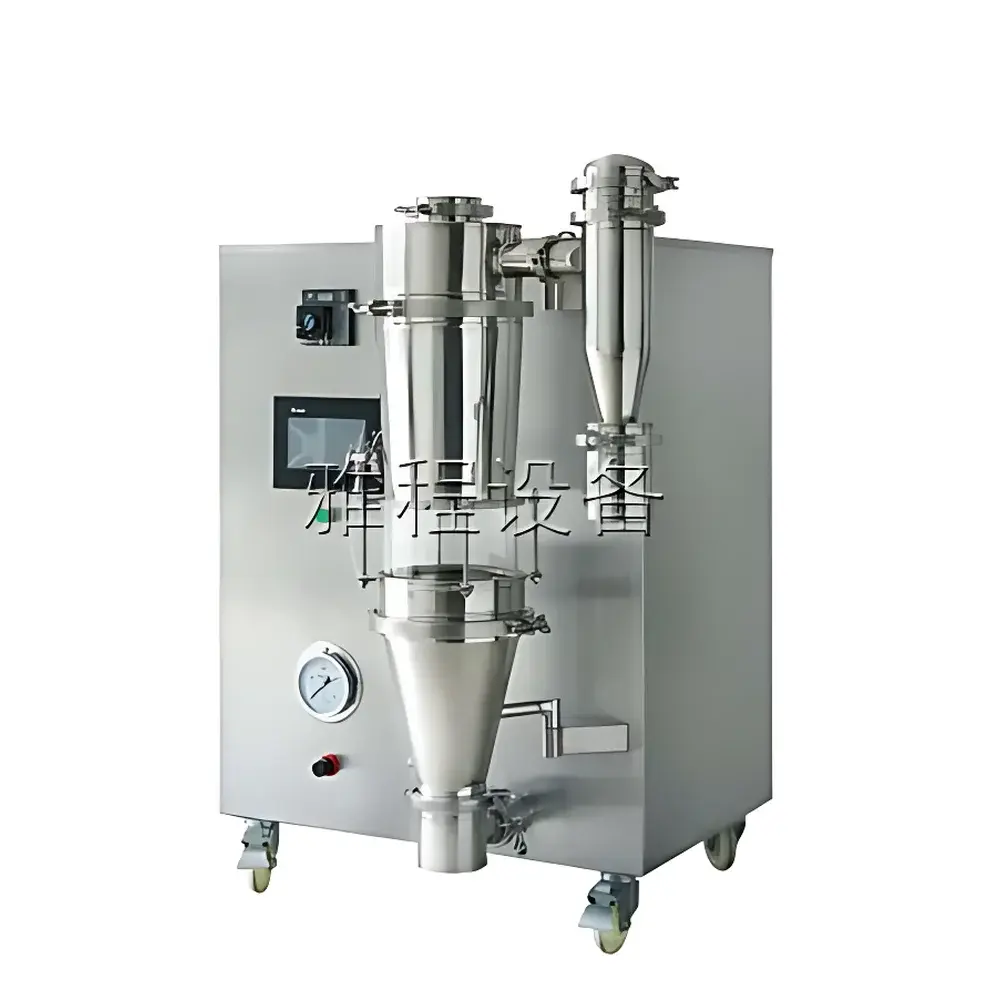
YaCheng YC-1800 Low-Temperature Laboratory Spray Dryer
| Brand | YaCheng / PILOTECH |
|---|---|
| Origin | Shanghai, China |
| Manufacturer Type | Direct Manufacturer |
| Country of Origin | China |
| Model | YC-1800 |
| Heating Temperature Range | 110–150 °C |
| Max. Feed Rate | 1800 mL/h |
| Min. Sample Volume | 50 mL |
| Temperature Control Accuracy | ±1 °C |
| Nozzle Orifice Options | 0.5 / 0.7 / 1.0 / 1.5 / 2.0 mm |
| Power Supply | 4 kW / 380 V |
| Construction | Full Stainless Steel (316L-grade contact surfaces) |
| Atomization | Two-Fluid Pneumatic Nozzle System |
| Touchscreen Interface | Color LCD with PID-Controlled Thermal Management |
Overview
The YaCheng YC-1800 Low-Temperature Laboratory Spray Dryer is an engineered solution for the gentle, reproducible drying of thermolabile natural product extracts—particularly those derived from traditional Chinese medicinal herbs, fruit juices, polysaccharide-rich botanicals, and bioactive macromolecules. Unlike conventional laboratory spray dryers operating at inlet temperatures ≥160 °C, the YC-1800 employs precisely regulated two-fluid pneumatic atomization coupled with real-time PID-controlled thermal management to achieve complete droplet-to-powder conversion at an inlet air temperature as low as 110 °C. This operational envelope mitigates Maillard reactions, caramelization, and thermal degradation commonly observed in high-sugar, high-molecular-weight phytochemical matrices. The system operates on the principle of rapid solvent evaporation via convective heat transfer within a controlled laminar airflow chamber, where atomized feed droplets undergo transient heating (<2–5 s residence time), enabling preservation of labile functional groups, enzymatic activity, and stereochemical integrity in dried particulates.
Key Features
- Low-temperature operation (110–150 °C inlet air) optimized for heat-sensitive biologics, glycosides, flavonoids, and polyphenol-rich extracts
- Two-fluid stainless steel (316L) nozzle assembly with five interchangeable orifice diameters (0.5–2.0 mm) for precise control over droplet size distribution and powder morphology
- Integrated automatic needle cleaner (‘通针’) with programmable frequency adjustment to prevent nozzle clogging during high-viscosity or particulate-laden feed processing
- Full-color LCD touchscreen interface with intuitive Chinese/English bilingual navigation and real-time graphical display of inlet/outlet temperature, feed rate, and airflow status
- PID-regulated heating system ensuring ±1 °C thermal stability across the entire operational range, critical for method transfer and inter-laboratory reproducibility
- Self-contained architecture: no external chiller, compressor, or exhaust ducting required; operates as a standalone unit on standard 380 V industrial power supply
- Stainless steel construction compliant with ISO 14644-1 Class 7 cleanroom-compatible surface finish (Ra ≤ 0.8 µm) for GMP-aligned process development
Sample Compatibility & Compliance
The YC-1800 is validated for consistent drying performance with aqueous and ethanol-based extracts containing >30% total solids—including viscous polysaccharide gels, pectin suspensions, anthocyanin concentrates, and protein–polysaccharide complexes. Its low-thermal-load profile supports compliance with multiple regulatory frameworks: residual moisture content in dried powders typically falls within 3–5% w/w—meeting USP <<751> limits for herbal dosage forms. The closed-loop design minimizes aerosol escape, facilitating adherence to OSHA 1910.1200 (Hazard Communication) and EU Directive 2004/37/EC (carcinogen/mutagen exposure). While not certified to FDA 21 CFR Part 11 out-of-the-box, audit-ready electronic logs (time-stamped temperature/feed profiles, operator ID, parameter changes) can be exported in CSV format for GLP/GMP documentation workflows.
Software & Data Management
The embedded control firmware records all critical process parameters at 1-second intervals—including inlet/outlet temperature differentials, peristaltic pump RPM, air flow rate (calibrated mass flow sensor), and nozzle backpressure. Data is stored internally (16 GB onboard memory) and exportable via USB 2.0 to standard spreadsheet formats. Optional Ethernet connectivity enables integration into centralized LIMS environments using Modbus TCP protocol. All parameter modifications are logged with timestamp, user credential (if enabled), and pre-/post-change values—supporting ALCOA+ data integrity principles (Attributable, Legible, Contemporaneous, Original, Accurate, Complete, Consistent, Enduring, Available).
Applications
- Rapid formulation screening of TCM extract powders for tabletting, capsule filling, or inhalable dry powder aerosols
- Stabilization of probiotic cultures, enzymes, and antibody fragments without cryoprotectant additives
- Production of uniform microparticles for sustained-release studies (e.g., curcumin–PLGA co-dried systems)
- Preparation of reference standards for HPLC-MS quantification where thermal decomposition must be excluded
- Scale-down modeling for pilot-scale spray drying processes under ICH Q5C and Q8(R2) quality-by-design guidelines
FAQ
What is the minimum sample volume required for method development?
50 mL is sufficient for preliminary trials when feed solids concentration exceeds 15% w/w; however, ≥100 mL is recommended for robust statistical assessment of yield and particle size distribution.
Can the YC-1800 handle ethanol-based extracts?
Yes—provided ethanol concentration remains below 40% v/v and explosion-proof electrical certification (ATEX Zone 2) is confirmed prior to operation; nitrogen inerting option available upon request.
Is nozzle wear compensated automatically during long-duration runs?
No automatic wear compensation is implemented; however, the system includes a calibrated nozzle alignment jig and torque-spec tooling to ensure repeatable positioning after replacement.
Does the instrument support IQ/OQ documentation packages?
Factory-supplied IQ/OQ templates aligned with ASTM E2500-13 and ISO 9001:2015 are provided, including calibration certificates for all embedded sensors traceable to NIST standards.
How is residual solvent content verified post-drying?
The dried powder output is compatible with headspace GC-FID analysis per USP ; typical residual water content is 3.2 ± 0.4% w/w, and ethanol residuals remain <500 ppm under optimized 110 °C/1200 mL·h⁻¹ conditions.



