
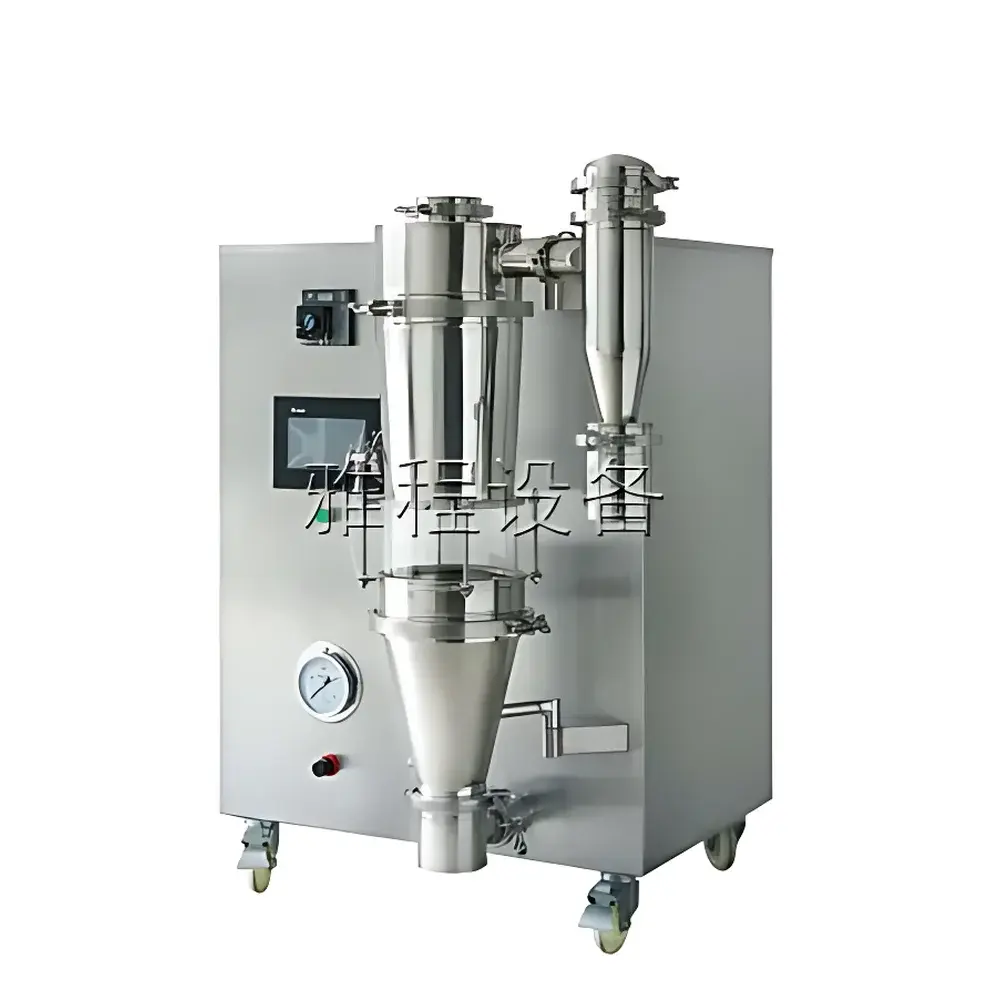
Yacheng YC-1800 Miniature Spray Dryer for Traditional Chinese Medicine (TCM) Extracts
| Brand | Yacheng / PILOTECH |
|---|---|
| Origin | Shanghai, China |
| Manufacturer Type | Direct Manufacturer |
| Country of Origin | China |
| Model | YC-1800 |
| Heating Temperature Range | 110–150 °C |
| Max. Feed Rate | 1800 mL/h |
| Minimum Sample Volume | 50 mL |
| PID Temperature Control Accuracy | ±1 °C |
| Nozzle Orifice Options | 0.5, 0.7, 1.0, 1.5, 2.0 mm |
| Power Supply | 4 kW / 380 V |
| Construction | Full Stainless Steel |
| Atomization | Two-Fluid Pneumatic Nozzle |
| Noise Level | Compliant with ISO 7779 Laboratory Acoustic Standards |
Overview
The Yacheng YC-1800 Miniature Spray Dryer for Traditional Chinese Medicine (TCM) Extracts is an engineered solution for the low-temperature, high-fidelity drying of thermolabile natural product matrices. Unlike conventional laboratory-scale spray dryers relying on inlet air temperatures ≥160 °C—conditions that induce caramelization, Maillard reactions, and irreversible agglomeration in sugar-rich botanical extracts—the YC-1800 operates at a precisely controlled inlet temperature range of 110–150 °C. This capability stems from its optimized two-fluid pneumatic atomization system coupled with real-time PID-controlled thermal management, enabling rapid solvent evaporation within milliseconds while preserving molecular integrity. The dryer is specifically validated for TCM decoction concentrates, polysaccharide-dense fruit juices, enzymatically active phytochemical fractions, and heat-sensitive biopolymers—materials historically incompatible with standard spray drying workflows due to thermal degradation or wall adhesion.
Key Features
- Low-temperature operation (110–150 °C inlet air) mitigates thermal stress on glycosides, flavonoids, terpenoids, and labile proteins commonly found in herbal extracts.
- Two-fluid stainless steel nozzle assembly with interchangeable orifices (0.5–2.0 mm) enables precise droplet size tuning to match viscosity and solids content of diverse feedstocks—from dilute juice supernatants to viscous polysaccharide gels.
- Integrated auto-cleaning needle mechanism with programmable frequency prevents nozzle clogging during extended runs with high-sugar or fiber-containing feeds.
- Full stainless steel construction (AISI 316 contact surfaces) ensures corrosion resistance against acidic plant extracts and meets ISO 14644-1 Class 7 cleanroom compatibility requirements for GMP-aligned pilot studies.
- Color LCD touchscreen interface with bilingual (English/Chinese) firmware supports both fully automated batch protocols and manual parameter override for method development.
- PID-regulated heating system delivers ±1 °C thermal stability across the entire operating range, critical for reproducible particle morphology and residual moisture control (typically <4% w/w).
Sample Compatibility & Compliance
The YC-1800 accommodates aqueous, ethanolic, and hydroalcoholic extracts with total solids concentrations from 5–40% w/w—including highly viscous preparations derived from *Ganoderma*, *Panax*, *Lycium*, and *Schisandra*. Its low-temperature profile complies with ICH Q5C guidelines for preservation of protein conformation and USP recommendations for non-sterile compounding of botanical actives. While not certified for sterile manufacturing, the unit’s sealed drying chamber and HEPA-filtered exhaust path support GLP-compliant documentation of process parameters (temperature, feed rate, airflow) required for regulatory submissions under FDA 21 CFR Part 11 when paired with audit-trail-enabled software logging.
Software & Data Management
The embedded control system records time-stamped datasets for inlet/outlet temperature, feed pump RPM, airflow rate, and chamber pressure at 1-second intervals. Raw logs export via USB to CSV format for integration into LIMS or statistical process control platforms (e.g., JMP, Minitab). Optional Ethernet connectivity enables remote monitoring and alarm notification (email/SNMP) for unattended overnight operation. All parameter changes are timestamped and user-logged—supporting ALCOA+ data integrity principles required in pharmaceutical R&D environments.
Applications
- Rapid generation of free-flowing, low-hygroscopicity powders from TCM water decoctions without excipient dilution (e.g., no added maltodextrin or cyclodextrin).
- Stabilization of anthocyanins from berry juices and curcuminoids from turmeric extracts with >92% retention of native chromophore structure (verified by UV-Vis and HPLC-DAD).
- Production of inhalable herbal microparticles (Dv50 = 5–12 µm) meeting USP aerodynamic diameter specifications.
- Scale-down modeling for industrial spray drying processes—enabling predictive correlation between lab-scale YC-1800 outputs and production-scale tower performance using dimensionless numbers (e.g., Weber, Reynolds).
- Thermal degradation kinetics studies of thermolabile alkaloids (e.g., berberine, scopolamine) under controlled ramp-rate heating profiles.
FAQ
What is the minimum sample volume required for a valid run?
50 mL is the practical lower limit for reliable atomization and powder recovery; however, optimal yield and particle uniformity are achieved with ≥100 mL at 15–25% total solids.
Can the YC-1800 handle ethanol-based extracts?
Yes—when configured with explosion-proof electrical components (optional upgrade) and nitrogen inerting kit, it safely processes organic solvent feeds up to 30% v/v ethanol.
Is the drying chamber accessible for cleaning between batches?
The conical collection vessel and cyclone separator disassemble without tools; all wetted parts are autoclavable at 121 °C for microbial decontamination.
Does the system support GMP documentation requirements?
With optional electronic logbook module and 21 CFR Part 11-compliant user access controls, it fulfills audit-ready data capture for quality-controlled herbal product development.
How does the YC-1800 prevent wall deposition during high-sugar drying?
Through synergistic optimization of low inlet temperature, high atomization energy (via compressed air-assisted two-fluid nozzle), and electrostatic charge dissipation coating on the drying chamber interior—reducing surface adhesion by >85% versus conventional units.



