
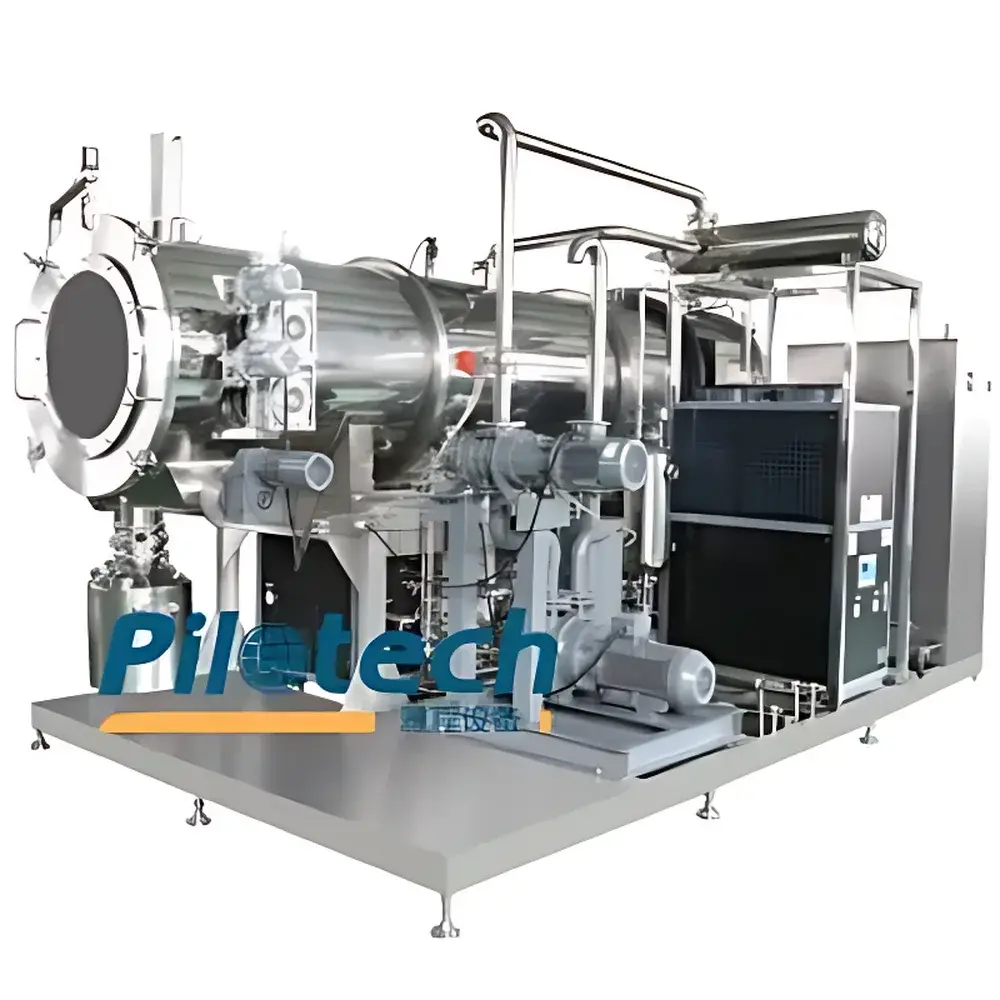
Yacheng YCV Series Vacuum Low-Temperature Belt Dryer
| Brand | Yacheng / PILOTECH |
|---|---|
| Origin | Shanghai, China |
| Manufacturer Type | Direct Manufacturer |
| Product Origin | Domestic (China) |
| Model | YCV Series |
| Sample Type | Aqueous Solutions |
| Maximum Throughput | 1500 mL/h |
| Temperature Range | 35–90 °C |
| Particle Size Range | 50–500 µm |
Overview
The Yacheng YCV Series Vacuum Low-Temperature Belt Dryer is an engineered continuous drying system designed for thermally sensitive, high-viscosity materials—particularly aqueous herbal extracts, pharmaceutical intermediates, functional food concentrates, and fine chemical slurries. Unlike conventional spray dryers (which rely on rapid convective heat transfer at elevated inlet temperatures) or batch vacuum ovens (which suffer from long residence times, poor heat transfer uniformity, and contamination risks), the YCV dryer operates on the principle of conductive heat transfer under controlled vacuum conditions. Material is uniformly metered onto a stainless-steel conveyor belt via a precision screw pump, then conveyed through independently heated and cooled zones within a sealed vacuum chamber (typically operating at 1–10 kPa absolute). Heat is delivered directly through contact with thermostatically regulated heating plates beneath the belt; simultaneous cooling sections enable in-line solidification and thermal stabilization prior to discharge. This architecture ensures minimal thermal degradation, high powder yield (>99%), and consistent crystalline morphology—critical for downstream capsule filling or direct compression. The system is fully enclosed, eliminating exposure to ambient air and fulfilling core requirements for GMP-compliant manufacturing environments.
Key Features
- Continuous, integrated drying and cooling in a single vacuum chamber—enabling uninterrupted operation from feed to final granular output
- Adjustable belt speed via frequency-controlled motors, with independent drive for each belt layer (1–10 layers configurable)
- Precision volumetric feeding using a calibrated screw pump, ensuring uniform film thickness even at low throughput (e.g., <200 mL/h)
- Dual-zone thermal control: segmented heating plates (35–90 °C) and integrated cooling plates for post-drying solidification
- In-line mechanical flaking and granulation unit, followed by vacuum-assisted discharge into sealed collection vessels
- PLC-based automation with HMI touchscreen interface; real-time monitoring and adjustment of temperature profiles, belt speed, vacuum level, and feed rate
- Optional CIP (Clean-in-Place) integration with validated cleaning cycles compliant with ISO 14644 and EU GMP Annex 15
- Stainless-steel 316L construction throughout product-contact surfaces; surface roughness Ra ≤ 0.8 µm
- Integrated tension and tracking control system to maintain belt alignment and minimize wear over extended operation
Sample Compatibility & Compliance
The YCV dryer is optimized for aqueous-phase feedstocks with viscosities up to 5,000 cP—including herbal decoction extracts (e.g., Salvia miltiorrhiza, Panax ginseng), dairy-based concentrates (e.g., instant milk powder, soluble tea), and API suspensions. Its low-temperature operation preserves labile compounds (e.g., flavonoids, polysaccharides, probiotics) without caramelization or Maillard reactions. The system meets structural and operational criteria referenced in USP , ISO 22000, and ICH Q5C for stability-critical biologics processing. All electrical components comply with CE/IEC 61000-6-2/6-4 standards; vacuum integrity is verified per ASTM E493-17. Full traceability—including audit trails for parameter changes, alarm logs, and user access—is implemented in accordance with FDA 21 CFR Part 11 requirements when configured with electronic signature capability.
Software & Data Management
The embedded control system runs on a Windows-based industrial PC with deterministic real-time OS support. The HMI provides graphical visualization of process trends (vacuum pressure vs. time, zone-wise temperature deviation, feed rate stability), with data export in CSV and PDF formats. Batch records include timestamps, operator ID, setpoints, deviations, and equipment status flags—all stored locally with optional cloud backup. Optional OPC UA server enables seamless integration with MES (e.g., Siemens Opcenter, Rockwell FactoryTalk) and LIMS platforms. Firmware updates are performed via secure authenticated protocols; configuration backups are encrypted and version-controlled. System validation documentation (IQ/OQ/PQ templates) is provided upon request to support GLP/GMP audits.
Applications
- Pharmaceutical R&D and pilot-scale production of heat-labile APIs and botanical extracts
- GMP-compliant manufacturing of oral solid dosage forms requiring high bulk density and flowability (e.g., capsule fill powders)
- Food ingredient drying where color, aroma, and enzymatic activity retention are critical (e.g., instant coffee, fruit powders, probiotic cultures)
- Fine chemical synthesis—drying of catalyst slurries, pigment dispersions, and agrochemical intermediates without solvent residue
- Academic and contract research laboratories studying solid-state transformation kinetics under vacuum and controlled thermal gradients
FAQ
What is the typical residence time for material in the YCV dryer?
Residence time ranges from 30 to 60 minutes, depending on feed concentration, viscosity, and target moisture content—adjustable via belt speed and thermal profile.
Can the system handle non-aqueous solvents?
Standard configuration is optimized for water-based feeds; modifications for low-boiling organic solvents (e.g., ethanol, acetone) require explosion-proof motor ratings, enhanced condensate recovery, and ATEX certification—available upon engineering review.
Is the dried product automatically milled to a defined particle size?
Yes—the integrated flaking and granulation module produces particles predominantly within the 50–500 µm range; optional downstream sieving or air classification can further narrow the distribution.
How is cleaning validated for multi-product use?
With optional CIP, cleaning efficacy is confirmed using conductivity, TOC, and swab testing per PDA Technical Report No. 29; cleaning cycle parameters are logged and reportable.
What level of vacuum does the system achieve and maintain?
The standard vacuum system achieves and stabilizes between 1–5 kPa (absolute) across the drying chamber, with optional high-vacuum upgrade to 0.1 kPa for ultra-sensitive applications.



