
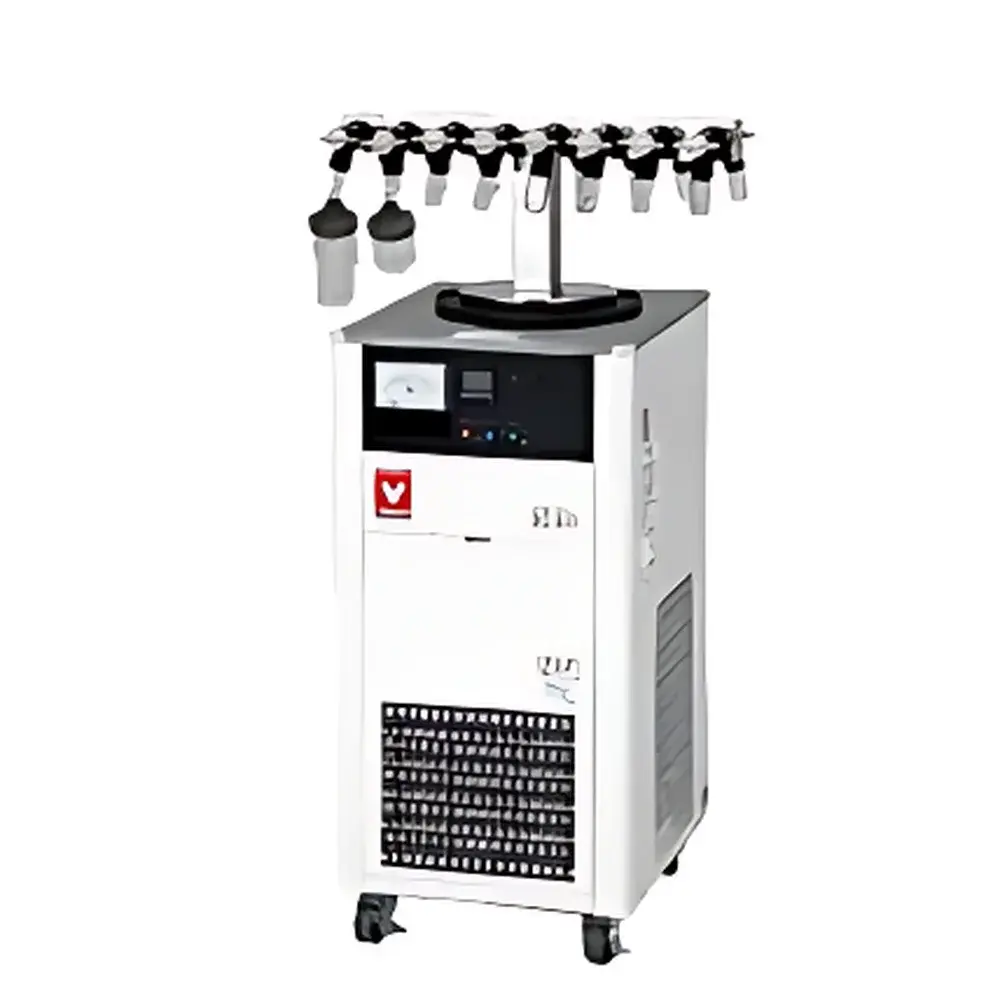
YAMATO DC801 Laboratory Freeze Dryer
| Brand | YAMATO |
|---|---|
| Origin | Japan |
| Model | DC801 |
| Instrument Type | Manifold Freeze Dryer |
| Application | Laboratory Use |
| Shelf Area | 0.12 m² |
| Ultimate Vacuum | 60 Pa |
| Condensate Capacity (24 h) | 1.0 L |
| Cold Trap Temperature | −85 °C |
| Dimensions (L×D×H) | 405 × 500 × 846 mm |
| Weight | ~65 kg |
| Power Supply | AC 100 V, 50/60 Hz, 7 A (20 A max) |
| Refrigerant | R600a + blended refrigerant |
| Cooling Method | Air-cooled compressor (350 W) |
| Vacuum Gauge | Pirani gauge |
| Defrosting Method | Hot-gas bypass |
| Safety Features | Overcurrent leakage breaker, compressor overload protection, reverse-flow prevention valve |
| Ambient Operating Temperature | 5–30 °C |
| Cold Trap Dimensions | Ø153 × H235 mm |
| Internal Volume | ~4 L |
| Vacuum Pump Compatibility | 50–60 L/min displacement |
Overview
The YAMATO DC801 is a compact, air-cooled manifold freeze dryer engineered for precision lyophilization in academic, pharmaceutical, and quality control laboratories. It operates on the fundamental principle of sublimation—removing water from frozen samples under vacuum while maintaining product integrity through controlled thermal management. The system features a high-efficiency cold trap capable of reaching −85 °C, enabling reliable condensation of volatile solvents and aqueous matrices without ice bridging or vapor backstreaming. Its integrated Pirani vacuum gauge provides real-time pressure monitoring down to 60 Pa, ensuring consistent process conditions across batch runs. Designed for benchtop deployment, the DC801 delivers a shelf area of 0.12 m²—sufficient for simultaneous drying of multiple vials, flasks, or ampoules via its four-port manifold configuration—while maintaining strict compliance with ISO 22000 and GLP-aligned operational traceability.
Key Features
- Air-cooled, low-noise R600a-based refrigeration system (350 W) eliminates need for external cooling water or glycol loops
- −85 °C cold trap with cylindrical stainless-steel chamber (Ø153 × H235 mm) and optimized internal geometry for uniform frost distribution
- Hot-gas bypass defrosting mechanism enables rapid, non-invasive cold trap regeneration without disassembly
- Pt100Ω temperature sensor and 7-segment LCD display monitor cold trap surface temperature with ±0.5 °C repeatability
- Dual-circuit power design: dedicated 6 A outlet for vacuum pump and separate 2 A heating circuit for optional shelf warming (not included)
- Integrated safety architecture including electromagnetic leakage circuit breaker, compressor thermal overload cutoff, and check-valve–based reverse-flow prevention
- Compact footprint (405 × 500 × 846 mm) with castor-mounted base and locking brackets for stable bench integration
Sample Compatibility & Compliance
The DC801 supports lyophilization of diverse sample formats—including serum vials (10–50 mL), round-bottom flasks (up to 500 mL), and custom glassware—via its universal manifold ports with silicone O-ring seals. Its −85 °C cold trap ensures efficient capture of water and common organic solvents (e.g., ethanol, acetone, tert-butanol) used in formulation development. The system complies with JIS B 7952:2018 (freeze-drying equipment performance testing), meets electrical safety requirements per JIS C 61010-1, and supports audit-ready documentation when paired with validated vacuum pumps and data loggers. While not inherently 21 CFR Part 11–compliant, its analog control interface permits integration with third-party compliant data acquisition systems for GMP environments.
Software & Data Management
The DC801 operates as a standalone instrument with no embedded microprocessor or digital communication ports. All operational parameters—including cold trap temperature, vacuum level, and elapsed time—are displayed locally via the front-panel LCD and Pirani gauge. For regulated applications, users may connect external USB or RS-232–enabled chart recorders or PC-based DAQ systems to log temperature and pressure trends. Optional YAMATO-compatible data logging kits (sold separately) provide timestamped CSV export, alarm-triggered event capture, and configurable sampling intervals—facilitating adherence to ISO/IEC 17025 documentation standards and internal QC protocols.
Applications
- Stabilization of heat-labile biologics (e.g., monoclonal antibodies, enzymes, vaccines) during pre-formulation studies
- Preparation of reference standards and certified reference materials (CRMs) requiring long-term matrix stability
- Drying of microbial cultures, tissue extracts, and botanical concentrates for metabolomic profiling
- Removal of residual solvents from synthetic intermediates prior to NMR or HPLC analysis
- Processing of diagnostic reagents and calibration standards in clinical laboratory settings
- Teaching freeze-drying fundamentals in undergraduate chemistry and pharmaceutical sciences curricula
FAQ
What vacuum pump specifications are recommended for optimal DC801 performance?
A two-stage oil-sealed rotary vane pump with 50–60 L/min free-air displacement and ultimate vacuum ≤5 Pa is recommended. Pumps must include gas ballast and inlet filter to prevent oil contamination and moisture ingress.
Can the DC801 be used for solvent-freeze drying of organic compounds?
Yes—its −85 °C cold trap effectively condenses low-boiling solvents such as methanol, acetonitrile, and dichloromethane; however, compatibility with aggressive solvents (e.g., chloroform, THF) requires verification of seal material resistance and cold trap corrosion tolerance.
Is shelf heating available on the DC801?
No—the DC801 is a condenser-only system without heated shelves. For primary drying optimization requiring controlled product temperature, users should consider YAMATO’s DCE series or integrate external temperature-controlled sample holders.
How frequently should the cold trap be defrosted during continuous operation?
Defrosting is required when frost accumulation approaches 80% of cold trap volume or when vacuum degradation exceeds 15 Pa over baseline—typically every 12–24 h depending on sample load and solvent composition.
Does the DC801 support automated cycle programming?
No—it operates in manual mode only. Process sequencing (e.g., ramped freezing, stepwise vacuum reduction) must be executed manually using external timers and vacuum regulators.



