
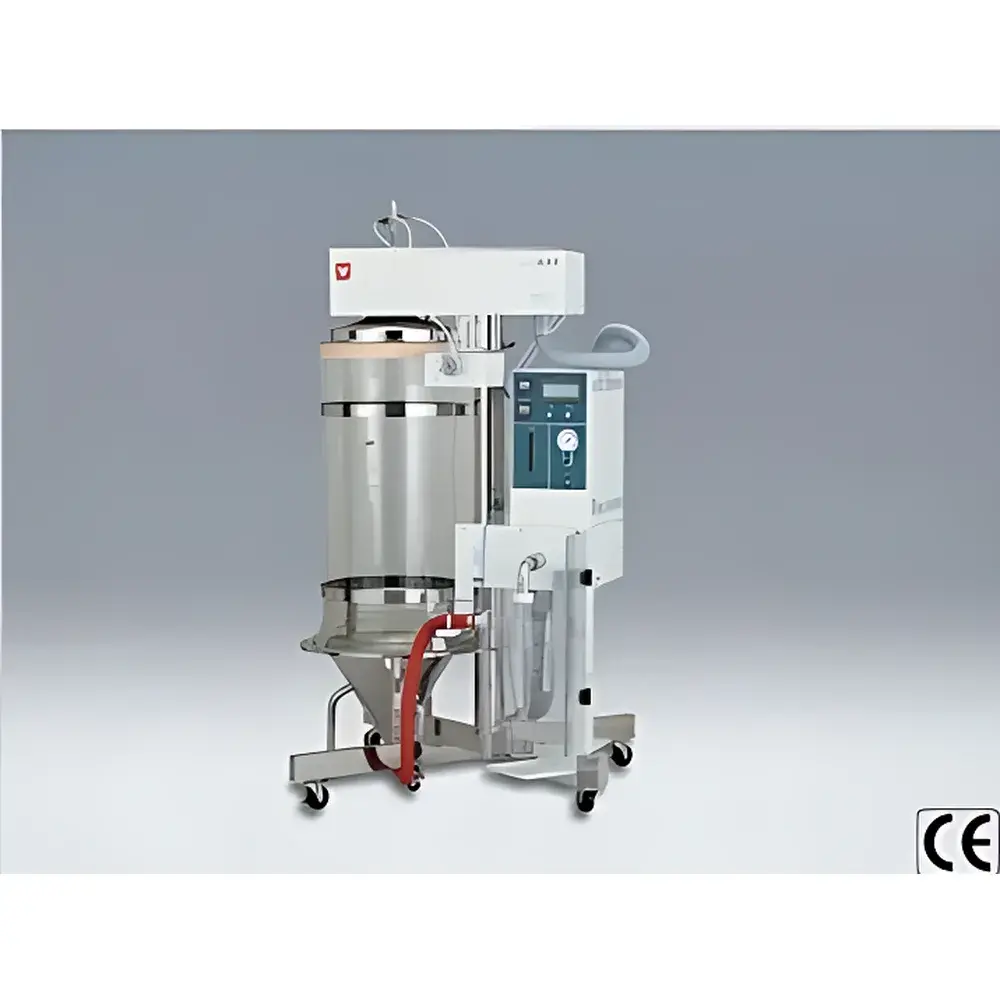
YAMATO DL410 Large-Capacity Spray Dryer for Micron-Sized Particles (40–100 µm)
| Brand | YAMATO |
|---|---|
| Origin | Japan |
| Model | DL410 |
| Maximum Water Evaporation Rate | 3000 mL/h |
| Spray Method | Two-Fluid Nozzle (Orifice Diameter: 0.7 mm) |
| Feed Pump | Volumetric Peristaltic Pump (0–70 mL/min) |
| Blower | DC Brushless Motor (0.3–1.0 m³/min) |
| Inlet Temperature Range | 0–300 °C (PID Control, ±1 °C Stability) |
| Heating Power | 2 × 2.0 kW Stainless Steel Heating Elements |
| Drying Chamber Dimensions | Ø457 mm × H975 mm (Borosilicate Glass) |
| Chamber & Cyclone Material | Ultra-Hard Borosilicate Glass |
| Standard Features | Automatic Nozzle Orifice Cleaning (Timer-Controlled Probe Tapping), Nozzle Air Purge, Motorized Head Elevation, Electrostatic Discharge Brush, Safety Guard, Dual Overtemperature Protection (Inlet/Outlet + Independent Heater Chamber Cut-off), 4–20 mA Analog Outputs for Inlet/Outlet Temperatures |
| Power Supply | AC 220 V, 24 A, 50/60 Hz |
| Net Weight | ~180 kg |
| External Dimensions | W1060 × D880 × H1770 mm |
| Compliance | Designed for GLP-compliant R&D environments |
Overview
The YAMATO DL410 is a high-capacity, research-grade spray dryer engineered for the reproducible production of spherical, free-flowing microparticles in the 40–100 µm range—dimensions typically associated with industrial-scale ceramic granules, pharmaceutical dry powder inhalers (DPIs), and functional food additives. Unlike conventional laboratory spray dryers optimized for sub-20 µm aerosols or lyophilization-like fine powders, the DL410 employs a deliberate concurrent downward two-fluid nozzle configuration combined with an enlarged borosilicate glass drying chamber (Ø457 × H975 mm) to extend residence time under controlled thermal conditions. This architecture ensures complete solvent evaporation and particle densification prior to cyclonic separation—critical for achieving mechanical robustness, low moisture content (<2% w/w typical), and narrow particle size distribution (PSD) without agglomeration. The system operates on fundamental principles of thermodynamic equilibrium between atomized liquid feed, heated drying air (up to 300 °C inlet), and convective mass transfer—enabling precise control over particle morphology, crystallinity, and residual solvent levels per ICH Q5C and Q8(R2) guidelines.
Key Features
- Two-fluid pneumatic nozzle (0.7 mm orifice) delivering consistent droplet generation across variable feed viscosities (up to 500 cP), supported by integrated compressed-air purge to prevent nozzle clogging during continuous operation.
- Motorized vertical head adjustment facilitates rapid access to the drying chamber for cleaning, inspection, or nozzle maintenance—eliminating manual disassembly and reducing cross-contamination risk.
- Automated orifice cleaning via programmable probe tapping synchronized with process cycles, minimizing downtime and ensuring long-term nozzle performance stability.
- DC brushless blower motor provides stable airflow (0.3–1.0 m³/min) with low vibration, extended service life (>20,000 h), and precise modulation synchronized to inlet temperature and feed rate.
- Full touchscreen HMI with tri-lingual UI (English/Japanese/Chinese), real-time parameter logging, and intuitive dialog-driven workflow navigation—no programming expertise required.
- Dual K-type thermocouples (inlet/outlet) coupled with PID-controlled heating ensure thermal precision within ±1 °C at inlet, critical for heat-sensitive biologics and amorphous solid dispersions.
- Standard electrostatic discharge brush and grounded borosilicate collection vessel maximize powder recovery (>92% typical for aqueous feeds), reducing material loss and improving batch-to-batch consistency.
Sample Compatibility & Compliance
The DL410 accommodates aqueous, alcoholic, and low-boiling organic solvent systems (e.g., acetone, ethanol, ethyl acetate) when paired with the optional GAS410 solvent recovery unit—enabling safe operation under OSHA 1910.106 and ATEX Zone 2 compliance frameworks. Its all-glass wetted path (dry chamber, cyclone, collector) resists corrosion and permits direct visual monitoring of atomization behavior, particle trajectory, and wall deposition dynamics—essential for troubleshooting spray pattern anomalies or optimizing nozzle alignment. The system meets structural and electrical safety requirements per IEC 61010-1 and includes redundant thermal cutoffs (inlet, outlet, heater chamber), earth leakage protection, and reverse-pump rotation detection. For regulated environments, the analog 4–20 mA outputs support integration into SCADA or LIMS platforms compliant with FDA 21 CFR Part 11 when paired with validated data acquisition software.
Software & Data Management
While the DL410 operates as a standalone instrument with embedded microcontroller-based logic, its analog outputs (inlet/outlet temperature) are compatible with third-party data loggers (e.g., Omega OM-DAQPRO, National Instruments CompactDAQ) configured for GxP-aligned electronic records. Process parameters—including air flow, feed rate, nozzle pressure, and cleaning interval—are stored locally with timestamps and can be exported via USB for traceability. Optional YAMATO-developed PC software (not bundled) enables remote supervision, trend analysis of drying kinetics, and export of CSV-formatted reports suitable for regulatory submissions under ISO 17025 or MHRA Annex 11 expectations. All parameter changes are logged with operator ID (if network-authenticated) and timestamp—supporting ALCOA+ data integrity principles.
Applications
- Pharmaceutical development: Production of respirable DPI carriers (lactose, mannitol), sustained-release microparticles, and spray-dried dispersions (SDDs) for bioavailability enhancement.
- Ceramic & battery materials: Synthesis of spherical cathode precursors (e.g., NMC, LFP), alumina/zirconia granules for dry pressing, and binder-free electrode powders.
- Food & nutraceuticals: Encapsulation of probiotics, omega-3 oils, and heat-labile vitamins using maltodextrin or gum arabic matrices.
- Chemical catalysts: Preparation of supported metal oxide nanoparticles with controlled surface area and pore volume.
- Academic research: Fundamental studies on droplet drying kinetics, crust formation mechanisms, and glass transition effects during particle solidification.
FAQ
What particle size distribution can the DL410 consistently achieve?
The DL410 is specifically engineered to produce median diameters (D50) between 40 and 100 µm with a span (D90/D10) typically <2.0, verified by laser diffraction (Malvern Mastersizer) under optimized feed concentration (5–15% w/w), inlet temperature (160–220 °C), and atomizing air pressure (1.5–3.0 bar).
Is the DL410 suitable for handling flammable solvents?
Yes—when equipped with the optional GAS410 inert gas recirculation and solvent condensation system, the DL410 supports closed-loop drying under nitrogen or argon, meeting NFPA 484 and EU Directive 1999/92/EC requirements for Class II hazardous areas.
How is process reproducibility ensured across multiple batches?
Reproducibility relies on hardware-level stability (brushless blower, PID thermal control, calibrated peristaltic pump) and standardized operating procedures documented per ISO 20938. Users are advised to perform quarterly nozzle orifice verification using optical microscopy and validate chamber temperature uniformity via calibrated PT100 mapping.
Can the DL410 be integrated into an automated lab infrastructure?
Yes—the 4–20 mA analog outputs interface directly with PLCs or DCS systems. Optional Ethernet/IP or Modbus TCP modules (available via YAMATO’s engineering services group) enable full remote parameter control and alarm notification in centralized lab management platforms.



