
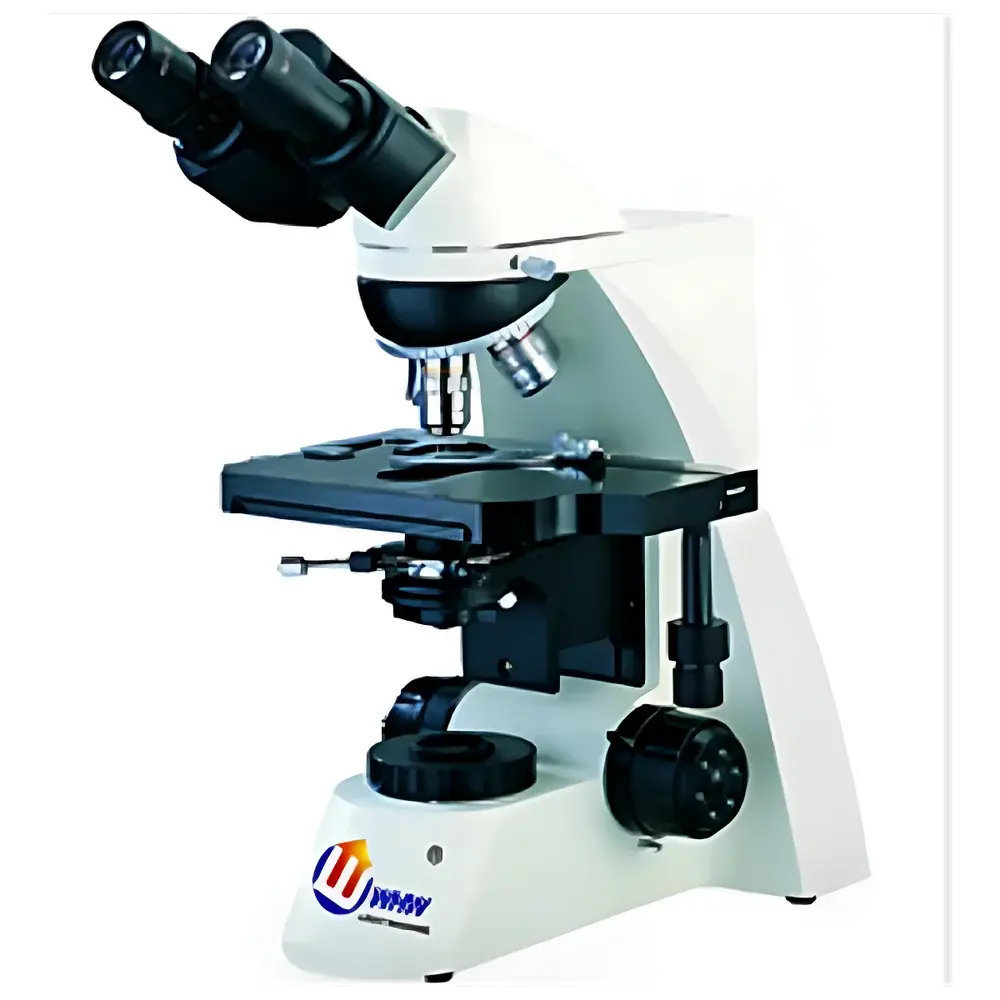
YANRUN BI-24 Biological Inverted Microscope
| Brand | YANRUN |
|---|---|
| Origin | Shanghai, China |
| Manufacturer Type | Original Equipment Manufacturer (OEM) |
| Product Category | Inverted Microscope |
| Eyepiece Configuration | Binocular |
| Magnification Range | 40×–1000× |
| Eyepieces | Widefield WF10× (Φ20 mm) |
| Objective Lenses (BI-24A) | 4×/0.10, 10×/0.25, 40×/0.65 (spring-loaded), 100×/1.25 (spring-loaded, oil immersion) |
| Objective Lenses (BI-24B) | 4×/0.10, 10×/0.25, 20×/0.40, 40×/0.65 (spring-loaded), 100×/1.25 (spring-loaded, oil immersion) |
| Interpupillary Adjustment | Hinged binocular head with diopter correction |
| Focusing Mechanism | Coaxial coarse/fine focus with locking knob and upper/lower limit stops |
| fine focus graduation | 2 µm |
| Nosepiece | BI-24A — 4-position inward-rolling ball bearing turret |
| Stage | Dual-layer mechanical stage (210 mm × 140 mm) |
| travel range | 75 mm × 50 mm |
| Condenser | Abbe condenser, N.A. 1.25, vertically adjustable |
| Illumination | 6 V / 20 W halogen lamp with brightness control |
| Filters | Blue filter, ground glass diffuser |
| Optional Accessories | Phase contrast kits (PH-I/PH-II turret, PHP objectives), darkfield condensers (dry/wet), polarizing components, LED power adapters (9 V / 500 mA, 110 V or 230 V input), USB/VIDEO camera eyepieces, infinity-corrected optical pathway upgrade modules |
Overview
The YANRUN BI-24 Biological Inverted Microscope is an engineered solution for routine and advanced cell culture observation, live-cell imaging, and routine histological assessment in academic, clinical, and industrial life science laboratories. Designed around an inverted optical architecture, the BI-24 positions the objective lenses beneath the specimen stage—enabling direct access to culture vessels (e.g., Petri dishes, flasks, multi-well plates) without disturbing sample integrity or requiring mounting on glass slides. Its optical path integrates a finite-conjugate system optimized for high-contrast transmitted-light microscopy, supporting brightfield, phase contrast, and darkfield modalities via interchangeable condensers and specialized objectives. The microscope’s mechanical stability, ergonomic binocular head (inclined at 30°), and coaxial focusing system ensure reproducible positioning and long-term operator comfort during extended imaging sessions. All optical components—including widefield WF10× eyepieces (20 mm field number) and plan achromat objectives—are corrected for chromatic and spherical aberrations across standard magnifications (40× to 1000×), delivering consistent resolution and flatness of field critical for quantitative morphological analysis.
Key Features
- Hinged binocular head with independent diopter adjustment per eyepiece, facilitating user-specific interpupillary alignment and visual acuity compensation.
- Integrated halogen illumination system (6 V / 20 W) with continuous intensity regulation and heat-absorbing filters, ensuring stable thermal output and prolonged bulb life under daily use conditions.
- Abbe condenser (N.A. 1.25) with vertical height adjustment and centering screws, compatible with both phase contrast and darkfield configurations when paired with optional accessories.
- Coaxial coarse/fine focusing mechanism featuring dual-limit stops and a calibrated fine-focus scale (2 µm per division), enabling precise Z-axis navigation and repeatable focal plane registration.
- Dual-layer mechanical stage (210 mm × 140 mm) with 75 mm × 50 mm travel range and vernier scales, supporting accurate specimen repositioning and multi-location documentation workflows.
- Four-position (BI-24A) or five-position (BI-24B) inward-rolling ball-bearing nosepiece, providing smooth, backlash-free objective switching and long-term positional repeatability.
Sample Compatibility & Compliance
The BI-24 accommodates standard cell culture formats including 35 mm, 60 mm, and 100 mm Petri dishes, T-25 to T-225 flasks, and 6–96-well plates—without requiring coverslip inversion or media removal. Its low-profile stage design and extended working distance objectives allow unobstructed access for micromanipulation tools or environmental chamber integration. While not certified to ISO 13485 or FDA 21 CFR Part 11 out-of-the-box, the instrument’s mechanical and optical architecture supports GLP-compliant documentation when used with validated digital imaging systems (e.g., USB/VIDEO camera eyepieces with timestamped metadata export). Optional phase contrast and darkfield modules comply with ASTM E2861–18 (Standard Guide for Phase Contrast Microscopy) and ISO 8578:2017 (Microscopy — Darkfield illumination — Requirements and verification methods).
Software & Data Management
The BI-24 does not include proprietary acquisition software but is fully compatible with third-party imaging platforms supporting UVC-compliant USB video devices or analog composite (VIDEO) inputs. When equipped with optional USB or VIDEO camera eyepieces, it interfaces seamlessly with open-source tools such as ImageJ/Fiji, commercial packages including NIS-Elements (Nikon), or HALCON-based custom QA/QC applications. Metadata capture—including magnification, objective ID, illumination intensity, and timestamp—can be embedded via external frame grabbers compliant with GenICam v3.0 or DirectShow protocols. For regulated environments, audit trail functionality requires integration with laboratory information management systems (LIMS) that support ALCOA+ principles (Attributable, Legible, Contemporaneous, Original, Accurate, Complete, Consistent, Enduring, Available).
Applications
- Monitoring confluence, morphology, and motility of adherent mammalian cell lines (e.g., HeLa, NIH/3T3, CHO-K1) in real time.
- Quality control of primary cell isolates and stem cell cultures prior to cryopreservation or differentiation induction.
- Assessment of microbial contamination in bioreactor harvests using brightfield and phase contrast modes.
- Preparation and validation of cytological smears and tissue sections for downstream staining protocols (e.g., H&E, immunofluorescence).
- Teaching core microscopy principles—including Köhler illumination alignment, phase ring centering, and condenser N.A. matching—in undergraduate and graduate laboratory curricula.
FAQ
Is the BI-24 suitable for oil immersion imaging?
Yes—the 100×/1.25 NA spring-loaded objective is designed for oil immersion use and achieves theoretical resolution down to ~0.25 µm under optimal Köhler illumination and immersion medium matching.
Can the BI-24 be upgraded to infinity-corrected optics?
Yes—optional infinity-corrected eyepiece tubes, objectives (including PH-capable variants), and tube lenses are available as retrofit kits, enabling compatibility with modern fluorescence filter cubes and laser scanning modules.
What voltage options are supported for LED illumination replacement?
Two dedicated LED power adapters are offered: one rated for 110 V AC / 50–60 Hz input (output 9 V / 500 mA), and another for 230 V AC / 50–60 Hz input (same output specification).
Does the microscope meet CE or UL safety standards?
The BI-24 complies with IEC 61010-1:2010 for electrical safety in laboratory equipment; CE marking is applied to units distributed within the European Economic Area following conformity assessment by an EU-notified body.
Are phase contrast alignment tools included?
A centering telescope is provided with all phase contrast accessory kits to align phase rings in both the objective and condenser annuli, ensuring optimal contrast transfer and minimal halo artifacts.





