
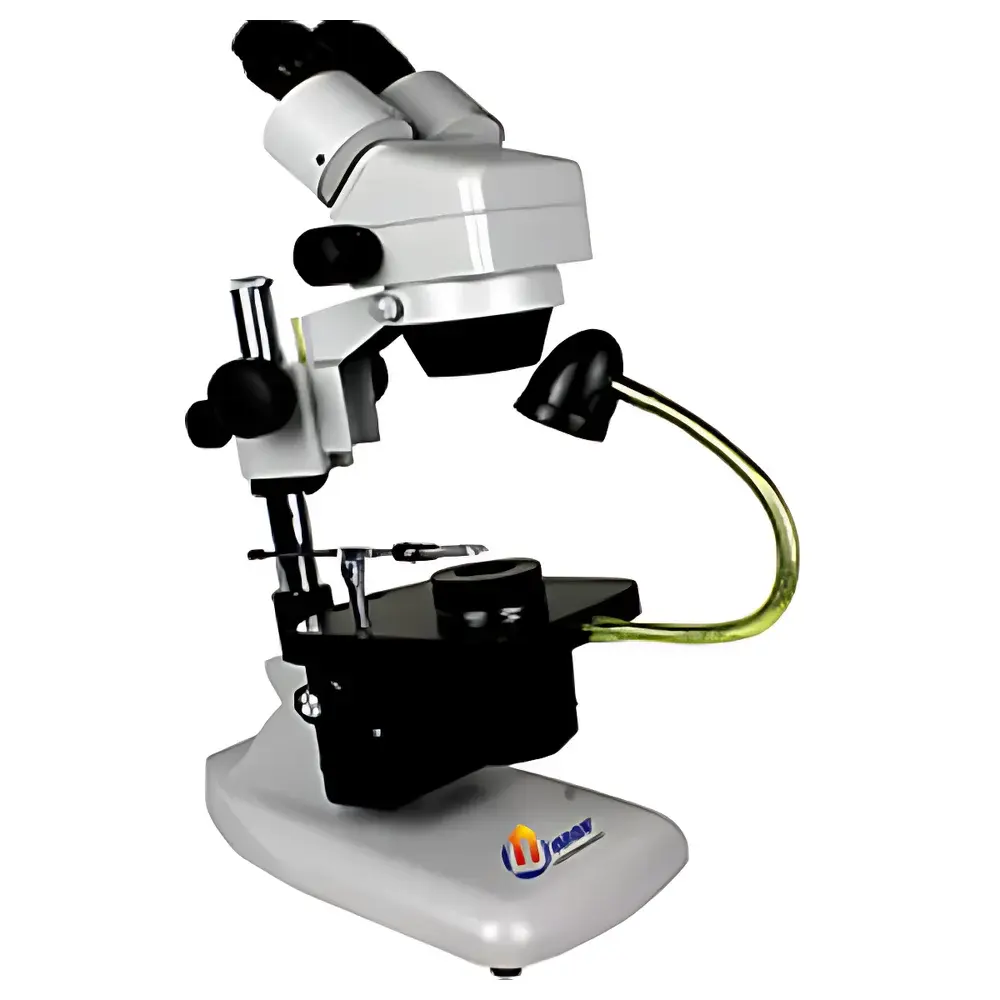
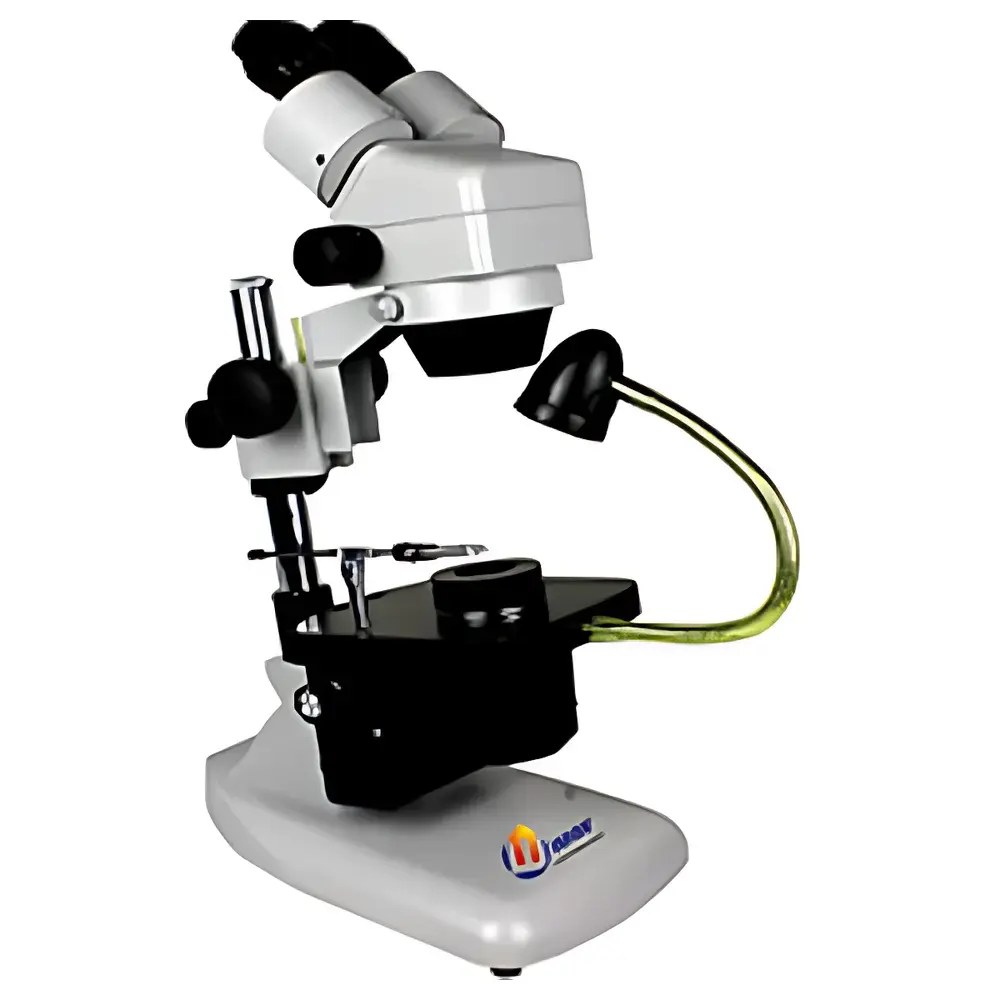
YANRUN BPAS-120 Stereo Gemological Microscope
| Brand | YANRUN |
|---|---|
| Origin | Shanghai, China |
| Manufacturer Type | Direct Manufacturer |
| Country of Origin | China |
| Model | BPAS-120 Stereo Gemological Microscope |
| Price | USD 1 (Reference Only) |
| Working Distance | 95 mm (extendable to 115 mm) |
| Zoom Range | 7×–45× continuous (expandable to 50×) |
| Eyepiece | Wide-field WF10×/23 mm |
| Interpupillary Adjustment | 55–75 mm |
| Focus Travel | 125 mm |
| Optional Accessories | Auxiliary Objectives (0.75× WD 105 mm |
Overview
The YANRUN BPAS-120 Stereo Gemological Microscope is an ergonomically engineered optical instrument designed specifically for gemstone identification, inclusion analysis, cutting assessment, and jewelry quality control in professional gemological laboratories, appraisal centers, and manufacturing workshops. Built upon a robust Greenough-type stereo optical path architecture, it delivers true stereoscopic imaging with high depth perception and minimal parallax—essential for precise three-dimensional evaluation of facet geometry, surface polish, internal strain patterns, and crystallographic features. Its coaxial illumination system and modular lighting interface support both incident and oblique illumination modes, enabling optimal contrast enhancement for refractive index estimation, birefringence detection, and pleochroism observation. The microscope conforms to the fundamental optical requirements outlined in ISO 11698 (Jewellery — Methods of examination of gemstones) and supports workflows aligned with GIA, AGS, and CIBJO documentation standards.
Key Features
- Continuous zoom optics with 7×–45× magnification range (expandable to 50× via auxiliary objective lenses), providing seamless transition between macroscopic inspection and fine structural analysis;
- Extended working distance of 95 mm (up to 115 mm with optional base extension), accommodating large cabochons, mounted settings, and rough specimens without obstruction;
- Wide-field 10×/23 mm eyepieces with interpupillary adjustment from 55 mm to 75 mm, ensuring anatomical compatibility across diverse user populations;
- 125 mm vertical focus travel—among the longest in its class—enabling stable focusing across highly variable sample heights, including prong-set rings and deep-carved artifacts;
- Modular illumination interface with tool-free lamp head rotation and multi-angle positioning, facilitating dynamic control over shadow direction, edge definition, and relief enhancement;
- Dual-purpose gem clamping system: steel-wire clamp (optimized for minimal girdle occlusion and full lateral visibility) and flat-jaw clamp (for fragile or irregularly shaped stones); both mount via standardized threaded holes on the stage periphery;
- Integrated polarizer module compatible with standard analyzer insertion slots, supporting systematic birefringence mapping, optic sign determination, and strain-induced interference pattern analysis.
Sample Compatibility & Compliance
The BPAS-120 accommodates a broad spectrum of gemological specimens—from loose faceted stones (0.5–30 mm diameter), cabochons, and pearl strands to mounted jewelry pieces up to 80 mm in height. Its open-stage design and adjustable clamping geometry eliminate positional constraints common in conventional metallurgical microscopes. All optical components utilize BK7-grade borosilicate glass with anti-reflective broadband coatings (400–700 nm), meeting spectral transmission requirements defined in ASTM E2309 (Standard Practice for Calibration of Microscopes). Mechanical construction adheres to ISO 10110-7 for surface quality of optical elements and incorporates corrosion-resistant stainless-steel fasteners compliant with ISO 3506-1. The unit is CE-marked for electromagnetic compatibility (EMC Directive 2014/30/EU) and low-voltage safety (LVD Directive 2014/35/EU).
Software & Data Management
While the BPAS-120 operates as a standalone optical platform, its standardized C-mount port (23.2 mm thread) enables direct coupling with industry-standard digital imaging systems—including USB 3.0 CMOS cameras (e.g., Lumenera Lt545) and HDMI-enabled capture modules. When integrated with certified gemology software suites (e.g., GemRay Pro, GemCad v7.2), the microscope supports image annotation with calibrated scale bars, inclusion mapping overlays, and report generation compliant with GLP audit trails. Metadata embedding (EXIF + custom XMP tags) ensures traceability of magnification, lighting configuration, and observer ID—critical for ISO/IEC 17025-accredited laboratory documentation.
Applications
- Gemstone identification and origin assessment via inclusion typology, growth zoning, and fluid inclusion morphology;
- Facet symmetry and polish quality evaluation per AGS Light Performance Standards;
- Setting integrity verification (prong wear, solder joint inspection, bezel fit accuracy);
- Colored stone treatment detection (dye penetration, fracture filling residue, laser drilling channels);
- Micro-abrasion and lapidary process monitoring during cutting and polishing;
- Educational demonstration of crystallographic orientation, cleavage planes, and twinning phenomena in mineral specimens.
FAQ
What auxiliary objectives are compatible with the BPAS-120?
The BPAS-120 accepts standardized M25.5×0.75 threaded auxiliary objectives: 0.75× (WD 105 mm), 1.5× (WD 47 mm), and 2× (WD 33 mm). Each maintains telecentricity and field flatness within ±0.02 mm across the FOV.
Is the polarizer module removable for routine brightfield use?
Yes—the analyzer rotates independently and can be fully withdrawn from the light path without tools, preserving native resolution and illumination uniformity.
Can the microscope be calibrated for measurement traceability?
When paired with a NIST-traceable stage micrometer (e.g., Edmund Optics #58-822), pixel-to-micron scaling is validated per ISO 10110-5. Routine calibration logs may be archived in accordance with ISO/IEC 17025 Clause 6.4.10.
Does the BPAS-120 meet FDA or CLIA requirements for clinical gem testing?
While not classified as a medical device, its optical stability, repeatability (<±0.5% magnification drift over 8 h), and documentation-ready output satisfy analytical instrument qualification (AIQ) prerequisites for forensic gemology under USP guidelines.




