
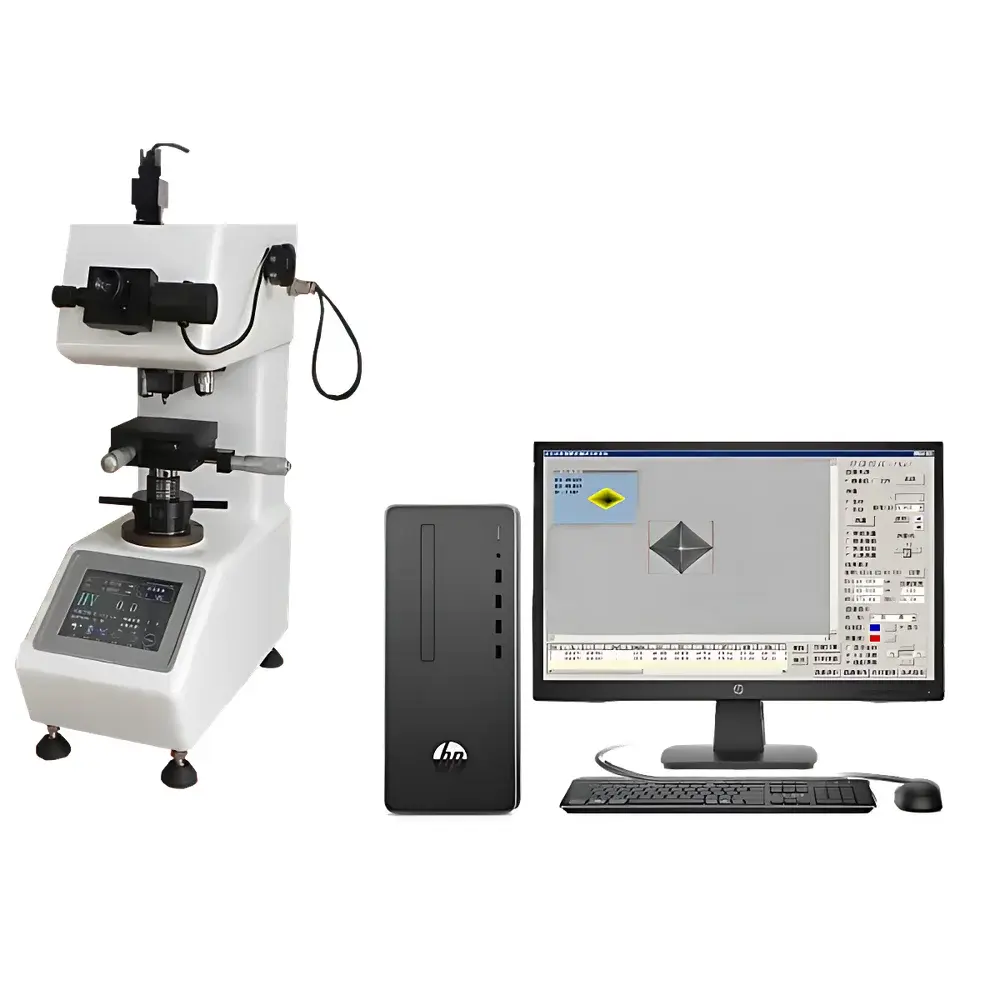
YANRUN HMAS-D1000SM Advanced Digital Microhardness Testing System with Integrated Image Analysis Software
| Brand | YANRUN |
|---|---|
| Origin | Shanghai, China |
| Manufacturer Type | Direct Manufacturer |
| Instrument Type | Digital Microhardness Tester |
| Measurement Range | 0.001–6000 HV |
| Test Forces | 10, 25, 50, 100, 200, 300, 500, 1000 gf (0.098–9.807 N) |
| Standards Compliance | GB/T 4340 |
| Total Magnification | 100× / 400× (optical), up to 1600× (digital) |
| Minimum Detectable Indentation Resolution | 0.013 µm |
| X-Y Stage Travel | 25 × 25 mm |
| Max Specimen Height | 65 mm |
| Data Storage | 60 test records on-device |
| Software | HMAS v5.x with Auto-Indent Recognition, SPC, 3D Indent Modeling, and Multi-format Reporting (PDF/Word/Excel) |
Overview
The YANRUN HMAS-D1000SM Advanced Digital Microhardness Testing System is a fully integrated microindentation instrument engineered for high-precision Vickers hardness measurement in research laboratories, metallurgical QA/QC departments, and advanced materials development facilities. Based on the principle of optical indentation metrology—where a diamond pyramid indenter (136° apex angle) is applied under controlled static load to produce a geometrically defined impression—the system quantifies material resistance via diagonal length measurement of the residual indent under calibrated magnification. Unlike conventional analog microhardness testers, the HMAS-D1000SM couples mechanical precision with digital image acquisition and AI-assisted analysis, enabling traceable, operator-independent hardness evaluation compliant with ISO 6507-1, ASTM E384, and GB/T 4340.1. Its dual-path observation architecture—simultaneous eyepiece viewing and real-time CCD imaging—ensures full transparency in measurement workflow, while the rigid aluminum alloy monolithic frame minimizes vibration-induced drift during long-duration dwell cycles.
Key Features
- Automated indentation imaging pipeline: High-resolution 5 MP CCD camera coupled with motorized Z-axis focus control and programmable LED illumination ensures consistent contrast across diverse surface finishes—including polished metals, thin films, nitrided layers, and brittle ceramics.
- Dual-mode operation: Manual turret positioning with tactile feedback for rapid setup; software-guided auto-positioning for repeatable multi-point mapping sequences.
- HMAS v5.x proprietary software suite: Implements real-time auto-indent detection using adaptive edge enhancement and sub-pixel centroid calculation—eliminating manual cursor placement error. Supports dynamic focus simulation (digital refocusing) to enhance depth-of-field perception without mechanical adjustment.
- Full-scale hardness reporting: Generates audit-ready reports per GLP/GMP requirements, including timestamped metadata, operator ID, calibration certificate traceability, statistical process control (SPC) charts (X̄-R, Cp/Cpk), and hardness gradient profiling across case-depth cross-sections.
- 3D indent reconstruction engine: Converts 2D optical impressions into parametric 3D surface models (width, length, depth, volume) using calibrated stereoscopic scaling algorithms—enabling quantitative assessment of plastic deformation behavior beyond standard HV calculation.
- Multi-standard hardness conversion: Real-time calculation across 16 scales (HV, HK, HBW, HRA–HR45T, etc.) per ASTM E140 and GB/T 1172, with user-definable material-specific correction factors.
Sample Compatibility & Compliance
The HMAS-D1000SM accommodates specimens up to 65 mm in height and 110 mm from column centerline, supporting standard metallographic mounts, coated substrates, heat-treated gears, turbine blades, and MEMS components. Its 10×/40× parfocal objective lens set (with optional 20×/50×/100× configurations) delivers diffraction-limited resolution at all magnifications, validated per ISO 14644-1 Class 5 cleanroom-compatible optical alignment protocols. All hardness values are traceable to national metrology institutes via factory-certified reference blocks (NIST-traceable HV 100–800 range). The system meets electromagnetic compatibility (EMC) requirements per IEC 61326-1 and electrical safety standards per IEC 61010-1. Software complies with FDA 21 CFR Part 11 for electronic records and signatures when configured with role-based access control and audit trail logging.
Software & Data Management
HMAS v5.x operates on Windows 10/11 x64 platforms and features a modular architecture designed for laboratory information management system (LIMS) integration via OPC UA or CSV/JSON export. Core modules include: (1) Live Imaging Dashboard with adjustable gamma, white balance, and 12 selectable background color presets optimized for low-contrast alloys (e.g., Al-Mg, Cu-Ni); (2) SPC Engine with real-time control charting, outlier detection (Dixon’s Q-test), and capability index computation; (3) Depth Profiling Toolkit for automated line-scan indentation arrays (up to 100 points) with interpolated hardness gradient curves; (4) Report Generator supporting PDF/A-1b archival format, Word .docx templates with institutional branding, and Excel .xlsx exports with embedded formulas for secondary analysis. All raw image files (.tiff) and measurement logs (.xml) are stored with SHA-256 checksums to ensure data integrity.
Applications
This system is routinely deployed for: case depth verification of carburized and nitrided steels per ISO 2639; intermetallic phase hardness mapping in Ni-based superalloys; coating adhesion assessment via microindentation fracture analysis; hardness homogeneity evaluation of additive-manufactured Ti-6Al-4V builds; quality gate testing of sintered tungsten carbide tooling; and thin-film hardness validation (e.g., DLC, TiN, Al₂O₃) down to 100 nm thickness using 10 gf loads. Its sub-micron resolution enables quantitative comparison of grain boundary vs. intragranular hardness in polycrystalline ceramics—a critical parameter in nuclear fuel pellet characterization.
FAQ
Does the HMAS-D1000SM support automated hardness mapping across large sample areas?
Yes—when paired with optional motorized X-Y-Z translation stages (sold separately), the HMAS software supports programmable grid-based indentation sequences with automatic stage repositioning and image stitching.
Can measurement data be exported to external statistical analysis tools like Minitab or JMP?
Absolutely—CSV exports include all raw pixel coordinates, dwell time, load, temperature, and environmental metadata required for multivariate regression modeling.
Is the system compatible with ISO/IEC 17025-accredited calibration workflows?
Yes—calibration certificates include uncertainty budgets per GUM (JCGM 100:2008), and software audit trails record every calibration event with digital signature and timestamp.
What maintenance intervals are recommended for long-term accuracy retention?
Annual verification using certified reference blocks is advised; optical path alignment checks every 6 months; and indenter tip inspection via SEM after every 5,000 indentations.
How does the “simulated focus” algorithm improve measurement repeatability?
It applies constrained deconvolution to compensate for minor defocus caused by thermal drift or specimen tilt—reducing diagonal length measurement variance by up to 42% compared to manual focusing, as verified in inter-laboratory round-robin studies (N=12 labs, p < 0.01).



