
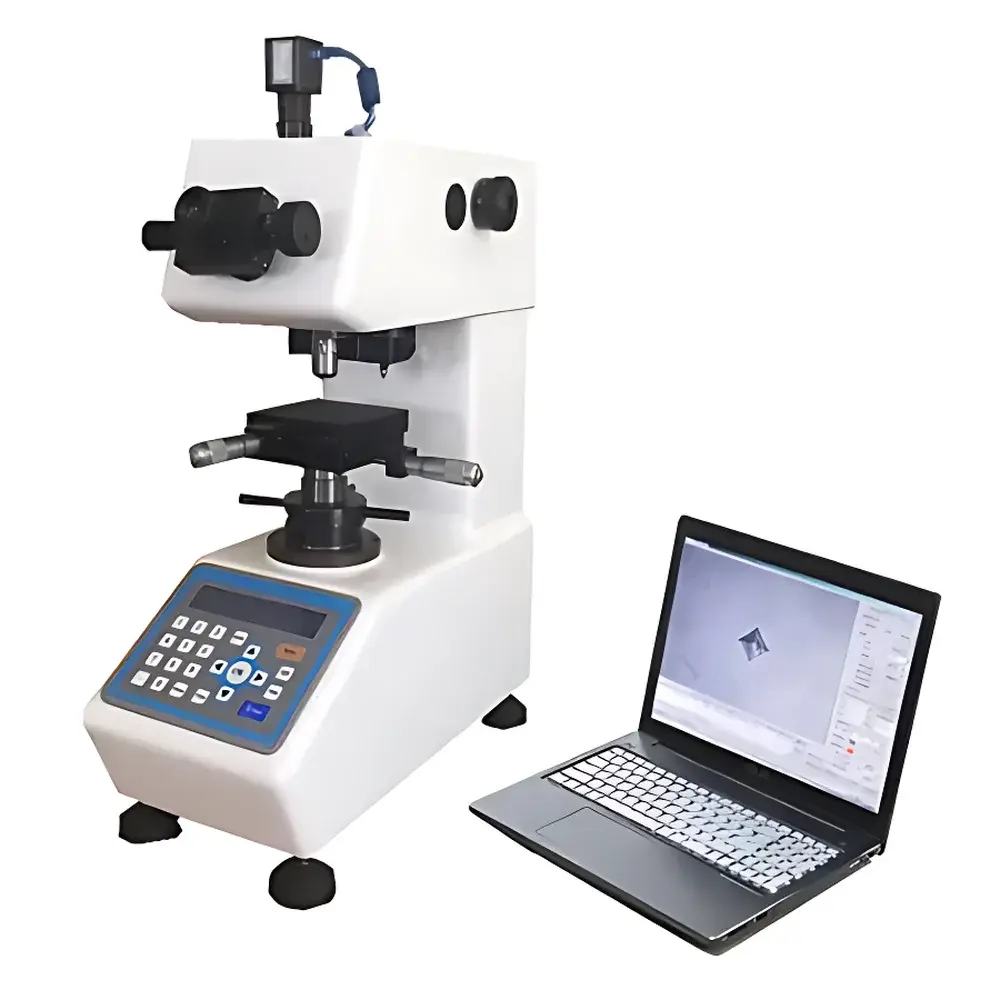
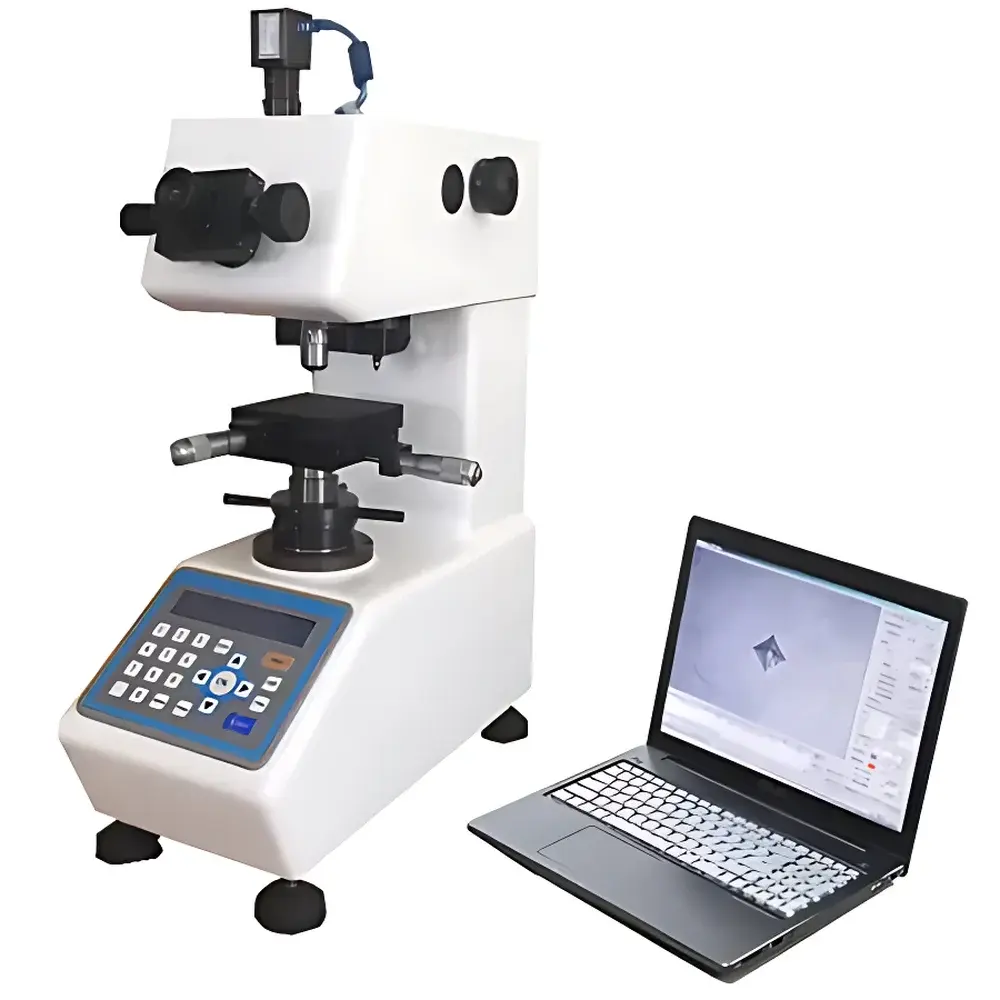
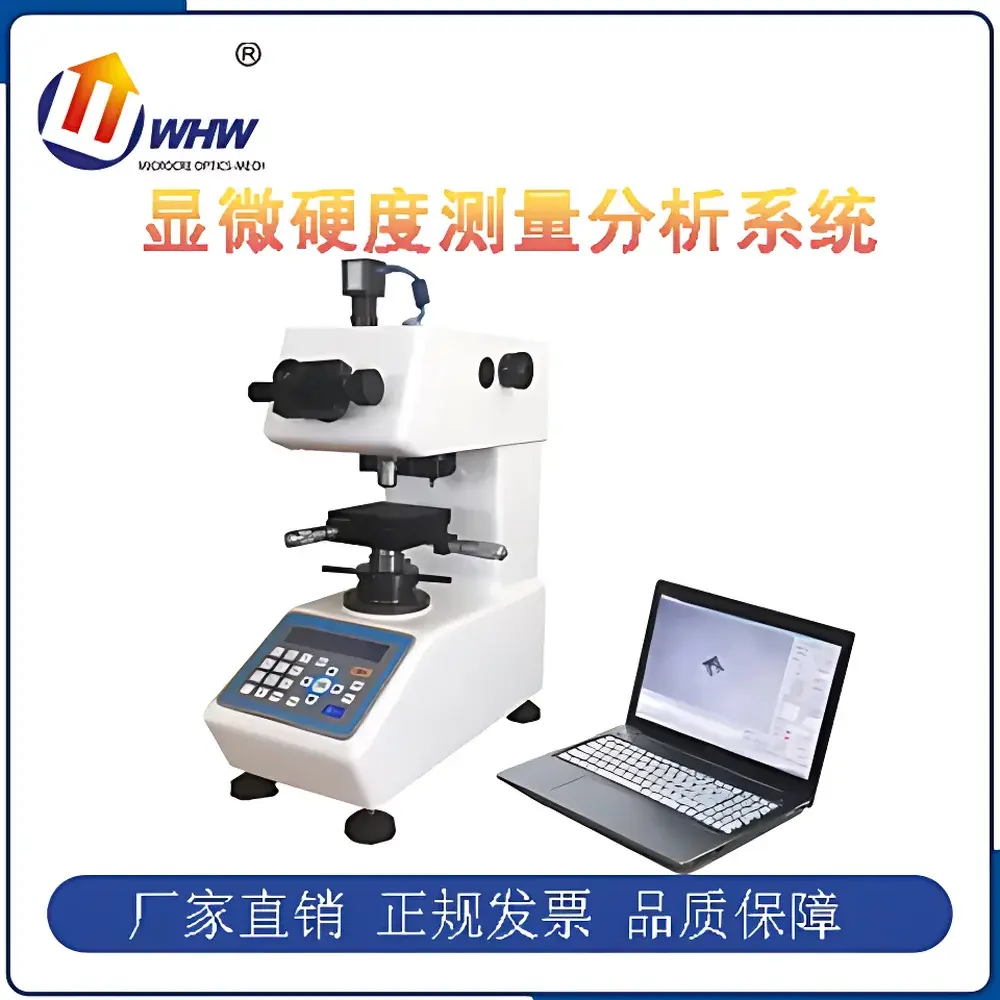
YANRUN HMAS-D1000Z Automated Microhardness Testing & Analysis System
| Brand | YANRUN |
|---|---|
| Origin | Shanghai, China |
| Manufacturer Type | OEM Manufacturer |
| Instrument Type | Automatic Microindentation Hardness Tester |
| Measurement Range | 0–6000 HV |
| Test Forces (8-step) | 0.098 N, 0.245 N, 0.490 N, 0.981 N, 1.961 N, 2.942 N, 4.903 N, 9.807 N |
| Equivalent in gf | 10 gf, 25 gf, 50 gf, 100 gf, 200 gf, 300 gf, 500 gf, 1000 gf |
| Indentation Standards | HV0.01–HV1 |
| Specimen Height Capacity | 55 mm |
| Depth from Indenter Axis to Chamber Wall | 110 mm |
| X–Y Stage Travel | 25 mm × 25 mm |
| Minimum Detectable Indentation Dimension | 0.5 µm |
| Total Optical Magnification | 400× (objective + eyepiece), ~1600× on monitor |
| Compliance | GB/T 4340.1–2009 (equivalent to ISO 6507-1 and ASTM E384) |
Overview
The YANRUN HMAS-D1000Z is an automated microhardness testing and analysis system engineered for precision measurement of Vickers hardness (HV) at low test loads—ranging from 10 gf (0.098 N) to 1000 gf (9.807 N). It operates on the principle of diamond pyramid indentation under controlled static load, followed by high-resolution optical imaging and digital image analysis to determine diagonal lengths of the residual impression. Designed for metrological rigor in R&D laboratories, quality control departments, and materials science facilities, the system supports full compliance with international standards including ISO 6507-1, ASTM E384, and GB/T 4340.1–2009. Its dual-path observation architecture enables simultaneous visual inspection via 10× mechanical eyepiece and real-time digital capture through a calibrated CCD sensor, ensuring traceability, repeatability, and operator-independent measurement outcomes.
Key Features
- Fully automated indentation cycle—including loading, dwell (0–99 s adjustable in 1-s increments), and unloading—with programmable force application rate of 0.05 mm/s.
- Motorized or manual turret selection between 10× (observation) and 40× (measurement) objectives; total magnification up to 1600× on display via integrated digital imaging pipeline.
- Precision-machined aluminum alloy frame with cast-body structural integrity, minimizing thermal drift and mechanical vibration during long-duration tests.
- High-sensitivity CCD imaging system coupled with proprietary HMAS-D software for sub-micron-level indent detection (0.5 µm resolution).
- Dual calibration path: hardware-based micrometer stage (0.01 mm mechanical readout) and software-driven pixel-to-micron mapping with auto-calibration routines.
- Intelligent image enhancement suite including Digital Focus Simulation—algorithmic sharpening that emulates optical refocusing without physical lens adjustment—improving edge contrast for small or shallow indents (e.g., thin films, nitrided layers).
- Real-time SPC-compatible data logging with statistical process control templates aligned to AIAG and ISO/IEC 17025 reporting frameworks.
Sample Compatibility & Compliance
The HMAS-D1000Z accommodates specimens up to 55 mm in height and 110 mm laterally from the indenter axis—ideal for cross-sectional analysis of case-hardened components, coatings, weld zones, and metallurgical samples. Its XY translation stage (25 × 25 mm travel, 0.01 mm vernier scale) allows precise positioning of heat-affected zones, diffusion boundaries, or multi-phase microstructures. The system supports standardized test methods for depth profiling of carburized, nitrided, and induction-hardened layers per ASTM E92, ISO 26692, and JIS Z 2244. All hardness calculations adhere to GB/T 4340.1–2009, which mirrors ISO 6507-1 requirements for uncertainty estimation, environmental condition documentation, and verification of indenter geometry. Optional fixtures—including thin-sheet clamps, wire holders, and universal vise mounts—extend usability to non-planar or fragile specimens without compromising alignment fidelity.
Software & Data Management
The HMAS-D software platform is a validated, stand-alone Windows application built for GLP/GMP environments. It features full 21 CFR Part 11 compliance-ready audit trails, user access levels (admin/operator/observer), electronic signatures, and immutable raw-data archiving. Core capabilities include:
- Automated indent recognition and diagonal length calculation using adaptive threshold segmentation and sub-pixel interpolation.
- 3D topographic reconstruction of indent geometry—displaying width, depth, and aspect ratio with interactive rotation and scaling.
- Hardness gradient mapping across linear scan paths, generating ISO-compliant hardness distribution curves with confidence intervals.
- Multi-standard hardness conversion (HV, HK, HRA–HRC, HRN–HRT, HBW) with NIST-traceable lookup tables.
- SPC module supporting Cp/Cpk indices, control charts (X̄–R, I-MR), and out-of-spec alerts tied to user-defined tolerance bands.
- Report generation in PDF, Word (.docx), and Excel (.xlsx) formats—including embedded metadata (operator ID, timestamp, calibration certificate ID, environmental log).
All reports retain embedded image thumbnails, measurement coordinates, and raw pixel data—ensuring full forensic reproducibility during regulatory audits.
Applications
This system serves advanced characterization workflows in academia, aerospace, automotive, medical device manufacturing, and semiconductor packaging. Typical use cases include:
- Depth-resolved hardness profiling of surface-treated alloys (e.g., Ti-6Al-4V plasma-nitrided layers, AISI 52100 bearing steel carburized cases).
- Thin-film mechanical property assessment—such as DLC (diamond-like carbon), TiN, or Al₂O₃ PVD coatings—where traditional macro-indentation lacks spatial resolution.
- Quality assurance of additive-manufactured metal parts, evaluating local hardness variations across build layers and heat-affected regions.
- Failure analysis of brittle intermetallic phases in solder joints or brazed assemblies via crack-length-based brittleness rating per ASTM E384 Annex A3.
- Calibration verification of reference blocks used in accredited hardness laboratories (ISO/IEC 17025 scope).
FAQ
Does the HMAS-D1000Z support remote operation and networked data export?
Yes—the system integrates Ethernet connectivity and supports OPC UA and TCP/IP protocols for integration into MES or LIMS platforms. Raw image datasets and measurement logs can be exported via FTP or SMB shares with configurable folder structures.
Is the diamond pyramid indenter certified to ISO 6507-2 specifications?
Each unit ships with a NIST-traceable diamond indenter certified to ISO 6507-2:2018, including angular tolerance (136° ± 0.5°), face symmetry, and tip radius verification report.
Can the software perform batch analysis across multiple sample images?
Yes—HMAS-D includes batch processing mode with template-driven parameter inheritance, enabling consistent measurement logic across hundreds of indents from different fields of view or timepoints.
What environmental conditions are required for optimal accuracy?
Operation is specified for ambient temperatures of 10–35°C, relative humidity ≤80% non-condensing, and vibration isolation per ISO 25378 Class 2. Calibration verification is recommended before each shift when used in production QA settings.
Are firmware and software updates provided post-purchase?
YANRUN offers free minor version upgrades for the lifetime of the instrument; major releases (v3.x+) are available under optional annual maintenance contracts including on-site validation support.
Related Products



