
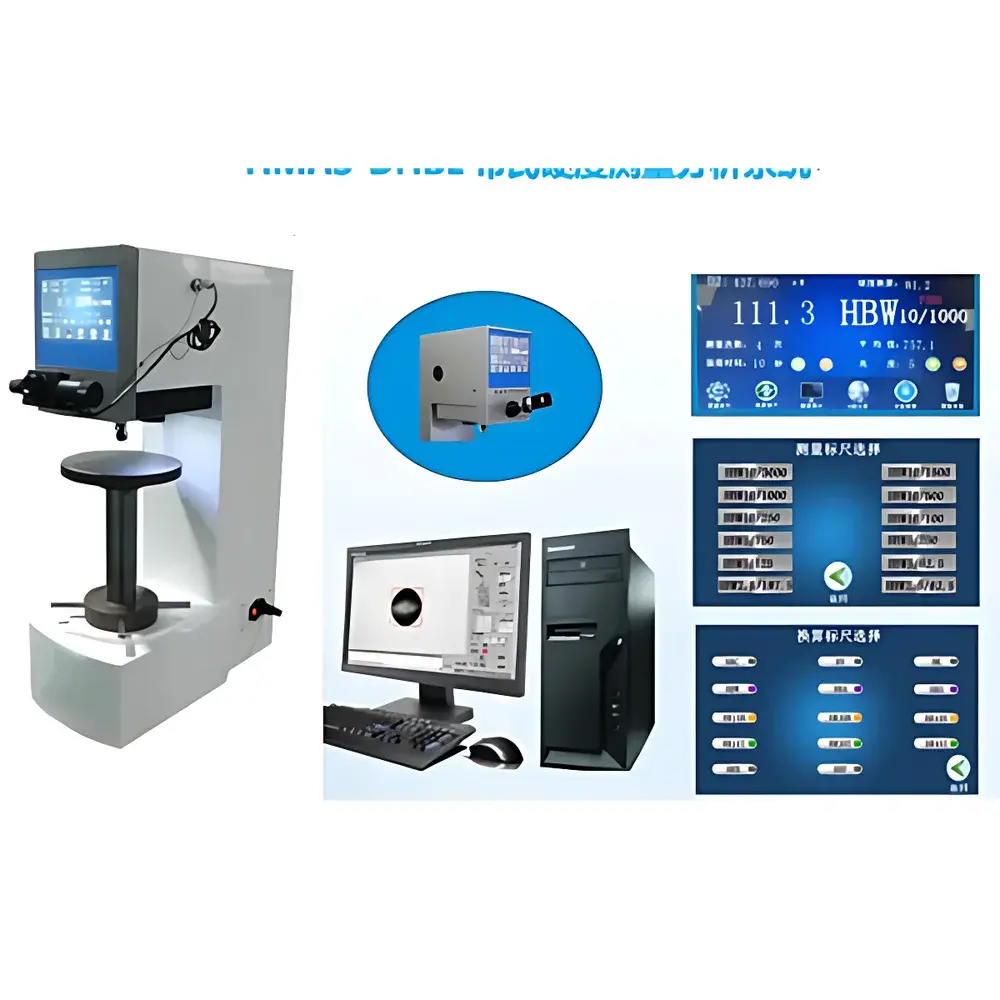
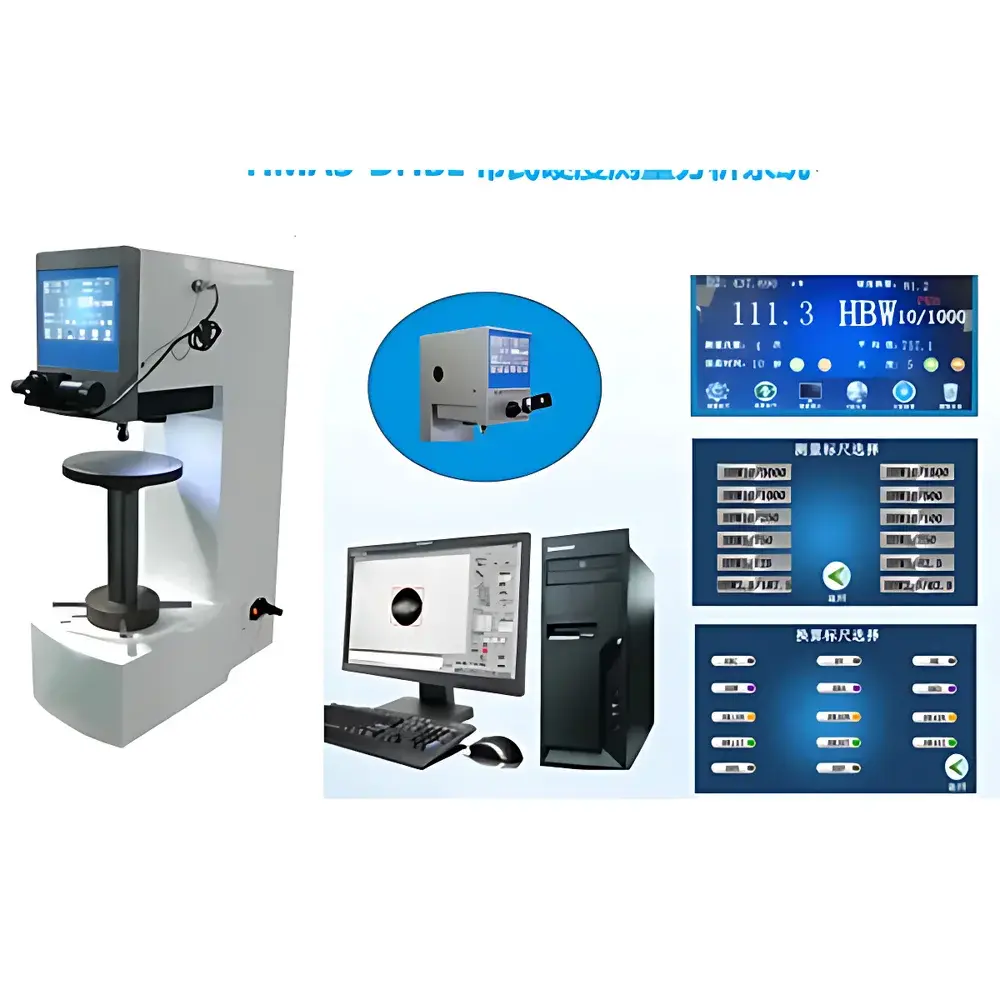
YANRUN HMAS-DHBL Brinell Hardness Measurement & Analysis System
| Brand | YANRUN |
|---|---|
| Origin | Shanghai, China |
| Manufacturer Type | Direct Manufacturer |
| Country of Origin | China |
| Model | HMAS-DHBL |
| Instrument Type | Brinell Hardness Tester |
| Hardness Range | 8–650 HBW |
| Test Forces | 62.5 kgf, 100 kgf, 125 kgf, 187.5 kgf, 250 kgf, 500 kgf, 750 kgf, 1000 kgf, 1500 kgf, 3000 kgf |
| Maximum Specimen Height | 235 mm |
| Depth from Indenter Center to Column | 155 mm |
| Indenter Balls | Ø2.5 mm, Ø5 mm, Ø10 mm Tungsten Carbide |
| Digital Eyepiece Magnification | 20× |
| Eyepiece Resolution | 0.5 µm |
| Load Duration | 0–60 s (adjustable in 1-s increments) |
| Hardness Scale Conversion | HRA, HRB, HRC, HRD, HEF, HK, HV, HR15N/30N/45N, HR15T/30T/45T, HBW |
| Compliance | GB/T 231.2, JJG 150 |
| Data Storage | Up to 30 test records |
| Loading Control | Motor-driven, closed-loop force feedback |
| Power Supply | AC 220 V |
| Dimensions (W×D×H) | 520 × 230 × 750 mm |
| Weight | ~130 kg |
Overview
The YANRUN HMAS-DHBL Brinell Hardness Measurement & Analysis System is an automated, image-based hardness testing platform engineered for precision Brinell hardness evaluation in metallurgical laboratories, quality control departments, and materials research facilities. It operates on the fundamental Brinell principle—applying a standardized spherical indenter (tungsten carbide ball) under controlled static load to produce a permanent indentation on the material surface; hardness is then calculated from the measured indentation diameter using the ISO 6506-1 and ASTM E10 equations. Unlike superficial methods, Brinell testing yields large-diameter impressions that average microstructural heterogeneity—making it especially suitable for coarse-grained materials such as cast iron, forged steels, aluminum alloys, copper, and soft non-ferrous metals. The HMAS-DHBL integrates mechanical loading, high-resolution digital imaging, and advanced metrology software into a single robust architecture designed for repeatability, traceability, and regulatory alignment.
Key Features
- Motor-driven, closed-loop force control ensures precise application and maintenance of test loads across all 10 standard levels (62.5–3000 kgf), minimizing operator influence and enhancing reproducibility.
- Dual-path optical system: simultaneous visual observation via calibrated 20× digital eyepiece (0.5 µm resolution) and real-time CCD imaging for computer-assisted analysis.
- Automated indentation detection and measurement powered by proprietary HMAS software—eliminating manual caliper use and reducing human measurement variability.
- True 3D indentation modeling capability: reconstructs depth, width, and aspect ratio from 2D image data using geometric interpolation algorithms; supports interactive rotation and dimensional overlay.
- Smart simulated focusing algorithm enhances edge contrast and sharpness of low-SNR indentations without physical refocusing—critical for thin coatings or low-contrast surfaces.
- Twelve user-selectable background color schemes optimize contrast for diverse sample types: nitrided steel, anodized aluminum, brass, gray iron, and heat-treated forgings.
- Built-in thermal printer enables immediate hardcopy output of test parameters, indentation images, and calculated values—supporting GLP-compliant lab notebooks.
Sample Compatibility & Compliance
The HMAS-DHBL accommodates specimens up to 235 mm in height and 155 mm in depth from the column axis—enabling evaluation of large castings, structural components, and billets. Its modular test table configuration (flat, V-groove, and medium platforms) ensures stable positioning of irregular geometries. All hardness measurements comply with national and international standards including GB/T 231.2 (Chinese equivalent of ISO 6506-2), JJG 150 (calibration verification protocol), and ASTM E10. The system supports full traceability through timestamped test logs, audit-ready SPC reports, and optional 21 CFR Part 11–compliant electronic signatures when deployed with validated network configurations. Calibration verification is performed using certified reference blocks (low/medium/high HBW ranges), with documented uncertainty budgets aligned to ISO/IEC 17025 requirements.
Software & Data Management
The HMAS software suite functions as a dedicated metrology workstation—not merely a viewer but a full-cycle hardness analytics engine. It provides real-time image acquisition, auto-thresholded indentation segmentation, sub-pixel diameter calculation, and automatic HBW derivation per ISO 6506-1. Statistical process control (SPC) tools include X-bar/R charts, Cp/Cpk indices, outlier detection, and trend analysis across batches or time series. Reporting modules generate export-ready files in PDF (print-optimized), Excel (.xlsx with raw + derived data), and Word (.docx with customizable templates). All reports embed metadata: operator ID, equipment ID, calibration date, environmental conditions (optional input), and digital signatures. Image archives support lossless TIFF storage with EXIF-tagged acquisition parameters. Audit trails record every user action—including measurement edits, report exports, and configuration changes—with immutable timestamps.
Applications
This system serves critical roles across multiple industrial and academic domains: incoming raw material verification for foundries and forging plants; post-heat-treatment validation of case depth uniformity in carburized or nitrided components; R&D characterization of new alloy systems; failure analysis of fractured machine parts; and teaching labs where students require visual, quantitative understanding of plastic deformation behavior. Its ability to resolve small indentations on thin films (<50 µm) and quantify depth profiles makes it applicable to surface engineering studies—particularly where Brinell’s large impression size correlates more reliably with bulk mechanical response than microhardness methods.
FAQ
What Brinell test forces and ball diameters does the HMAS-DHBL support?
It offers 10 selectable test forces (62.5–3000 kgf) and three tungsten carbide indenters (Ø2.5 mm, Ø5 mm, Ø10 mm), enabling full compliance with all 12 standard Brinell scales (e.g., HBW 10/3000, HBW 5/750).
Does the system meet international calibration standards?
Yes—measurements adhere to GB/T 231.2 (ISO 6506-2 equivalent) and JJG 150; verification uses NIST-traceable hardness reference blocks with documented uncertainties.
Can the software generate compliant quality reports for ISO 9001 or IATF 16949 audits?
Yes—reports include operator ID, equipment ID, calibration status, environmental notes, statistical summaries, and digital signatures; raw data exports support third-party SPC software integration.
Is remote operation or network data sharing supported?
The HMAS software supports LAN-connected deployment; test data can be exported to shared drives or LIMS via scheduled CSV/PDF dumps—no proprietary cloud dependency.
What maintenance is required for long-term accuracy?
Annual verification using certified reference blocks is recommended; routine cleaning of optical paths and indenter surfaces, plus biannual calibration of load cell and encoder subsystems per manufacturer guidelines.



