
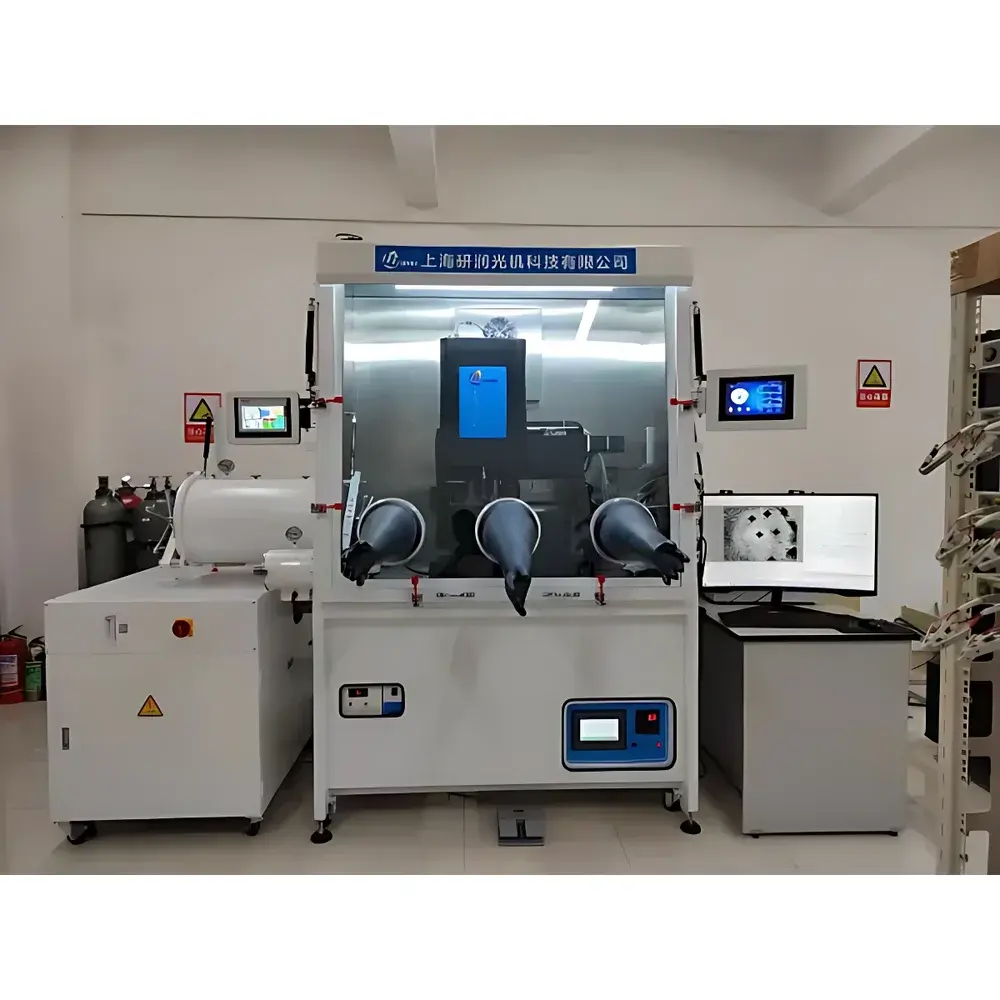
YANRUN HMAS-HT1500CM Full-Temperature-Field High-Temperature Vickers Hardness Tester (up to 1400 °C)
| Brand | YANRUN |
|---|---|
| Origin | Shanghai, China |
| Manufacturer Type | Manufacturer |
| Country of Origin | China |
| Model | HMAS-HT1500CM |
| Instrument Type | Vickers Hardness Tester |
| Temperature Range | 400–1400 °C |
| Max Load Capacity | 30 kgf (optional up to 150 kgf) |
| Objective Working Temp | ≤1400 °C (10× or 20×) |
| Load Control | Continuous variable loading with real-time force–time acquisition |
| Hold Time | Up to 72 h |
| Temperature Uniformity | ±5 °C across 100×80×80 mm furnace cavity |
| Thermal Stability | ±1 °C |
| Heating Rate | 1–40 °C/min |
| Optical Resolution | 1.44 µm (10×), optional 1.19 µm (20×) |
| XY Motion Precision | ≤±1 µm |
| Z-Axis Resolution | ≤0.1 µm |
| Sample Size Limit | Ø30×30 mm |
| Quick-Change Cycle | ≤50 s at 1400 °C |
| Cooling | Dual-mode (water + inert gas), <5 s cooldown to <55 °C |
Overview
The YANRUN HMAS-HT1500CM is a full-temperature-field high-temperature Vickers hardness tester engineered for in situ mechanical property characterization of advanced materials under extreme thermal conditions—from 400 °C to 1400 °C. Unlike conventional hot-stage microhardness systems that rely on localized heating or limited thermal stability, the HMAS-HT1500CM maintains a uniform, fully enclosed temperature field across its entire measurement volume (100 × 80 × 80 mm), enabling true isothermal indentation, real-time optical observation, and uninterrupted force–time data acquisition during loading, dwell, and unloading phases. Its core principle leverages high-temperature-compatible load train architecture, refractory optical path design, and multi-axis synchronized motion control—all calibrated and validated for operation at sustained 1400 °C. This system supports ASTM E384, ISO 6507, and GB/T 4340-compliant Vickers hardness testing while extending metrological rigor into regimes previously inaccessible to standard hardness instrumentation.
Key Features
- Full-temperature-field furnace with MoSi2 U-shaped heating elements and S-type Pt–Rh thermocouples, delivering ±1 °C thermal stability and ≤±5 °C axial/radial gradient over the active test zone.
- High-temperature dynamic loading module with 0.1–30 kgf range (extendable to 150 kgf), featuring real-time force feedback via high-stability high-temp load cells and sub-0.01% FS resolution for force–time modeling.
- 1400 °C-rated optical imaging system with 10× objective (1000× system magnification; 1.44 µm resolution) and optional 20× objective (2000×; 1.19 µm), both qualified for continuous operation up to 50 hours at maximum temperature.
- Multi-axis high-precision motion control (up to 9 axes), including XY positioning (±1 µm repeatability), Z-axis indentation (0.1 µm resolution), and independent sample lift (0–60 mm), all operating within the same thermal envelope.
- Integrated rapid sample exchange mechanism achieving ≤50 s cycle time at 1400 °C—enabling high-throughput comparative testing across multiple specimens without thermal cycling.
- Dual-cooling architecture: closed-loop water cooling (±0.3 °C stability, 13 L/min flow) and pulsed inert-gas quenching (≤5 s to <55 °C), ensuring thermal management integrity for repeated high-temp cycles.
- Modular glovebox integration (O2/H2O ≤1 ppm) with vacuum transition lock and optional multi-station configuration for oxidation-sensitive samples.
Sample Compatibility & Compliance
The HMAS-HT1500CM accommodates cylindrical or disc-shaped specimens up to Ø30 × 30 mm, compatible with refractory metals (e.g., Mo, Nb, W alloys), ceramic matrix composites (CMCs), ultra-high-temperature ceramics (UHTCs), nuclear fuel cladding materials, and thermal barrier coatings (TBCs). All mechanical and optical subsystems are designed to meet GLP-aligned operational traceability requirements. Force calibration follows ISO 376 procedures using NIST-traceable deadweight standards; temperature calibration is verified per ASTM E220 against reference thermocouples. The system supports audit-ready data logging compliant with FDA 21 CFR Part 11 when configured with electronic signature and access-controlled user roles. Optional documentation packages include IQ/OQ protocols aligned with ISO/IEC 17025 laboratory accreditation frameworks.
Software & Data Management
Control and analysis are executed via a wall-mounted industrial PC running YANRUN’s proprietary HT-Hardness Suite v4.x—a deterministic real-time OS environment optimized for synchronized thermal, mechanical, and optical data capture. The software acquires force–time curves at ≥1 kHz sampling, overlays live video with dynamic scale bars and temperature metadata, and automatically identifies Vickers indent geometry (d1, d2) using edge-detection algorithms validated per ISO 14577 Annex A. All raw datasets—including thermal profiles, motor encoder positions, load cell outputs, and timestamped image sequences—are stored in HDF5 format with embedded calibration coefficients and operator annotations. Export options include CSV, MATLAB .mat, and ASTM E1445-compliant XML reports. Remote monitoring and secure data export are supported via TLS-encrypted Ethernet interface; no cloud dependency or third-party telemetry is implemented.
Applications
- In situ creep–hardness coupling studies on turbine blade superalloys under simulated service temperatures.
- Thermo-mechanical fatigue evaluation of SiC/SiC composites for next-generation nuclear reactors.
- Fracture toughness derivation (KIC) via indentation crack length analysis at elevated temperatures, per ASTM C1327.
- High-temperature phase transformation mapping through sequential indentation arrays across controlled thermal gradients (ramp/soak/cool).
- Qualification of thermal spray coatings (e.g., YSZ, La2Zr2O7) for aerospace applications under representative operating conditions.
- Development and validation of constitutive models linking hardness, yield stress, and homologous temperature in refractory intermetallics.
FAQ
What is the maximum continuous operating temperature of the optical path?
Both the 10× and 20× objectives are rated for uninterrupted operation at ≤1400 °C for up to 50 hours per cycle, with thermal expansion compensation built into the lens mount and focus drive.
Can the system perform hardness testing under inert or vacuum atmosphere?
Yes—the base configuration includes a glovebox option with O2/H2O ≤1 ppm; vacuum transition lock and optional large-volume chamber support pressures down to 10−3 Pa.
Is long-term dwell testing (e.g., >24 h) supported at 1400 °C?
Yes—72-hour dwell capability is standard, with active thermal drift compensation and real-time force recalibration during extended holds.
How is force calibration maintained at high temperature?
Calibration is performed offline using traceable deadweights at ambient and at three intermediate temperatures (600 °C, 1000 °C, 1400 °C); in situ verification uses a secondary high-temp reference sensor integrated into the load train.
Does the system support automated multi-point hardness mapping?
Yes—programmable XY grid patterns with auto-focus, auto-indent, and auto-image capture are fully supported, including temperature-synchronized step-and-hold sequences.



