
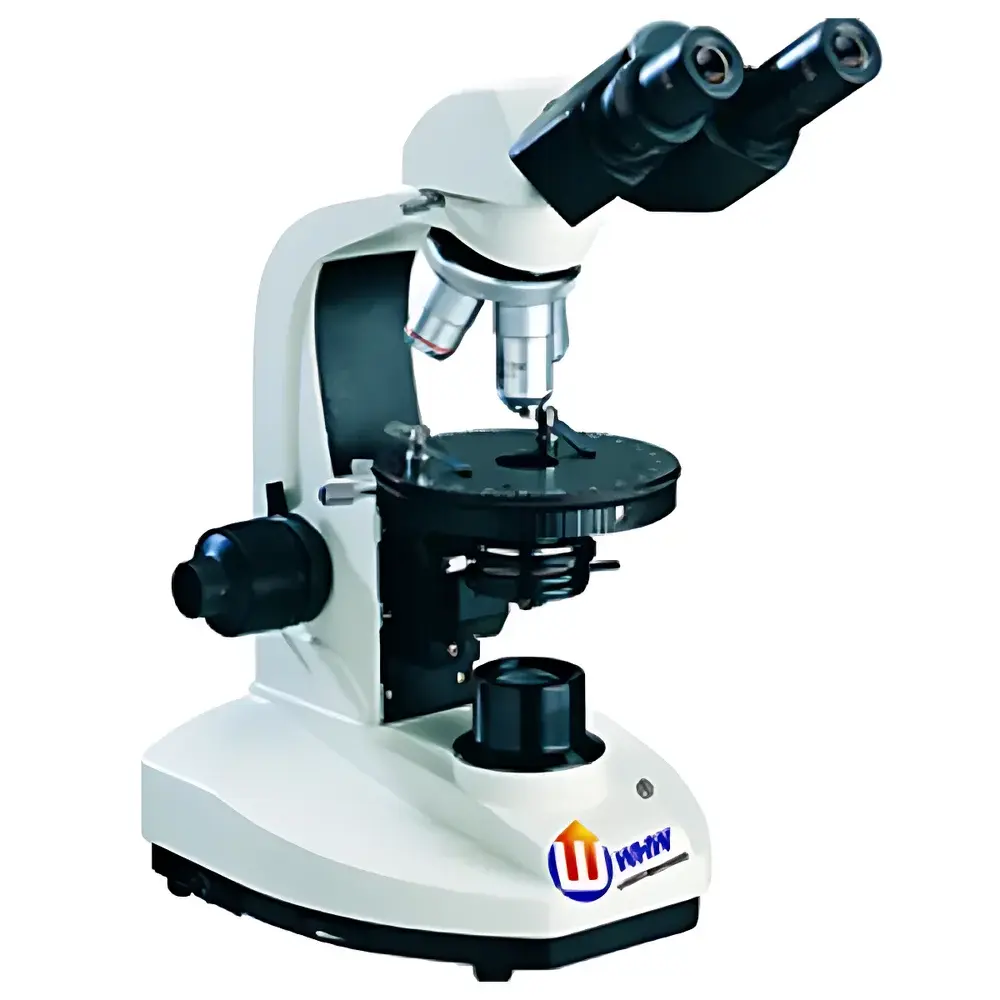
YANRUN PM-10 Upright Polarizing Microscope
| Brand | YANRUN |
|---|---|
| Origin | Shanghai, China |
| Manufacturer Type | Direct Manufacturer |
| Product Category | Domestic (China-Made) |
| Model | PM-10 Upright Polarizing Microscope |
| Price | USD 1 (Base Unit, Ex-Works) |
| Optical Magnification | 40×–1000× |
| Eyepieces | Wide-Field WF10× (Φ18 mm) |
| Objectives | Achromatic 4×/0.10, 10×/0.25, 40×/0.65 (spring-loaded), 100×/1.25 (spring-loaded, oil-immersion) |
| Binocular Head | Inclined 30°, interpupillary adjustment |
| Analyzer | Sliding-type, removable |
| Focusing Mechanism | Coaxial coarse/fine focus |
| fine focus graduation | 2 µm |
| Nosepiece | Four-position, inward-rolling ball bearing centering |
| Stage | PM-10 — rotating stage (Φ120 mm) |
| PM-10A — dual-layer mechanical stage (135 mm × 125 mm) with integrated Φ100 mm rotating insert (X–Y travel | 75 mm × 35 mm) |
| Condenser | Abbe type, NA 1.25, vertically adjustable |
| Filters | Blue filter, ground glass diffuser |
| Polarizer | 360° rotatable, graduated scale |
| Illuminator | 6 V / 20 W halogen lamp, continuously variable intensity control |
| Optional Accessories | WF16× (Φ11 mm) or reticle eyepiece (10×, 0.1 mm/div) |
Overview
The YANRUN PM-10 Upright Polarizing Microscope is a precision-engineered optical instrument designed for quantitative birefringence analysis, crystallographic orientation mapping, and anisotropic material characterization in geological, metallurgical, pharmaceutical, and polymer laboratories. Based on the classic transmitted-light polarized light microscopy (PLM) principle, the system employs orthogonal linear polarization—generated by a rotatable polarizer (under the condenser) and a sliding analyzer (above the objective)—to reveal stress-induced birefringence, crystallinity, extinction angles, and interference color patterns in thin sections and bulk specimens. Its upright configuration supports standard slide-based sample handling while maintaining compatibility with routine histological and mineralogical preparation protocols. The microscope conforms to ISO 8578:2017 (microscopes — nomenclature and terminology) and meets essential optical performance criteria defined in ASTM D4100 (standard guide for polarized light microscopy of polymers) and ISO 10477 (geological thin section analysis).
Key Features
- Optical train optimized for high-contrast polarized imaging: achromatic objectives with anti-reflection coatings minimize chromatic aberration across visible wavelengths (400–700 nm), ensuring accurate retardation measurement and reliable Michel-Levy chart correlation.
- Rotatable 360° graduated polarizer and push-pull analyzer enable precise angular alignment for extinction angle determination and conoscopic observation setups.
- Dual-stage configurations: PM-10 offers a dedicated Φ120 mm rotating stage ideal for rapid crystal orientation surveys; PM-10A integrates a large-area mechanical stage (75 mm × 35 mm travel) with coaxial Φ100 mm rotation for multi-point positional repeatability during systematic thin-section scanning.
- NA 1.25 Abbe condenser with centering and height adjustment ensures optimal Köhler illumination for both brightfield and crossed-polarized modes, supporting full numerical aperture utilization up to 100× oil immersion.
- Coaxial coarse/fine focusing system with 2 µm fine-focus graduation, mechanical lock, and hard-stop limits guarantees reproducible Z-axis positioning—critical for serial focal plane acquisition and interference figure documentation.
- Halogen illumination (6 V / 20 W) provides stable, color-temperature-consistent output (≈3200 K); continuous dimming preserves filament life and avoids thermal drift during extended acquisition sessions.
Sample Compatibility & Compliance
The PM-10 accommodates standard 1″ × 3″ (25 mm × 75 mm) glass slides and coverslips (0.13–0.17 mm thickness), as well as polished metallographic mounts and polymer films up to 2 mm thick. It supports routine sample preparation methods including epoxy-embedded rock thin sections (30 µm), hot-stage mounting for thermal birefringence studies, and aqueous or glycerol-mounted biological anisotropic tissues. All optical components comply with RoHS Directive 2011/65/EU. Mechanical design adheres to IEC 61000-6-2 (immunity) and IEC 61000-6-3 (emission) standards. While not certified for GMP/GLP environments out-of-box, the system supports audit-ready documentation when paired with optional trinocular head and FDA 21 CFR Part 11–compliant imaging software (via third-party integration).
Software & Data Management
The PM-10 operates as a hardware platform compatible with industry-standard machine vision frameworks. Optional USB/VIDEO and digital camera interfaces allow seamless integration with open-source (e.g., Ocular, MicroManager) or commercial image acquisition suites (e.g., NIS-Elements, ZEN Blue). CCD relay lenses with calibrated reticles (0.5× with 0.1 mm/div graticule) support semi-quantitative linear birefringence estimation and grain size analysis per ASTM E112. Metadata embedding (objective magnification, polarizer angle, exposure time) is supported via EXIF-compatible drivers. Raw TIFF capture enables post-acquisition linearization, background subtraction, and RGB channel decomposition for retardation quantification using Jones matrix modeling.
Applications
- Geoscience: Identification of mineral species, twinning behavior, and deformation microstructures in petrographic thin sections.
- Materials Science: Assessment of residual stress in tempered glass, polymer extrusion anisotropy, and liquid crystal domain alignment.
- Pharmaceuticals: Polymorph screening of active pharmaceutical ingredients (APIs), detection of crystalline vs. amorphous phases in lyophilized formulations.
- Metallurgy: Evaluation of grain boundary birefringence in aluminum alloys and phase distribution in duplex stainless steels.
- Forensics: Fiber identification (cellulose vs. synthetic polymer), paint chip layer analysis, and gunshot residue morphology under crossed polars.
FAQ
Is the PM-10 suitable for quantitative retardation measurement?
Yes—when used with calibrated retardation standards (e.g., quartz wedge or Berek compensator, sold separately) and appropriate imaging software, it supports semi-quantitative Δn·d calculation within ±5% uncertainty at 550 nm wavelength.
Can the microscope be upgraded for fluorescence work?
No—the optical path lacks dichroic beam splitters and excitation filter slots; fluorescence capability requires a dedicated epi-illuminated platform.
What is the maximum specimen height clearance?
With the 4× objective and condenser fully lowered, vertical working distance is approximately 22 mm—sufficient for most standard slides and low-profile metallographic mounts.
Does the system include strain-free optics?
All objectives and the eyepiece barrel are strain-free certified per ISO 10477 Annex B; however, the standard halogen illuminator introduces minor thermal stress—use of a DC-stabilized power supply is recommended for long-duration polarimetric measurements.
Are replacement parts and service manuals available internationally?
Yes—YANRUN provides English-language technical documentation, spare objective lenses, polarizer/analyzer assemblies, and stage components through authorized regional distributors; lead time for spares is typically 4–6 weeks ex-Shanghai.



