
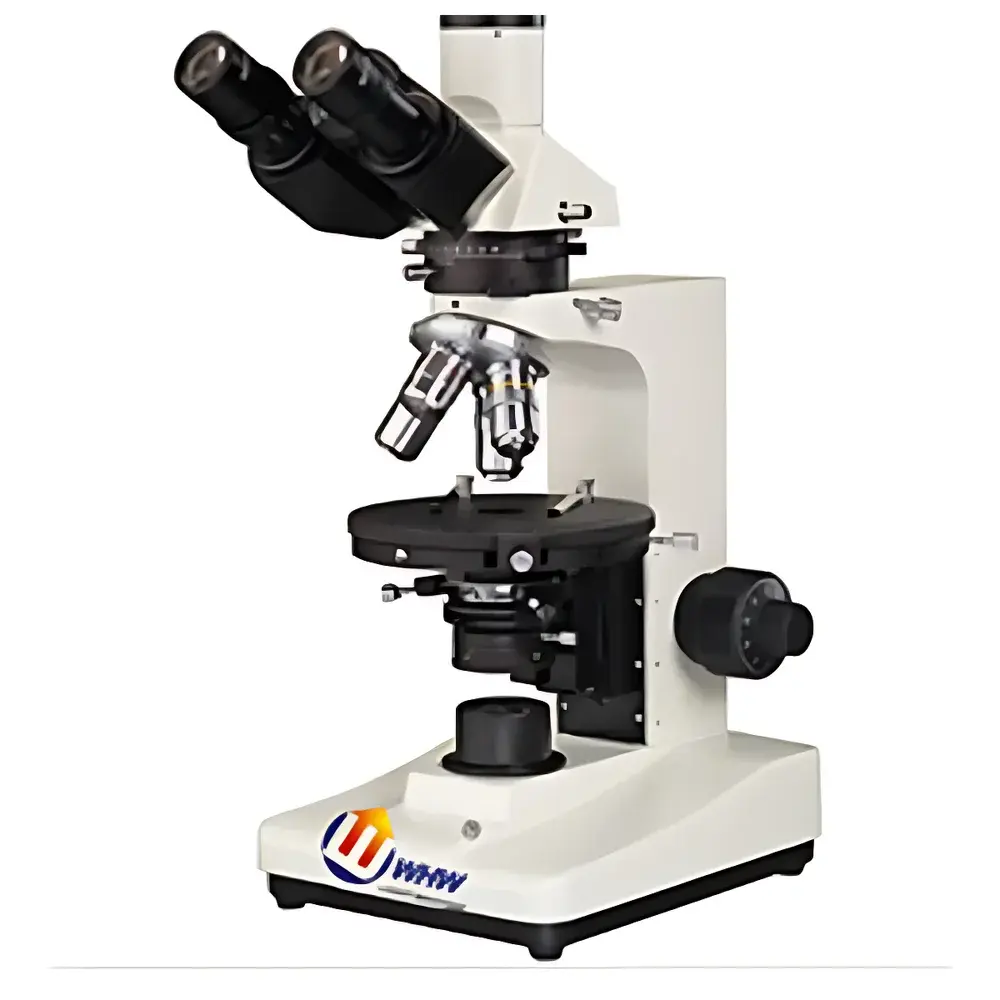
YANRUN PM-11 Polarizing Microscope with Transmitted and Reflected Light Capability
| Brand | YANRUN |
|---|---|
| Origin | Shanghai, China |
| Manufacturer Type | Direct Manufacturer |
| Model | PM-11 Polarizing Microscope (Transmitted/Reflected/Combined Illumination) |
| Illumination Options | Transmitted, Reflected, or Combined |
| Objective Lenses | Stress-Free Plan Achromatic (Center-Adjustable) |
| Eyepieces | Wide-Field WF10X (Φ18 mm), Graticule Eyepiece 10X (0.10 mm/div) |
| Magnification Range | 40–600× (PM-11A), 50–600× (PM-11B/C) |
| Condenser | NA 1.25 Adjustable Abbe Condenser (PM-11A/B) |
| Rotating Stage | Φ150 mm, 360° Graduated, Vernier Resolution 6′, Center-Adjustable & Lockable |
| Focusing Mechanism | Coaxial Coarse/Fine Focus, Fine Focus Graduation 2 µm, Limit Lock & Tension Adjustment |
| Polarization Components | Rotatable Polarizer (0°/90°/180°/270° detents), Rotatable Analyzer (360°, vernier resolution 12′), Push-In Bertrand Lens (center-adjustable), λ, λ/4, and Quartz Wedge Compensators |
| Illumination Source | 6 V / 20 W Halogen Lamp, Continuously Variable Intensity Control |
| Tube | Trinocular, 30° Inclined, 100% Light Path for Photomicrography |
| Nosepiece | Four-Position Internal Ball-Bearing Turret (Centering Adjustable on Optional Model) |
| Compliance | Designed for ASTM E112, ISO 9276, USP <788>, and GLP-aligned materials characterization workflows |
Overview
The YANRUN PM-11 Polarizing Microscope is a precision-engineered optical instrument designed for quantitative birefringence analysis and anisotropic material characterization across geological, metallurgical, pharmaceutical, and polymer science applications. Built upon classical polarized light microscopy principles—namely the interaction of linearly polarized incident light with optically active or doubly refracting specimens—the PM-11 enables rigorous qualitative and semi-quantitative evaluation of crystal orientation, stress distribution, phase composition, and domain structure. Its modular illumination architecture supports three operational configurations: PM-11A (transmitted-only), PM-11B (combined transmitted/reflected), and PM-11C (reflected-only), allowing seamless adaptation to opaque metals, transparent thin sections, or hybrid composite samples without hardware reconfiguration. The system’s optical train is fully strain-free, incorporating stress-compensated plan achromatic objectives and wide-field eyepieces to eliminate spurious birefringence artifacts—a prerequisite for ASTM E112 grain size analysis and ISO 9276 particle morphology assessment.
Key Features
- Tri-modal illumination flexibility: Selectable transmitted, reflected, or simultaneous dual-path illumination via intuitive mechanical levers and turret-mounted filters.
- Stress-free optical path: All critical components—including objectives, prisms, and tube lenses—are manufactured to DIN 0000-grade optical homogeneity standards to ensure zero intrinsic birefringence.
- Precision rotating stage: 150 mm diameter platform with 360° vernier scale (6 arcminute resolution), center-adjustable axis, and mechanical lock for repeatable angular positioning during extinction angle measurement.
- Dual polarization control: Independently rotatable polarizer (with quadrant-indexed stops at 0°, 90°, 180°, 270°) and analyzer (360° continuous rotation, 12′ vernier scale) enable precise azimuthal alignment per ISO 10110-6 calibration protocols.
- Compensation suite: Integrated push-in Bertrand lens for conoscopic observation; removable λ, λ/4, and quartz wedge compensators support retardation quantification from sub-nanometer to several hundred nanometers.
- Trinocular observation head: 30° inclined, 100% beam-splitting capability ensures full light throughput to both eyepieces and digital imaging ports—critical for FDA 21 CFR Part 11-compliant documentation workflows.
- Coaxial focusing system: Dual-range coarse/fine focus with 2 µm fine-step graduation, adjustable tension control, and mechanical upper/lower travel limit locks to protect objectives and specimens during high-magnification operation.
Sample Compatibility & Compliance
The PM-11 accommodates standard 26 mm × 76 mm petrographic slides, 1″ × 3″ metallographic mounts, and custom-thickness wafer substrates up to 30 mm vertical clearance. Its reflected-light configuration meets ASTM E3–22 requirements for metallic microstructure examination, while the transmitted mode conforms to ASTM D4123 for polymer spherulite analysis. The halogen illumination system delivers stable CCT (~3200 K) and uniform Köhler illumination across all magnifications—essential for ISO/IEC 17025-accredited laboratories performing inter-laboratory round-robin testing. All polarization components are calibrated traceable to NIST SRM 2082 (quartz reference wedges), supporting audit readiness under GLP and GMP environments.
Software & Data Management
The microscope integrates natively with third-party image acquisition platforms via USB 3.0 or analog video output (composite or S-video). Optional C-mount adapters (0.4×, 0.5×, 1×) support compatibility with scientific CMOS and CCD cameras compliant with EMVA 1288 standards. When paired with validated software (e.g., Image-Pro Premier or Olympus cellSens), the PM-11 supports metadata embedding—including objective ID, polarizer/analyzer angles, compensation state, and exposure parameters—enabling full traceability in 21 CFR Part 11–compliant audit trails. Digital photomicrographs retain EXIF tags for automated report generation aligned with ISO/IEC 17025 clause 7.8.2.
Applications
- Geosciences: Identification and extinction angle measurement of mineral assemblages in thin sections (e.g., quartz, feldspar, mica).
- Metallurgy: Grain boundary mapping, inclusion characterization, and residual stress evaluation in heat-treated alloys.
- Pharmaceuticals: Polymorph screening, crystallinity assessment of active pharmaceutical ingredients (APIs), and excipient interaction analysis per USP .
- Polymers & Composites: Spherulite size distribution, lamellar orientation, and filler dispersion homogeneity quantification.
- Forensics & Materials Failure Analysis: Birefringent fiber identification, fracture surface texture correlation, and thermal history reconstruction.
FAQ
Does the PM-11 support quantitative retardation measurement?
Yes—via integrated λ, λ/4, and quartz wedge compensators, enabling retardation determination from 550 nm down to ~10 nm using Michel-Lévy chart correlation or digital intensity profiling.
Is the microscope compatible with automated stage scanning systems?
The standard rotating stage is manually operated; however, optional motorized XY stages with encoder feedback (±0.5 µm repeatability) can be retrofitted via standardized M4 mounting threads.
What certification documentation is provided with shipment?
Each unit ships with a Factory Calibration Certificate referencing NIST-traceable polarization angle verification, optical axis alignment report, and illuminance uniformity map per ISO 9276-3 Annex B.
Can the PM-11 be used for differential interference contrast (DIC) observation?
No—DIC requires specialized Nomarski prisms and strain-free condenser optics not included in the base configuration; however, the strain-free optical path allows future DIC module integration by qualified service engineers.
Are replacement parts and service support available outside China?
YANRUN maintains authorized service partners in Germany, USA, and Singapore offering spare lens elements, polarizer assemblies, and on-site calibration services accredited to ISO/IEC 17025:2017.




