
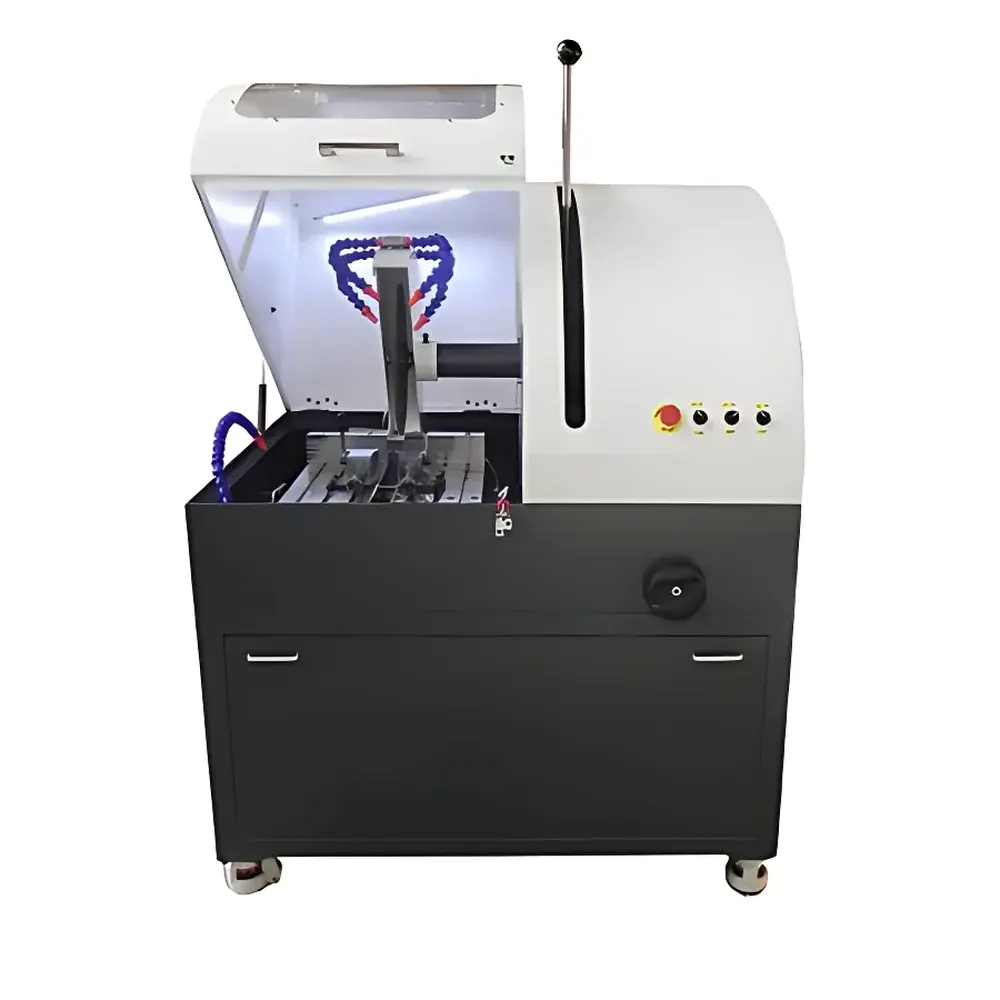
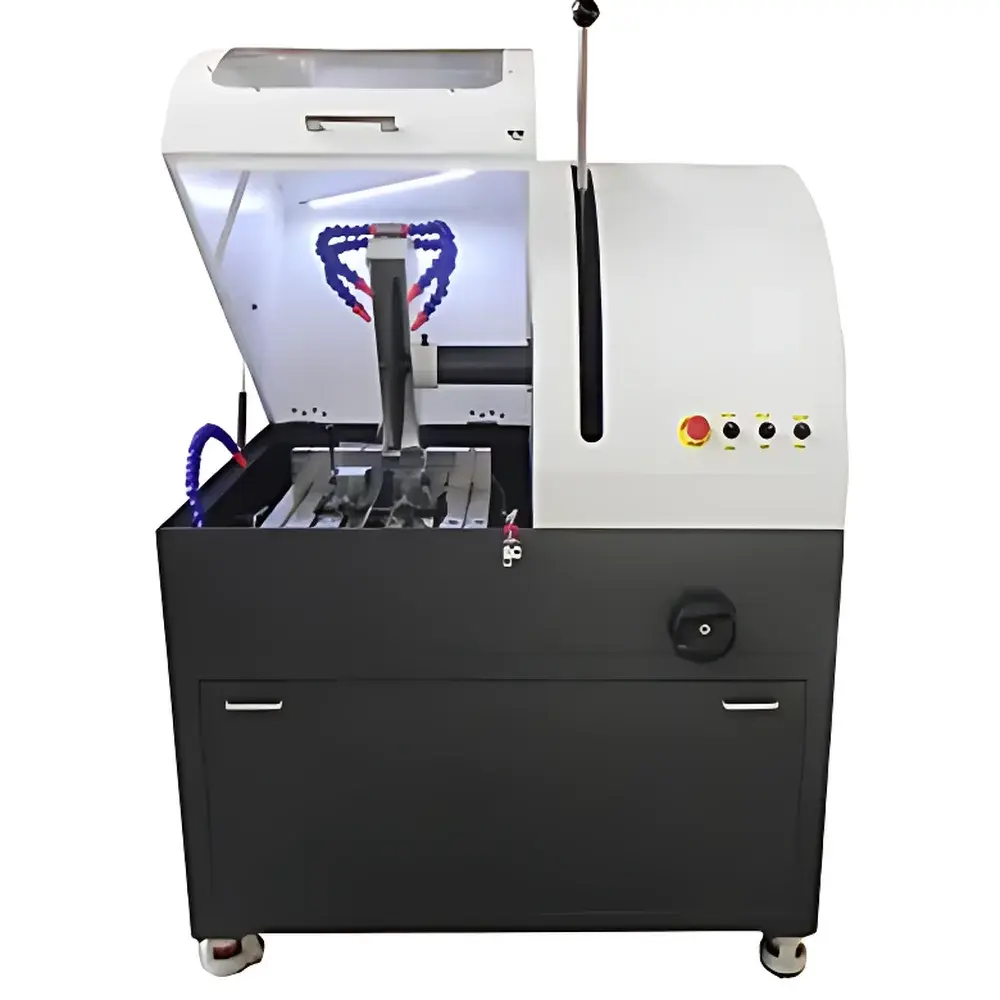
YANRUN QG-300 Large-Scale Three-Axis Metallographic Sample Cutting Machine
| Brand | YANRUN |
|---|---|
| Origin | Shanghai, China |
| Manufacturer Type | Direct Manufacturer |
| Country of Origin | China |
| Model | QG-300 |
| Instrument Type | Metallographic Cutting Machine |
| Spindle Speed | 2840 rpm |
| X-Axis Platform Travel | 70 mm |
| Y-Axis Spindle Stroke | 200 mm |
| Z-Axis Cutting Stroke | 100 mm |
| Max. Cutting Cross-Section | 200 × 140 mm |
| Max. Cutting Diameter | 150 mm |
| Cutting Method | Manual Three-Axis Control |
| Effective Feed Distance | 250 + 100 mm |
| Cutting Table Dimensions | 400 × 400 mm |
| Blade Specifications | (350–450) × (2.0–4.0) × 32 mm |
| Clamping Stage | Split-Type Dual-Layer Movable Precision Positioning Platform |
| Cooling System | Automatic 4-Channel Water Cooling |
| Water Tank Capacity | 150 L |
| Motor Power | 5.5 kW |
| Machine Configuration | Floor-Standing Integrated Design |
| Power Supply | 380 V AC |
| Weight | 550 kg |
Overview
The YANRUN QG-300 Large-Scale Three-Axis Metallographic Sample Cutting Machine is an engineered solution for precision sectioning of metallurgical, ceramic, composite, and geological specimens in quality control laboratories, R&D centers, and failure analysis facilities. Designed around a rigid floor-standing integrated architecture, the system implements orthogonal three-axis (X/Y/Z) mechanical positioning to enable repeatable, high-fidelity specimen extraction—critical for subsequent metallographic preparation stages including mounting, grinding, polishing, and microscopic evaluation. Unlike conventional single-axis or semi-automatic cutters, the QG-300 employs a split-type dual-layer movable precision positioning platform that decouples coarse and fine motion control, allowing both macro-level sample alignment and micro-adjustment within ±5 µm repeatability under load. The spindle operates at a fixed 2840 rpm—optimized for stable torque delivery across abrasive cutting wheels (350–450 mm diameter), minimizing vibration-induced kerf deviation and thermal distortion during high-duty-cycle operation. All motion axes are manually actuated with calibrated micrometer dials and vernier scales, ensuring full operator transparency and traceability—key requirements in GLP-compliant environments where automated actuation may introduce unverifiable variables.
Key Features
- Rigid floor-standing monocoque frame constructed from stress-relieved cast iron, providing long-term geometric stability and damping capacity for vibration-sensitive cutting tasks
- Split-type dual-layer precision positioning platform: upper layer enables fine incremental translation (0.01 mm resolution), lower layer supports coarse repositioning (70 mm X-travel, 200 mm Y-stroke, 100 mm Z-stroke)
- Integrated four-channel water cooling system with 150 L reservoir, delivering consistent coolant flow to blade interface and specimen contact zone—reducing thermal damage and extending abrasive wheel life
- High-torque 5.5 kW induction motor coupled directly to spindle, eliminating belt slippage and maintaining constant rotational speed under variable load conditions
- Modular clamping interface accommodating standard and custom fixtures—including optional gear-rack, universal, longitudinal-section, and rotary disc holders—enabling adaptation to irregular geometries and high-volume batch processing
- Full manual control architecture compliant with ISO 14971 risk management principles; no software-dependent functions eliminate cybersecurity exposure and firmware obsolescence concerns
Sample Compatibility & Compliance
The QG-300 accommodates specimens up to 200 × 140 mm cross-section or 150 mm diameter, supporting ferrous/non-ferrous alloys, sintered carbides, refractory ceramics, polymer composites, and mineralogical samples. Its open-access cutting chamber and adjustable fixture height allow vertical or angled sectioning of elongated components (e.g., turbine blades, weld coupons, or extruded profiles). The machine conforms to IEC 61000-6-2 (immunity) and IEC 61000-6-4 (emission) electromagnetic compatibility standards. While not certified to UL/CSA, its 380 V, 50 Hz three-phase electrical design aligns with industrial power infrastructure common in EU, APAC, and Middle East manufacturing labs. Documentation includes CE-conformity declaration (based on Machinery Directive 2006/42/EC), RoHS-compliant material certification, and traceable calibration records for all mechanical scales.
Software & Data Management
The QG-300 operates without embedded firmware or digital control units. All positional settings are recorded manually in laboratory notebooks or LIMS-integrated log sheets—ensuring full audit trail integrity per FDA 21 CFR Part 11 Annex 11 guidelines for non-automated systems. No data storage, network connectivity, or remote access capability is present, eliminating validation overhead associated with electronic records. Optional accessories—including engraved depth-stop collars and serialized fixture plates—support ISO/IEC 17025 accredited labs in establishing metrological traceability for each cutting event.
Applications
- Preparation of representative cross-sections from castings, forgings, and additive-manufactured parts for ASTM E3, ISO 643, and EN 10360 metallographic inspection
- Sectioning of multi-layer coatings (e.g., thermal barrier, PVD/CVD) for interfacial adhesion assessment and thickness profiling
- Extraction of fatigue crack initiation zones from failed components for fractographic analysis (ASTM E3022, ISO 24679)
- Controlled slicing of brittle materials—including silicon wafers, optical crystals, and dental ceramics—to minimize chipping and subsurface damage
- Batch processing of standardized test coupons (e.g., ASTM A370 tensile bars, ISO 6892-1 sub-sized specimens) with positional repeatability verified via CMM or optical comparator
FAQ
Is the QG-300 compatible with diamond-impregnated or resin-bonded abrasive wheels?
Yes—the spindle arbor accepts standard ISO 40 taper blades ranging from 350 mm to 450 mm in diameter and 2.0–4.0 mm thickness, including diamond, silicon carbide, and aluminum oxide variants.
Can the machine be integrated into an existing lab ventilation or central coolant system?
The unit features independent 4-channel water delivery with threaded NPT ports; retrofitting to centralized coolant loops requires external pressure regulation and flow balancing—YANRUN provides engineering drawings and interface specifications upon request.
What maintenance intervals are recommended for long-term reliability?
Lubrication of linear guides every 500 operating hours; spindle bearing inspection every 5,000 hours; coolant filtration and pH monitoring biweekly—detailed procedures included in the English-language technical manual.
Does YANRUN supply ISO 17025-accredited calibration certificates for the positioning scales?
Calibration certificates traceable to NIM (National Institute of Metrology, China) are available as a chargeable service; base configuration includes factory-verified scale linearity reports.
Are replacement blades and consumables stocked in regional distribution hubs?
Standard 350–450 mm abrasive wheels and coolant filters are maintained in YANRUN’s Singapore and Hamburg logistics centers, with typical lead time of 5–7 business days for air freight dispatch.
Related Products



