
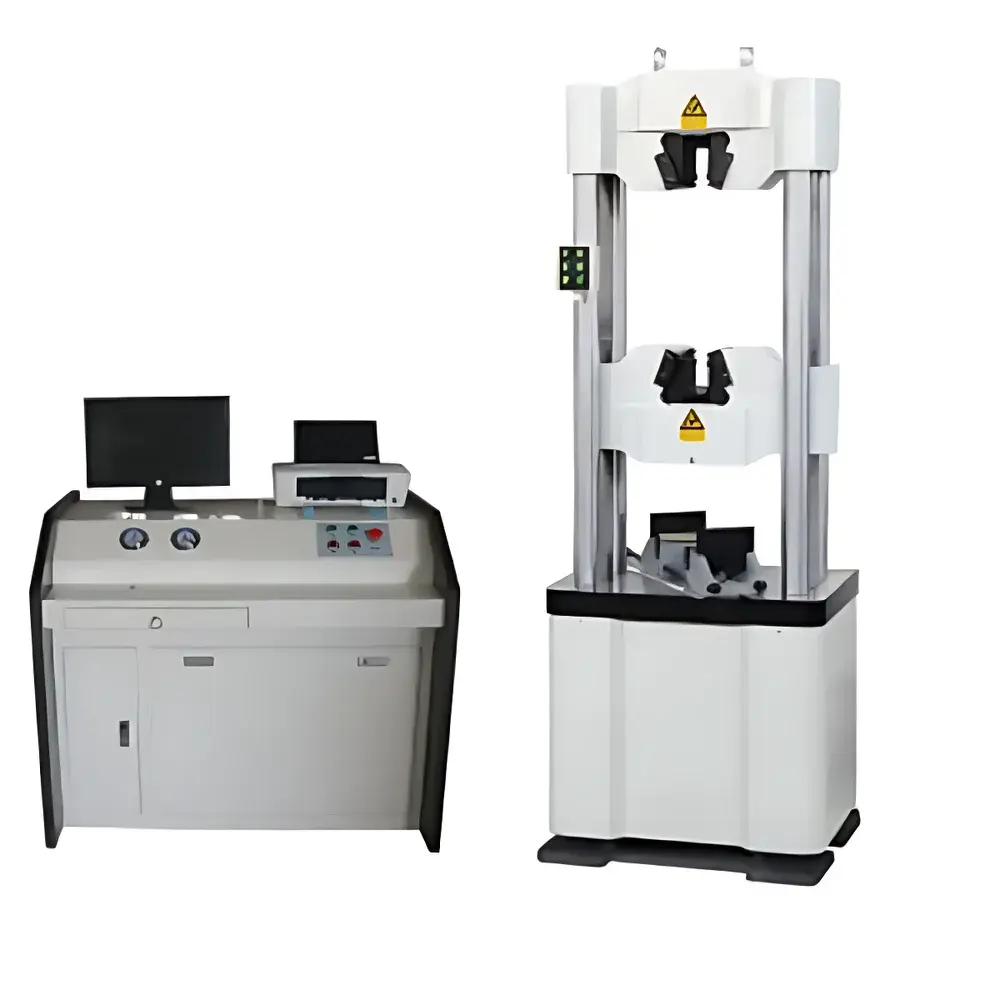
YANRUN WAW-1000D Microcomputer-Controlled Electro-Hydraulic Servo Universal Testing Machine
| Brand | YANRUN |
|---|---|
| Origin | Shanghai, China |
| Manufacturer Type | Direct Manufacturer |
| Model | WAW-1000D |
| Instrument Type | Electro-Hydraulic Servo Testing Machine |
| Load Capacity Range | 20 kN – 1000 kN |
| Load Measurement Accuracy | ±1% FS (or ±0.5% FS) |
| Displacement Resolution | 0.002 mm |
| Piston Maximum Speed | 80 mm/min |
| Max Tensile Test Space | 600 mm |
| Max Compressive Test Space | 550 mm |
| Flat Specimen Clamping Thickness | 0–15 mm (standard), optional extended range |
| Round Specimen Clamping Diameter | φ13–φ26 mm, φ26–φ40 mm, φ40–φ60 mm (optional) |
| Compression Platen Size | 200 × 200 mm |
| Bend Support Span | 500 mm |
| Support Width | 140 mm |
| Support Pin Diameter | 50 mm |
| Piston Stroke | 200 mm |
| Clamping Method | Hydraulic |
| Transducer | Oil-Pressure Load Cell |
| Signal Conditioning | PCI-Mounted Programmable Amplifier with Auto-Zero and Auto-Calibration |
Overview
The YANRUN WAW-1000D is a microcomputer-controlled electro-hydraulic servo universal testing machine engineered for high-force mechanical characterization of metallic, polymeric, composite, and ceramic materials under tension, compression, bending, and shear loading conditions. It operates on the principle of closed-loop hydraulic force actuation, where a servo-controlled hydraulic pump regulates piston displacement and load application in real time, synchronized with digital feedback from high-stability oil-pressure load cells and linear variable differential transformers (LVDTs). Designed to meet the structural integrity validation requirements of R&D laboratories, quality control departments, and third-party certification bodies, the WAW-1000D delivers traceable, repeatable mechanical property data—including yield strength, ultimate tensile strength, modulus of elasticity, fracture toughness parameters, and plastic deformation behavior—across standardized test protocols such as ASTM E8/E9, ISO 6892-1, ISO 37, and GB/T 228.1.
Key Features
- Electro-hydraulic servo architecture with dual-circuit pressure regulation ensures stable load ramping and dynamic response across the full 20 kN–1000 kN capacity range.
- High-resolution displacement measurement system with 0.002 mm resolution enables precise strain tracking during low-deformation regimes, critical for elastic modulus determination and proof stress evaluation.
- Triple-range round specimen grips (φ13–φ26 mm, φ26–φ40 mm, φ40–φ60 mm) and dual-thickness flat specimen clamps (0–15 mm standard; extended options available) support broad material form factor compatibility without manual tooling changeover delays.
- Hydraulically actuated wedge-type grips provide uniform clamping pressure distribution, minimizing slippage and premature failure at the jaw interface—especially essential for high-strength steels and fiber-reinforced composites.
- Integrated 200 × 200 mm hardened steel compression platen and adjustable 500 mm span bending fixture (with 140 mm support width and 50 mm diameter support pins) conform to ISO 3187 and ASTM C39/C78 geometrical requirements.
- PCI-based programmable signal amplifier with auto-zero and auto-calibration routines eliminates manual drift correction, reducing operator dependency and enhancing inter-laboratory reproducibility.
Sample Compatibility & Compliance
The WAW-1000D accommodates specimens ranging from thin sheet metal strips (≥0.5 mm thickness) to heavy-section structural beams (up to 60 mm diameter or 15 mm thickness), including castings, extrusions, weldments, and additively manufactured components. Its open-frame design permits vertical specimen alignment verification and in-situ extensometer mounting. The system supports compliance with international mechanical testing standards including ASTM E4 (load verification), ASTM E83 (extensometer calibration), ISO 7500-1 (static load verification), and GB/T 16825.1. All force and displacement outputs are traceable to national metrological standards via documented calibration certificates issued per ISO/IEC 17025-accredited procedures.
Software & Data Management
Control and analysis are performed via dedicated Windows-based software compliant with FDA 21 CFR Part 11 requirements, featuring electronic signatures, audit trails, and role-based user access control. Real-time data acquisition operates at ≥1 kHz sampling rate, supporting synchronized capture of load, displacement, and optional strain (via external extensometers or video extensometry). Test sequences—including multi-step cyclic loading, creep hold, and stress relaxation—are programmable with conditional logic (e.g., “hold at 80% FS for 300 s if strain rate < 0.001/s”). Export formats include CSV, XML, and PDF reports with embedded metadata (operator ID, calibration date, environmental conditions), suitable for GLP/GMP documentation workflows.
Applications
- Mechanical qualification of aerospace-grade aluminum alloys (e.g., 7075-T6) per AMS 4027 and MIL-STD-810.
- Tensile and compressive testing of civil engineering concrete cylinders (ASTM C39) and mortar prisms (ASTM C109).
- Weld joint evaluation per AWS D1.1, including tensile break tests and guided bend testing.
- Plastic deformation analysis of biomedical titanium implants (ASTM F1713) under quasi-static loading.
- Validation of additive manufacturing process parameters through post-build mechanical screening of Ti-6Al-4V lattice structures.
- Quality assurance of offshore pipeline girth welds per API RP 2X and DNVGL-RP-F103.
FAQ
What is the maximum allowable test speed for high-precision modulus measurement?
For elastic modulus determination per ASTM E111, the recommended crosshead speed is ≤0.005 mm/s during initial linear region acquisition; the WAW-1000D achieves this with sub-micron positional stability using its servo-valve feedback loop.
Can the system be integrated with an extensometer for true strain measurement?
Yes—the machine includes analog and digital I/O ports compatible with clip-on, non-contact, and video extensometers meeting ASTM E83 Class B2 or better specifications.
Is ISO/IEC 17025-compliant calibration documentation provided with shipment?
Each unit ships with a factory calibration certificate covering load cell linearity, zero balance, and displacement transducer accuracy, validated against NIST-traceable reference standards.
Does the software support automated report generation per ISO 14289-1 (PDF/A) archiving standards?
Yes—test reports are exportable in PDF/A-2u format with embedded digital signatures and tamper-evident hash verification.
What maintenance intervals are recommended for hydraulic system integrity?
Oil filtration and servo-valve inspection are advised every 1,500 operational hours or annually, whichever occurs first; scheduled maintenance logs are automatically archived within the software audit trail.



