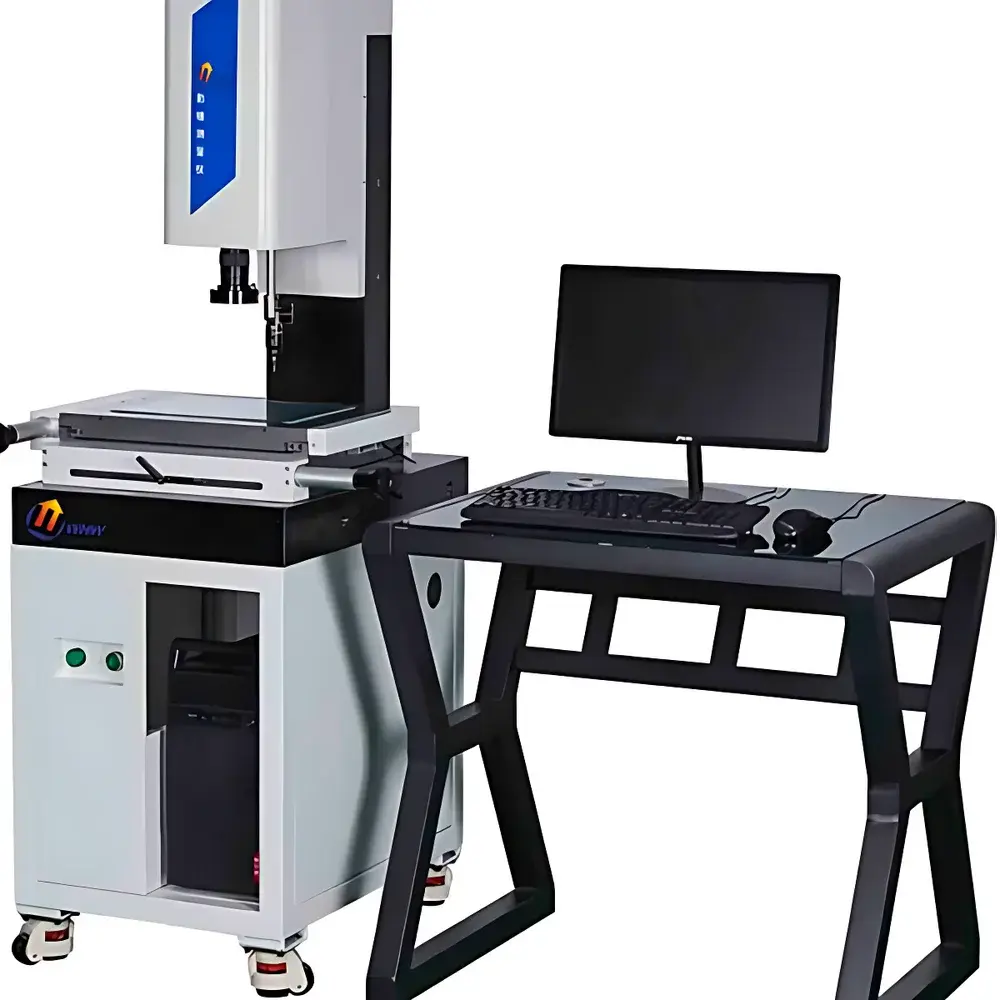
YANRUN YR3020-Z Semi-Automatic Vision Measuring Machine
| Brand | YANRUN |
|---|---|
| Origin | Shanghai, China |
| Manufacturer Type | Direct Manufacturer |
| Country of Origin | China |
| Model | YR3020-Z |
| Price | USD 1 (FOB Shanghai) |
| Measurement Accuracy | ±(3 + L/200) µm |
| Encoder Resolution | 1 µm (Closed-Loop Precision Glass Scale) |
| Optical Magnification | 20×–140× (Optional: 40×–280×) |
| Camera | Hikvision High-Speed Fiber-Optic Industrial Digital CCD |
| Illumination | Imported LED Ring/Circular Cold Light Source |
Overview
The YANRUN YR3020-Z Semi-Automatic Vision Measuring Machine is an engineered metrology solution designed for high-reproducibility geometric dimensioning and tolerancing (GD&T) inspection of precision mechanical components. It operates on the principle of optical coordinate measurement—capturing high-fidelity 2D images via a stabilized optical path, then computing dimensional relationships using pixel-to-micron calibration models traceable to NIST-traceable standards. The system integrates a rigid granite base (Grade 00, flatness ≤3 µm), crossed roller linear guides, and closed-loop glass scale encoders to minimize Abbe error and thermal drift. Its Z-axis employs a precision servo motor with auto-focus capability, enabling consistent focal plane maintenance across varying part heights up to 180 mm. Intended for QC labs, contract manufacturing facilities, and R&D workshops, the YR3020-Z delivers certified measurement uncertainty suitable for ISO/IEC 17025-compliant calibration workflows and first-article inspection per ASME Y14.5.
Key Features
- Rigid mechanical architecture: 00-grade granite base and column with surface flatness ≤3 µm, ensuring long-term stability under ambient temperature fluctuations.
- Closed-loop linear encoder system with 1 µm resolution and repeatability ≤1.5 µm, compliant with ISO 10360-2 positional accuracy requirements.
- Optical subsystem featuring a 0.7×–4.5× continuous zoom telecentric lens paired with a Hikvision industrial CCD camera (fiber-optic interface, ≥60 fps at full resolution), supporting both coaxial and oblique illumination paths.
- Dual-mode lighting: Adjustable LED ring light (for edge contrast enhancement) and circular cold light source (for surface texture discrimination), both intensity- and angle-tunable via software.
- Z-axis servo-driven autofocus with programmable focus depth tracking—enabling consistent edge detection across stepped or contoured surfaces without manual refocusing.
- Integrated semi-automatic operation logic: supports point-and-click measurement, region-of-interest (ROI) batch analysis, and rule-based auto-edge detection with configurable threshold and noise filtering.
Sample Compatibility & Compliance
The YR3020-Z accommodates parts up to 300 mm × 200 mm × 180 mm (X × Y × Z), including machined metal housings, stamped sheet-metal components, injection-molded plastic assemblies, and PCB substrates. Its non-contact optical methodology eliminates probe-induced deformation risks associated with tactile CMMs. All illumination sources comply with IEC 62471 photobiological safety standards for LED devices. The machine’s mechanical design conforms to ISO 10360-1 (CMM acceptance testing) and ISO 22476-1 (geometric product specification). While not certified to FDA 21 CFR Part 11 out-of-the-box, its ZONSON software supports audit trail configuration, electronic signature integration, and user-role-based access control—enabling validation readiness for GMP/GLP-regulated environments upon customer-specific qualification.
Software & Data Management
The system runs dual software layers: ZONSON Intelligent Metrology Suite (multi-language UI: English, German, Japanese, Simplified Chinese) and UWC3200 Semi-Automatic Analysis Engine. Core capabilities include GD&T evaluation per ISO 1101 and ASME Y14.5—parallelism, perpendicularity, position, concentricity, symmetry, profile of a line/surface, circular runout, and total runout. Measurement data export supports native formats (.zms, .csv) and industry-standard interchange: Excel (.xlsx), Word (.docx), PDF (with embedded traceability metadata), DXF (for CAD overlay verification), and AutoCAD-compatible DWG. Statistical Process Control (SPC) modules compute Cp/Cpk, X-bar/R charts, histogram distribution, and outlier detection—all traceable to measurement timestamps, operator IDs, and calibration event logs. Raw image archives are stored with EXIF metadata (lens magnification, exposure time, light channel settings) for forensic reanalysis.
Applications
- First-article inspection of automotive transmission gears, bearing races, and fuel injector nozzles.
- Dimensional validation of medical device components (e.g., surgical instrument jaws, catheter hubs) where tactile contact may compromise sterility or surface integrity.
- GD&T verification of aerospace fasteners and turbine blade root profiles per NAS963/AS9102 requirements.
- PCB pad-to-pad spacing, solder mask opening accuracy, and fiducial alignment checks in electronics manufacturing.
- Tooling verification for injection molds and die-cast dies—measuring cavity dimensions, draft angles, and ejection pin locations.
- Academic metrology training: used in university labs to demonstrate traceable optical measurement principles, uncertainty budgeting, and ISO/IEC 17025 documentation practices.
FAQ
What standards does the YR3020-Z comply with for measurement traceability?
The system supports traceability to national metrology institutes (e.g., NIM China, NIST USA) via calibrated artifacts (1 µm reference scale included). Measurement uncertainty budgets align with ISO/IEC Guide 98-3 (GUM) and VDI/VDE 2617 Part 6 for vision-based systems.
Can the system perform true 3D measurements?
Out-of-the-box, it performs 2.5D measurements (X/Y geometry + Z-height via focus peak detection). With optional Renishaw PH10MQ probe head and ruby stylus, it achieves full 3D coordinate acquisition—validated per ISO 10360-5 for tactile probing accuracy.
Is the software validated for regulated industries?
ZONSON software includes configurable audit trails, electronic signatures, and role-based permissions. Customers must execute their own IQ/OQ/PQ protocols per FDA 21 CFR Part 11 or EU Annex 11 when deploying in pharmaceutical or medical device QA environments.
What maintenance is required for long-term accuracy?
Annual recalibration of the optical axis alignment and encoder scale is recommended. Granite base cleaning with isopropyl alcohol and lint-free cloth every 6 months prevents particulate interference. No consumables or lubricants are required for the closed-loop motion system.
How is environmental sensitivity managed?
The granite structure provides inherent thermal mass; operational specifications assume ambient temperature 20 ± 1 °C with ≤1 °C/h drift. Optional air-bearing vibration isolation tables (sold separately) reduce floor-borne noise below 5 Hz—critical for sub-2 µm edge detection repeatability.