
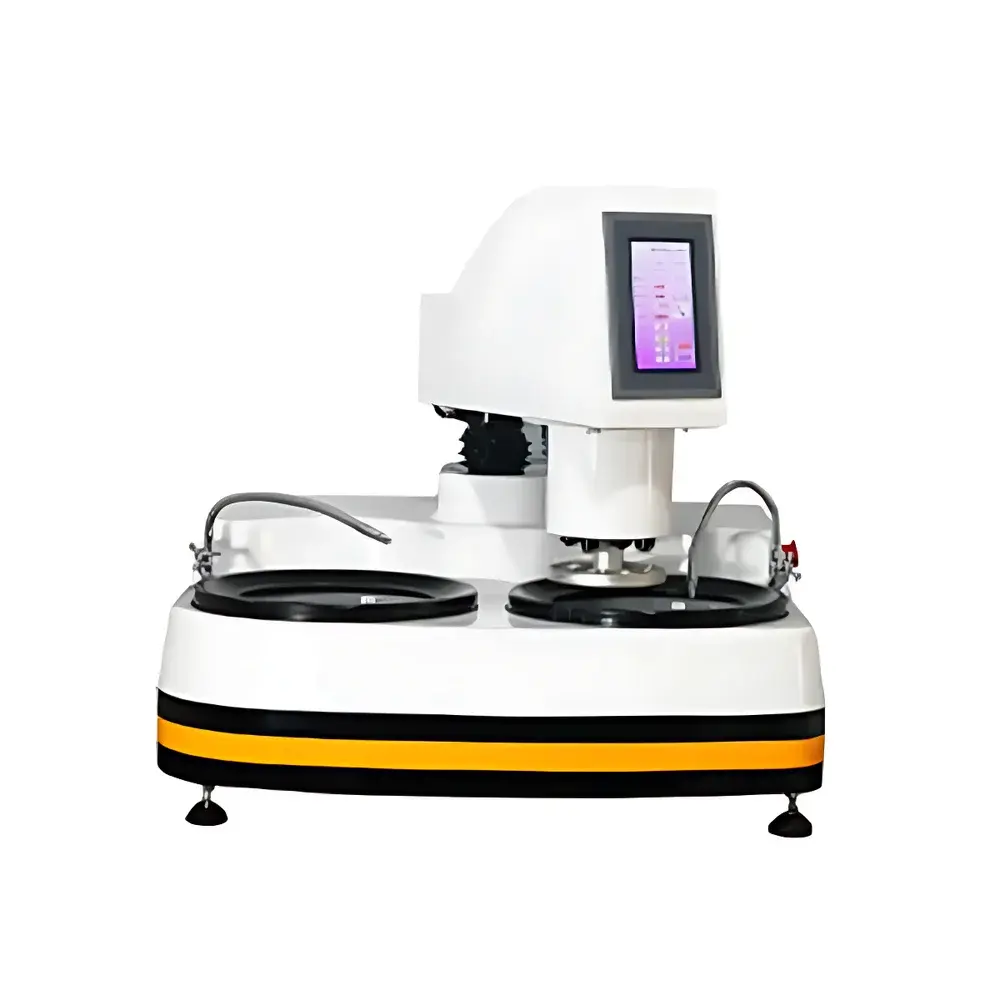
YANRUN ZMP-2000Z Intelligent Automated Metallographic Grinding and Polishing System
| Brand | YANRUN |
|---|---|
| Origin | Shanghai, China |
| Manufacturer Type | Direct Manufacturer |
| Model | ZMP-2000Z |
| Rotational Speed | 50–1500 rpm |
| Platen Diameter | 230 mm |
| Number of Platens | 2 |
| Dimensions (L×W×D) | 870 mm × 800 mm × 700 mm |
| Applied Pressure | Center Load 300 N |
| Air Supply Requirement | 0.5–0.9 MPa |
| Control System | PLC with 8-inch Color Touchscreen |
| Sample Capacity | 8 positions (6 × Ø30 mm + 2 × Ø40 mm) |
| Motor Power | 2 × 750 W servo motors (torque: 2.39 N·m each) |
| Grinding/Polishing Time Range | 0–9999 s per stage (dual-stage programmable) |
| Abrasive Dispensing | Dual-channel automated spray system |
| minimum dispensing interval & duration | 0.1 s |
| Storage Capacity | Up to 100 user-defined grinding-polishing protocols |
Overview
The YANRUN ZMP-2000Z Intelligent Automated Metallographic Grinding and Polishing System is an industrial-grade, pneumatically actuated dual-platen preparation platform engineered for high-reproducibility specimen surface conditioning in metallurgical, materials science, and quality control laboratories. It operates on the principle of controlled mechanical abrasion—applying precisely regulated normal force, rotational velocity, and timed abrasive delivery to achieve planar, scratch-free, and deformation-minimized surfaces essential for optical microscopy, SEM imaging, and microhardness testing. Unlike manual or semi-automated systems, the ZMP-2000Z integrates closed-loop pressure modulation, bidirectional platen rotation, and synchronized dual-channel abrasive dispensing to eliminate operator-induced variability across sample batches. Its architecture conforms to ISO 14577 (metallic materials — instrumented indentation test) and ASTM E3 (standard guide for preparation of metallographic specimens) procedural requirements, supporting GLP-compliant documentation workflows when paired with audit-trail-enabled software.
Key Features
- PLC-based intelligent control with an 8-inch color touchscreen interface offering menu-driven operation, real-time parameter monitoring, and intuitive protocol navigation.
- Dual-platen configuration (230 mm diameter each) enables simultaneous grinding and polishing—or independent operation for parallel multi-step preparation sequences.
- Pneumatic loading system delivering center-applied force (up to 300 N) or distributed single-sample loading (0–50 N per station × 8), adjustable within 0.5–0.9 MPa air supply range.
- Automated dual-channel abrasive dispensing with programmable spray timing (minimum 0.1 s resolution) and interval control, ensuring consistent slurry distribution without manual intervention.
- Two-stage time-programmable operation (0–9999 s per stage) with automatic transition logic, enabling complex multi-step protocols such as coarse grinding → fine grinding → rough polishing → final polishing.
- Integrated servo motor drive (2 × 750 W, 2.39 N·m torque) supports wide-speed-range platen rotation (50–1500 rpm) and independent head rotation (20–160 rpm), optimized for both aggressive material removal and delicate surface finishing.
- Standard 8-position sample holder (6 × Ø30 mm + 2 × Ø40 mm) accommodates standard metallographic mounts; custom fixtures available for non-standard geometries including irregular ceramics, electronic substrates, and geological thin sections.
Sample Compatibility & Compliance
The ZMP-2000Z is validated for use with ferrous and non-ferrous metals, sintered alloys, carbides, technical ceramics (e.g., Al₂O₃, SiC, ZrO₂), semiconductor wafers, geological specimens (rocks, minerals), glass composites, and emerging composite materials (e.g., CMCs, MMCs). Its pressure and speed flexibility allows adaptation to soft materials (e.g., aluminum, copper) requiring low-force polishing, as well as ultra-hard substrates (e.g., tungsten carbide, cubic boron nitride) demanding high-torque grinding. All operational parameters—including pressure profiles, rotational direction, dwell time, and abrasive delivery—are fully traceable and exportable, supporting compliance with ISO/IEC 17025 accreditation requirements, FDA 21 CFR Part 11 (when used with compliant data logging software), and internal GMP/GLP audit protocols.
Software & Data Management
The embedded PLC firmware stores up to 100 user-defined preparation protocols, each containing complete parameter sets: platen speed (rpm), applied load (N), duration (s), abrasive channel selection (A/B), spray frequency and duration (ms), and directional logic (forward/reverse/alternating). Protocol execution logs include timestamp, operator ID (via optional login module), ambient temperature (if sensor-equipped), and real-time motor current feedback—enabling post-run diagnostic review. Export options include CSV-formatted logs via USB port for integration into LIMS or statistical process control (SPC) platforms. Firmware updates are performed via secure USB transfer, maintaining version-controlled system integrity.
Applications
This system serves critical roles in failure analysis labs preparing fracture surfaces for fractography; R&D departments developing new alloy compositions or coating architectures; foundry QA units verifying grain structure uniformity; and academic materials characterization facilities conducting phase identification, inclusion analysis, or interfacial studies. It is routinely deployed for preparing specimens prior to Vickers/Knoop hardness testing (ASTM E92/E384), electron backscatter diffraction (EBSD), focused ion beam (FIB) milling, and quantitative image analysis per ASTM E112 (grain size determination). Its repeatability supports ISO 643-compliant microstructural assessment in steel certification workflows.
FAQ
What types of abrasive media are compatible with the ZMP-2000Z?
The system supports aqueous and oil-based slurries, diamond suspensions (0.5–40 µm), alumina powders (0.3–30 µm), silicon carbide papers (240–3000#), and cloth-mounted diamond discs. Both channel A and B can be independently assigned to different media types.
Can the machine operate under unattended conditions?
Yes—once a protocol is initiated, the system executes all stages autonomously, including pressure application, rotation control, abrasive dispensing, and cycle termination. An audible and visual alert signals completion or fault condition.
Is calibration documentation provided for regulatory audits?
Factory calibration certificates for pressure transducers, rotational encoders, and timer modules are included. Users may perform routine verification using NIST-traceable load cells and tachometers per internal SOPs.
What maintenance intervals are recommended?
Daily: Clean platen surfaces and fluid lines; inspect O-rings and air fittings. Quarterly: Lubricate pneumatic actuators; verify pressure regulator accuracy. Annually: Full motor encoder recalibration and touchscreen responsiveness validation.
Does the system support integration with laboratory information management systems (LIMS)?
Raw log exports (CSV) contain all metadata required for LIMS ingestion. Optional RS-232 or Ethernet communication modules enable real-time data streaming upon request.
Related Products



