
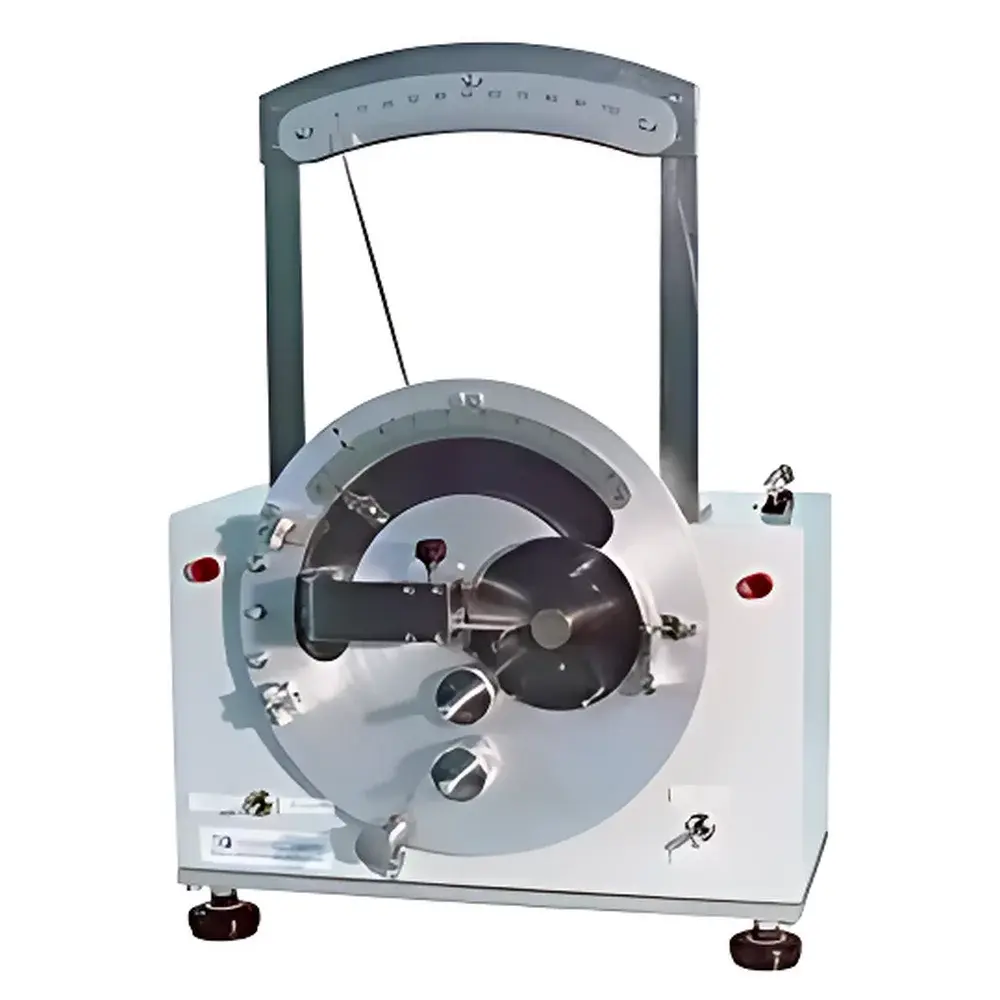
Yasuda No.429 Olsen-Type Apparent Bending Modulus Tester (Light-Load Configuration)
| Brand | Yasuda |
|---|---|
| Origin | Japan |
| Model | No.429 |
| Standards Compliance | JIS L1018, JIS L1096, ASTM D747 |
| Test Principle | Cantilever Beam Deflection Method |
| Load Range | Light-load configuration (typically ≤ 500 mN·m) |
| Angular Displacement Control | Fixed-angle deflection (e.g., 5°, 15°, 45° per standard protocols) |
| Specimen Clamping | Precision-machined chuck with adjustable grip force |
| Measurement Output | Apparent bending stiffness (mN·m/rad) and apparent bending modulus (cN·cm²/cm) |
Overview
The Yasuda No.429 Olsen-Type Apparent Bending Modulus Tester (Light-Load Configuration) is a precision mechanical testing instrument engineered for the quantitative evaluation of fabric bending rigidity under low-moment conditions. It implements the classical cantilever beam deflection method—standardized in JIS L1018 (Textiles — Methods of test for fabrics — Determination of stiffness), JIS L1096 (Textiles — Testing methods for woven and knitted fabrics), and ASTM D747 (Standard Test Method for Apparent Bending Stiffness of Plastics by the Cantilever Beam Method)—adapted specifically for thin, semi-rigid textile specimens such as coated fabrics, nonwovens, technical textiles, and lightweight composites. Unlike torsional or dynamic mechanical analyzers, this system applies static angular displacement to a clamped specimen and measures the resulting restoring moment at equilibrium, enabling direct calculation of apparent bending stiffness (in mN·m/rad) and, when normalized by specimen geometry, apparent bending modulus (in cN·cm²/cm). Its light-load architecture ensures high sensitivity and repeatability for materials exhibiting low resistance to bending deformation—critical for quality control in apparel R&D, medical textile development, and functional fabric certification.
Key Features
- Fixed-angle deflection mechanism compliant with JIS/ASTM angular specifications (e.g., 5°, 15°, and 45° preset positions), ensuring inter-laboratory comparability
- High-resolution torque transducer calibrated to ±0.5% full scale, optimized for sub-500 mN·m measurement range
- Adjustable specimen clamp with micrometer-controlled jaw pressure to prevent slippage without fiber damage
- Stainless-steel cantilever support arm with thermal-stable linear bearing assembly, minimizing hysteresis and drift
- Modular base design compatible with ISO 17025-accredited laboratory benches; includes vibration-dampening feet
- No software dependency for basic operation—mechanical readout via calibrated dial gauge or optional analog output interface (0–5 V DC)
Sample Compatibility & Compliance
The No.429 accommodates rectangular textile specimens measuring 2.5 cm × 25 cm (standard JIS L1018 dimensions) or custom widths up to 3.0 cm. It supports single-layer and laminated structures with thicknesses ranging from 0.1 mm to 2.0 mm and areal densities between 30 g/m² and 500 g/m². All mechanical components meet ISO 8503-2 surface roughness requirements for clamping interfaces to ensure consistent frictional engagement. The instrument’s test protocol satisfies GLP-aligned documentation requirements: each test cycle records specimen ID, orientation (warp/weft), deflection angle, measured moment, and environmental conditions (temperature/humidity logged separately per ISO 139). Full traceability to NIST-traceable torque standards is achievable via third-party calibration certificates (available upon request).
Software & Data Management
While the core No.429 operates as a stand-alone mechanical tester, an optional digital acquisition module (YAS-DAQ-429) enables USB 2.0 connectivity and real-time data logging at 10 Hz sampling rate. The accompanying Windows-based software (v3.2+) provides automated calculation of apparent bending modulus per JIS L1018 Annex A, generates ASTM D747-compliant reports, and exports CSV/Excel files with audit trail metadata. All electronic records comply with FDA 21 CFR Part 11 requirements—including electronic signatures, user access levels, and immutable change logs—making the system suitable for regulated environments conducting textile validation under ISO 13485 or IEC 60601-1-11 frameworks.
Applications
- Quality assurance of wrinkle-resistant cotton blends and nano-coated polyester fabrics
- Bending stiffness benchmarking during development of flame-retardant protective textiles
- Comparative analysis of biodegradable nonwovens versus conventional spunbond substrates
- Regulatory submission support for medical drapes and gowns requiring ASTM F1819 compliance (indirectly via bending rigidity correlation)
- Process optimization feedback for calendering, heat-setting, and resin-finishing lines
- Academic research on structure–property relationships in hybrid yarn architectures
FAQ
What standards does the Yasuda No.429 explicitly support?
JIS L1018 (2022 edition), JIS L1096 (2021 edition), and ASTM D747 (2020 revision). Calibration procedures follow ISO/IEC 17025:2017 Clause 6.5 guidelines.
Can the instrument test knitted fabrics with high extensibility?
Yes—provided the specimen exhibits measurable elastic recovery within the 5°–45° deflection range. Preconditioning per ISO 139 is mandatory to stabilize moisture content prior to testing.
Is third-party calibration included with purchase?
No—calibration is performed pre-shipment using NIST-traceable torque standards, but formal accredited calibration (e.g., by A2LA-certified labs) is available as a separate service.
How is specimen alignment verified before clamping?
A built-in optical alignment guide (±0.2° tolerance) ensures perpendicular placement relative to the cantilever axis; misalignment >1° invalidates JIS/ASTM compliance.
Does the system require compressed air or external power?
No—it is fully manual and gravity-assisted. Optional DAQ modules require only USB power (5 V DC) and do not necessitate auxiliary power supplies.



