
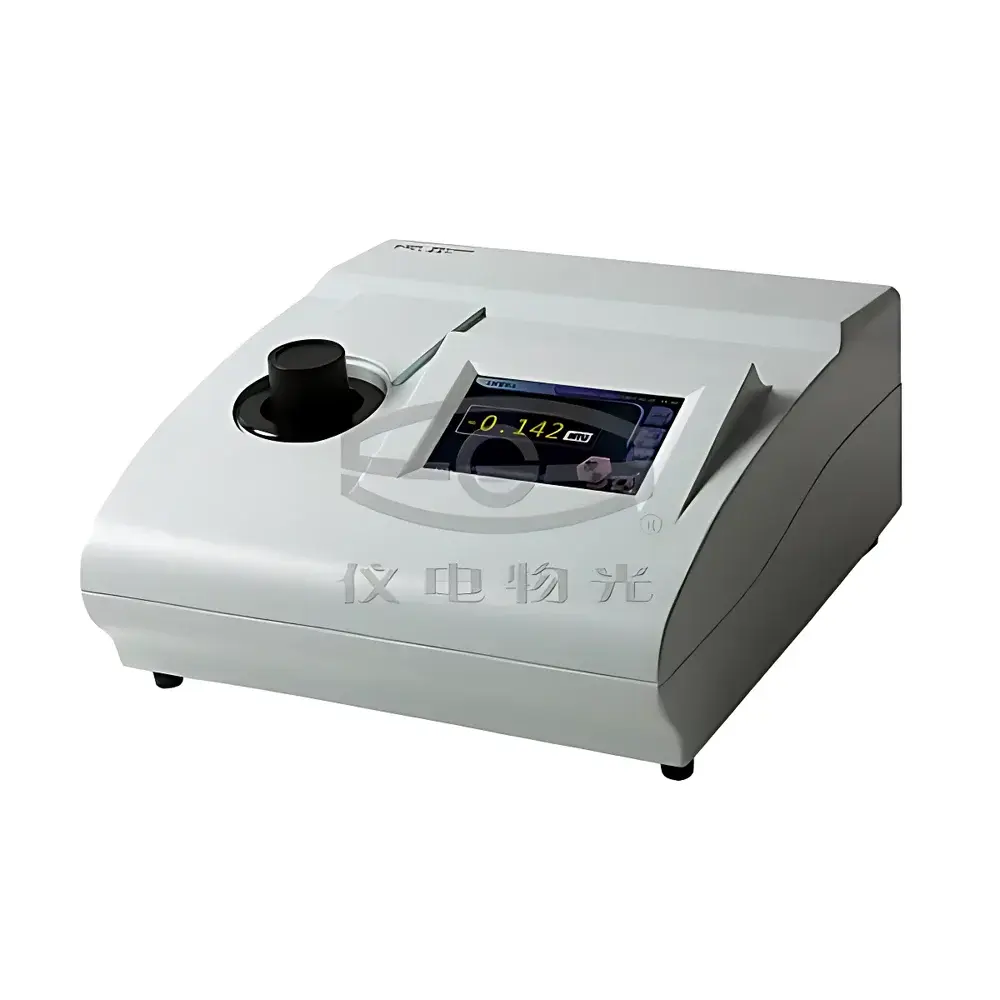
YD-WG WGZ-C Portable Turbidimeter
| Brand | YD-WG |
|---|---|
| Model | WGZ-C |
| Type | Portable Turbidimeter |
| Measurement Range | 0.000–100.0 NTU |
| Resolution | 0.01 NTU |
| Accuracy | ≤ ±6% |
| Zero Drift | ≤ ±0.3% FS |
| Stability | ≤ ±1% FS |
| Repeatability | ≤ 0.5% |
| Light Source | Infrared LED (860 nm) |
| Detector | Silicon Photocell |
| Sample Cell | Ø25 mm × 95 mm |
| Sample Volume | 30–40 mL |
| Data Storage | 1,000 records |
| Calibration | 3-point calibration |
| Interface | USB / USB flash drive support |
| Power Supply | 220 V ± 22 V, 50 Hz ± 1 Hz, 30 W |
| Dimensions | 358 × 323 × 160 mm |
| Net Weight | 6 kg |
Overview
The YD-WG WGZ-C Portable Turbidimeter is an optical measurement instrument engineered for quantitative turbidity assessment in pharmaceutical quality control laboratories. It operates on the principle of nephelometry—measuring the intensity of light scattered at 90° by suspended particles in a liquid sample under controlled infrared illumination (860 nm). This wavelength minimizes interference from coloration and intrinsic absorbance commonly encountered in parenteral drug solutions, ensuring compliance with pharmacopeial requirements for clarity testing. Designed specifically to meet the methodology outlined in Chinese Pharmacopoeia General Chapter 0902 “Clarity Testing—Method II (Turbidimetric Method)”, the WGZ-C delivers traceable, reproducible results for raw materials and finished injectables. Its compact benchtop form factor, integrated touchscreen interface, and robust mechanical architecture make it suitable for both routine QC environments and regulated GMP-compliant settings where audit readiness and method consistency are critical.
Key Features
- Nephelometric detection using an 860 nm infrared LED light source and silicon photocell detector—optimized for low-color interference and high signal-to-noise ratio in clear-to-slightly-turbid pharmaceutical solutions.
- Three-point calibration protocol supported by certified turbidity standards (e.g., Formazin or equivalent stable suspensions), enabling traceable verification across the full 0.000–100.0 NTU range.
- High-resolution digital display (0.01 NTU minimum increment) with intuitive 7-inch capacitive touchscreen interface—eliminating mechanical buttons and reducing cross-contamination risk during glove-based operation.
- Onboard data logging capacity for up to 1,000 measurement records, each timestamped and tagged with operator ID (if enabled via external authentication integration).
- USB host port supporting direct export to USB flash drives in CSV format—facilitating seamless transfer to LIMS or statistical process control (SPC) platforms without proprietary software dependency.
- Compliance-ready design: supports GLP/GMP documentation workflows through configurable audit trail settings (when used with validated third-party data management systems) and meets mechanical stability criteria per ISO 7027-1:2016 for turbidimeters.
Sample Compatibility & Compliance
The WGZ-C accepts standard Ø25 mm × 95 mm cylindrical glass vials with a nominal fill volume of 30–40 mL—compatible with USP/EP/ChP-compliant sample containers used in clarity testing. Its optical path geometry and detector alignment are optimized for low-volume, low-turbidity applications typical of sterile injectables, lyophilized reconstitutes, and active pharmaceutical ingredients (APIs). The instrument satisfies all instrumental performance criteria specified in Chinese Pharmacopoeia 2020 Edition, Chapter 0902 Method II, including linearity, repeatability, and zero stability requirements. While not pre-certified to FDA 21 CFR Part 11 out-of-the-box, its data export architecture and calibration traceability enable qualification under Part 11-compliant validation protocols when deployed within a validated laboratory information management system (LIMS) environment.
Software & Data Management
The WGZ-C operates independently of PC-based software—the embedded firmware handles all measurement logic, calibration routines, and data storage. Measurement records include date/time stamp, sample ID (user-entered), calibration status flag, and raw detector voltage output (for technical review). Exported CSV files contain columns for NTU value, measurement time, operator code (if assigned), and instrument serial number—supporting ALCOA+ data integrity principles (Attributable, Legible, Contemporaneous, Original, Accurate, Complete, Consistent, Enduring, Available). Optional thermal or dot-matrix printers (RD-TH32-SC or CK NT-T24S) provide hard-copy audit trails; printer output may be configured to include calibration certificate reference numbers for full method traceability.
Applications
- Clarity evaluation of injectable drug products per ChP 0902, USP <791>, and EP 2.2.1.
- Batch release testing of APIs and excipients where particulate load must remain below defined turbidity thresholds.
- In-process monitoring of filtration efficiency during sterile manufacturing operations.
- Stability-indicating assay support—tracking subtle increases in turbidity over time as an early indicator of degradation or aggregation.
- Supplier qualification testing for water-for-injection (WFI) and purified water systems, aligned with pharmacopeial conductivity and turbidity specifications.
FAQ
Does the WGZ-C comply with international pharmacopeias beyond the Chinese Pharmacopoeia?
Yes—the 860 nm nephelometric configuration and performance specifications align with ISO 7027-1:2016 and are functionally equivalent to turbidimeters referenced in USP <791> and EP 2.2.1, though formal pharmacopeial listing requires site-specific method validation.
Can the instrument be qualified under FDA 21 CFR Part 11?
The WGZ-C itself does not include electronic signature or role-based access control features; however, its data export architecture supports integration into Part 11-compliant LIMS or ELN systems where electronic records, audit trails, and user authentication are managed externally.
What calibration standards are recommended for routine use?
Formazin-based primary standards traceable to NIST SRM 2102 or equivalent ISO-certified suspensions are recommended for initial qualification; secondary standards prepared in-house per ChP guidelines may be used for daily verification.
Is temperature compensation available?
No—the WGZ-C is specified for operation at ambient laboratory conditions (typically 15–30 °C); users must ensure samples are equilibrated to room temperature prior to measurement, as required by ChP 0902.
How often should the optical path be cleaned or maintained?
The cuvette chamber and detector window should be inspected and wiped with lint-free optical tissue before each use; annual verification of light source intensity and detector response is advised as part of preventive maintenance per ISO/IEC 17025 laboratory requirements.




