
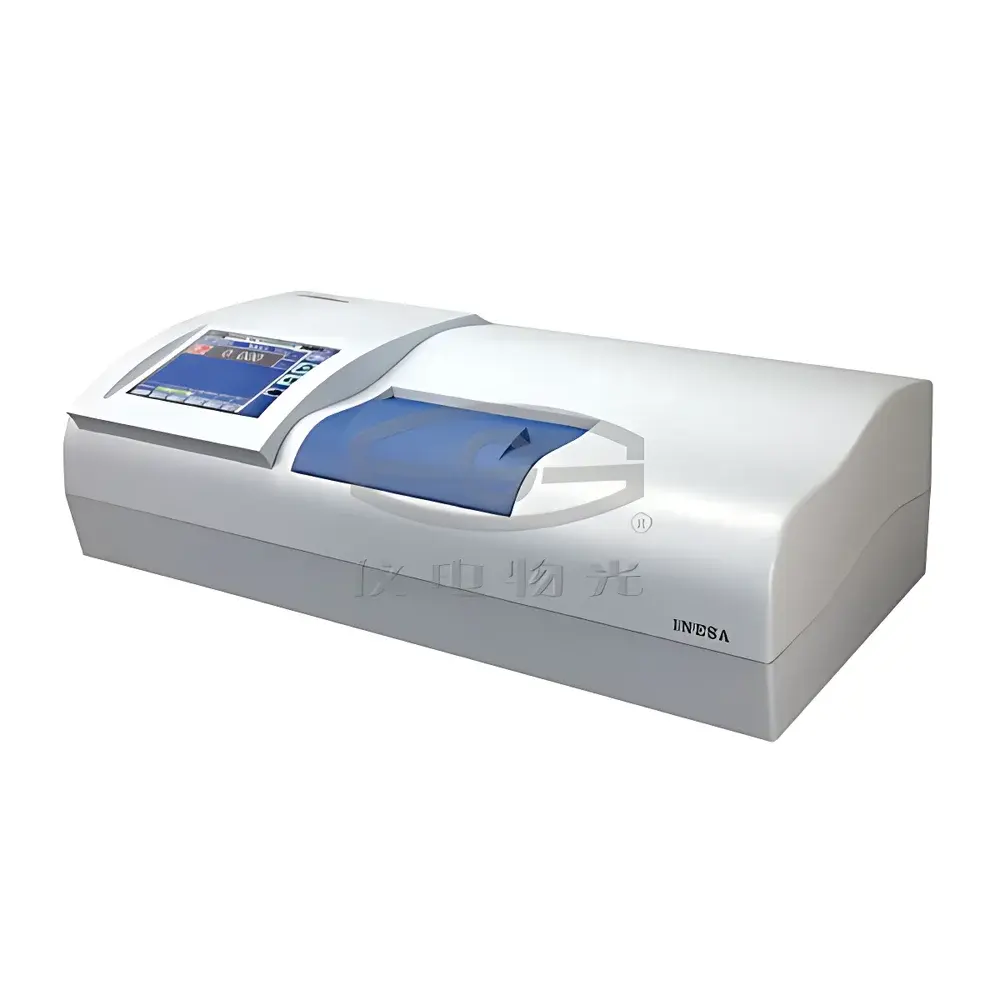
YDWG SGW®-532 Automatic High-Speed Polarimeter
| Brand | YDWG |
|---|---|
| Origin | Shanghai, China |
| Model | SGW®-532 |
| Product Type | Automatic Polarimeter |
| Temperature Control | Peltier-based (heating & cooling) |
| Display | 8-inch color TFT touchscreen |
| Light Source | LED with precision interference filter (589 nm, Na D-line equivalent) |
| Measurement Range | ±90° (optical rotation), ±259°Z (saccharimetric scale) |
| Minimum Resolution | 0.001° |
| Accuracy | ±0.004° |
| Repeatability (σ) | ≤0.002° |
| Zero Repeatability | 0.001° |
| Response Speed | 8°/s (full-scale) |
| Avg. Measurement Time | 26 s (6 readings) |
| Temp. Control Range | 10–50 °C |
| Temp. Accuracy | ±0.2 °C |
| Sample Transmittance Limit | ≥0.1% |
| Data Storage Capacity | 10,000 records |
| Compliance | JJG 536–2015 Class 0.01 |
| Interfaces | USB, RS232, dedicated printer port, USB flash drive support |
| Power | 220 V ±22 V, 50 Hz ±1 Hz, 200 W |
| Dimensions (W×D×H) | 702 × 376 × 240 mm |
| Net Weight | 21 kg |
Overview
The YDWG SGW®-532 Automatic High-Speed Polarimeter is a precision optical instrument engineered for quantitative determination of optical rotation in chiral substances—primarily used in pharmaceutical quality control, sugar refining, food & beverage analysis, and fine chemical synthesis. It operates on the fundamental principle of polarimetry: linearly polarized light is rotated upon passage through an optically active medium, with the magnitude and direction of rotation directly proportional to concentration, path length, specific rotation ([α]), and wavelength. The SGW®-532 employs a stabilized 589 nm LED light source—spectrally filtered to emulate the sodium D-line—with >100,000-hour operational lifetime, eliminating lamp replacement cycles and spectral drift associated with traditional sodium vapor lamps. Its high-speed galvanometer-driven optical system achieves full-scale angular response at 8°/s and delivers measurement stability within 26 seconds for six consecutive readings, enabling statistically robust averaging without manual intervention.
Key Features
- Integrated Peltier temperature control module (10–50 °C range, ±0.2 °C accuracy) for thermostatically regulated measurements using optional jacketed cells—critical for temperature-sensitive samples such as enzymatic hydrolysates or thermolabile APIs.
- 8-inch full-color capacitive touchscreen interface with intuitive icon-driven navigation, supporting multi-language UI (English default) and real-time graphical display of rotation trends and thermal profiles.
- Multi-parameter output capability: simultaneous calculation and display of optical rotation (α), specific rotation ([α]), concentration (g/100 mL), Brix-equivalent sugar content (°Z), and sucrose content (%)—all traceable to NIST-traceable quartz calibration standards.
- High-fidelity signal processing architecture ensures repeatability ≤0.002° (standard deviation) and zero-point stability of 0.001°, meeting JJG 536–2015 Class 0.01 metrological requirements for national verification in China.
- Robust mechanical design with vibration-damped optical bench, low-noise electronics, and electromagnetic shielding compliant with IEC 61326-1 for laboratory EMC environments.
Sample Compatibility & Compliance
The SGW®-532 accommodates standard 100 mm and 200 mm path-length cells (including non-temperature-controlled and Peltier-jacketed variants), as well as optional 50 mm micro-cells and 200 mm thermostatic cells for limited-volume or high-viscosity samples. Minimum sample transmittance requirement is 0.1%, permitting reliable measurement of deeply colored or turbid solutions common in molasses, fruit juice concentrates, or crude fermentation broths. Instrument validation documentation supports compliance with GMP Annex 11, FDA 21 CFR Part 11 (when paired with audit-trail-enabled software), and ISO/IEC 17025 method validation frameworks. All firmware and calibration routines are version-controlled and user-accessible for internal audit purposes.
Software & Data Management
Data acquisition and reporting are managed via embedded firmware with local storage of up to 10,000 complete measurement records—including timestamp, temperature, raw rotation values, averaged results, operator ID, and calibration metadata. Export is supported via USB mass storage (CSV/Excel-compatible), RS232 serial transmission (ASCII protocol), or direct thermal printing using the integrated printer interface. Optional PC software (YDWG PolarSoft™ v3.x) provides GLP-compliant electronic lab notebook functionality, statistical process control (SPC) charting, method archiving, and PDF report generation with digital signature fields. Audit trails record all parameter changes, calibration events, and user logins—fully compliant with ALCOA+ data integrity principles.
Applications
- Pharmaceutical QC: Identity confirmation and assay of chiral active pharmaceutical ingredients (e.g., levofloxacin, ibuprofen, L-DOPA) per USP , EP 2.2.7, and JP 6.07.
- Sugar industry: Routine determination of sucrose purity in raw cane syrup, beet molasses, and refined white sugar per ICUMSA Methods GS4/3-11 and AOAC 952.03.
- Food & Beverage: Quantification of fructose-glucose ratios in HFCS, citric acid enantiomeric excess in fermented beverages, and authenticity testing of honey and maple syrup.
- Academic research: Kinetic monitoring of asymmetric reactions, enzyme-catalyzed stereoselective hydrolysis, and chiral ligand screening in catalysis laboratories.
- Chemical manufacturing: Release testing of chiral intermediates and final products under ISO 9001 and IATF 16949 quality management systems.
FAQ
What wavelength does the SGW®-532 use, and how is spectral purity ensured?
The instrument uses a high-stability 589 nm LED combined with a narrow-band interference filter (FWHM ≤1.5 nm), delivering spectral output functionally equivalent to the sodium D-line—validated per ISO 13694 and referenced against NIST SRM 1690 quartz rotatory dispersion standards.
Can the SGW®-532 be validated for regulatory submissions?
Yes. Full IQ/OQ documentation packages—including installation specifications, operational test protocols, calibration certificates, and performance verification reports—are available upon request and align with ASTM E2500-13 and EU GMP Annex 15 guidelines.
Is temperature control mandatory for all measurements?
No. The Peltier module is fully programmable and may be disabled; ambient-temperature measurements are supported with standard cells. However, temperature-controlled operation is required for pharmacopoeial methods specifying 20 °C or 25 °C test conditions.
How is calibration performed, and what standards are recommended?
Multi-point automatic calibration is executed using certified quartz control plates (±5°, ±15°, ±34°, ±45°) traceable to NIM (China National Institute of Metrology). Daily zero-checks with air or solvent blanks are recommended per JJG 536–2015.
Does the instrument support network connectivity or LIMS integration?
While native Ethernet is not included, RS232 and USB-to-serial adapters enable seamless integration with LIMS platforms via standard ASCII command sets. Custom API support is available through YDWG’s OEM services division.





