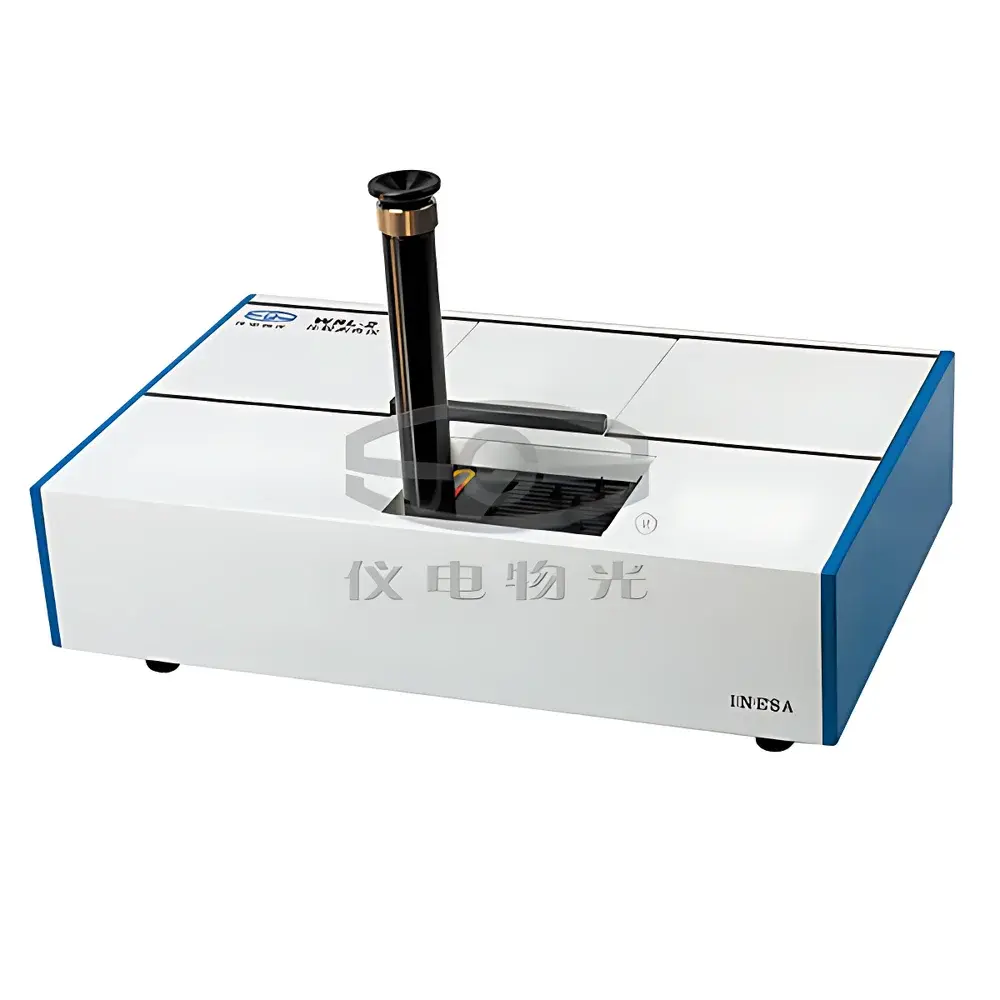
YDWG WSL-2 Lovibond Tintometer (Visual Color Comparator)
| Brand | YDWG |
|---|---|
| Origin | Shanghai, China |
| Model | WSL-2 |
| Red Scale Range | R 0.1–R79.9 Lovibond Units |
| Yellow Scale Range | Y 0.1–Y79.9 Lovibond Units |
| Blue Scale Range | B 0.1–B49.9 Lovibond Units |
| Neutral Grey Scale Range | N 0.1–N3.9 Lovibond Units |
| Minimum Scale Division | 0.1 Lovibond Unit |
| White Reference Plate Diffuse Reflectance | >80% |
| Viewing Tube Diameter | φ30 mm, Length: 215 mm |
| Standard Cell Dimensions | 10×20×40 mm, 25.4×20×40 mm, and 133.4×20×40 mm |
| Magnification | 1.9× |
| Power Supply | 220 V ±22 V, 50 Hz ±1 Hz, 50 W |
| Instrument Dimensions (Main Unit) | 500×320×130 mm |
| Net Weight | 8 kg |
Overview
The YDWG WSL-2 Lovibond Tintometer is a precision visual color comparator engineered for standardized, observer-based color assessment of translucent and opaque samples across industrial quality control laboratories. Operating on the internationally recognized Lovibond® color scale system, the instrument implements a dual-beam, side-by-side comparison methodology—where the sample is viewed simultaneously alongside calibrated glass color standards under controlled illumination. This principle adheres to the fundamental CIE-defined tristimulus color matching paradigm, enabling reproducible qualitative and semi-quantitative color evaluation without electronic sensors or spectral analysis. Designed for compliance with ASTM D1209 (for platinum-cobalt scale), ASTM D1500 (petroleum products), and ISO 4630 (used lubricating oils), the WSL-2 serves as a reference-grade comparator in environments where traceability to physical color standards—and human visual perception under standardized conditions—is essential.
Key Features
- Triple-scale Lovibond color standard alignment: independent adjustment of red (R), yellow (Y), and blue (B) glass filters, plus neutral grey (N) compensation for turbidity and light absorption effects
- Optically optimized viewing tube (φ30 mm × 215 mm) with 1.9× magnification lens for enhanced contrast resolution and reduced observer fatigue during extended evaluation sessions
- Three interchangeable cell holders accommodating standard pathlengths: 10 mm (for highly colored liquids), 25.4 mm (ASTM-compliant), and 133.4 mm (low-absorbance or dilute systems)
- High-stability white reference plate with diffuse reflectance >80%, certified per ISO 9050 and traceable to NIST-traceable ceramic standards
- Robust mechanical architecture: cast aluminum housing with vibration-damped base, non-corrosive anodized finish, and ESD-safe surface treatment for cleanroom-compatible operation
- Dedicated 220 V AC power supply with regulated internal illumination (CIE Illuminant C equivalent), eliminating dependency on ambient lighting conditions
Sample Compatibility & Compliance
The WSL-2 supports a broad range of sample formats—including clear to turbid liquids (e.g., edible oils, solvents, syrups), semi-solid colloids (paints, resins, waxes), granular solids (flour, sugar, spices), and powdered materials (pharmaceutical excipients, pigments). Its open-cell design permits direct insertion of non-standard containers up to 40 mm in height. The instrument meets requirements for GLP-compliant color documentation when used with standardized observation protocols (e.g., ISO 11664-1:2016, CIE Publication 15:2018). It is routinely employed in facilities subject to FDA 21 CFR Part 11 audit readiness, where manual comparator records are maintained with observer initials, date/time stamps, and reference standard lot numbers.
Software & Data Management
As a purely optical-mechanical comparator, the WSL-2 operates without embedded firmware or digital output interfaces. All measurements are recorded manually in laboratory notebooks or LIMS-integrated paperless workflows using standardized forms aligned with ISO/IEC 17025 documentation templates. Users may digitize results via validated spreadsheet templates (e.g., Excel-based color loggers compliant with Annex SL clause 7.5.2) that enforce mandatory fields: observer ID, calibration date, cell pathlength, observed R/Y/B/N values, and deviation notes. No proprietary software is required, ensuring long-term data accessibility and eliminating vendor lock-in risks associated with closed-source platforms.
Applications
- Edible oil refining: monitoring bleaching efficiency and oxidation stability via R/Y ratio tracking per AOCS Cd 13b-97
- Petrochemical QC: grading diesel fuel, lubricants, and transformer oils against ASTM D1500 reference scales
- Food & beverage: verifying consistency of jams, sauces, malt extracts, and caramel colorants per USP
- Paint & coatings: assessing batch-to-batch hue uniformity in solvent-based and waterborne systems
- Pharmaceutical excipients: confirming visual identity of lactose, microcrystalline cellulose, and starch grades per EP 2.2.2
- Textile dyeing: validating dyebath strength and shade matching prior to fabric immersion
FAQ
Is the WSL-2 compatible with digital color measurement systems?
Yes—Lovibond unit readings from the WSL-2 can be converted to CIELAB (L*, a*, b*) coordinates using NIST-traceable conversion matrices published in ASTM E308-22 Annex A3, enabling cross-platform correlation with spectrophotometers.
What maintenance is required for long-term accuracy?
Annual recalibration against certified Lovibond glass standards (traceable to UK National Physical Laboratory) is recommended; cleaning of optical surfaces with lens-grade isopropyl alcohol and lint-free wipes is performed before each use.
Can the WSL-2 measure fluorescent or phosphorescent samples?
No—its tungsten-halogen illumination source lacks UV excitation capability; such samples require dedicated fluorometric instrumentation per ISO 11664-7.
Does the instrument comply with ISO/IEC 17025 accreditation requirements?
Yes—when operated within documented SOPs covering observer training, environmental controls (23±2°C, 50±10% RH), and standard reference management, the WSL-2 satisfies Clause 7.2.2 (selection of methods) and Clause 7.7 (ensuring validity of results).
Are replacement Lovibond glass standards available through YDWG?
Yes—original equipment manufacturer (OEM) standards are supplied with NPL or PTB traceability certificates, including full uncertainty budgets per ISO/IEC 17025:2017 Clause 6.4.10.