
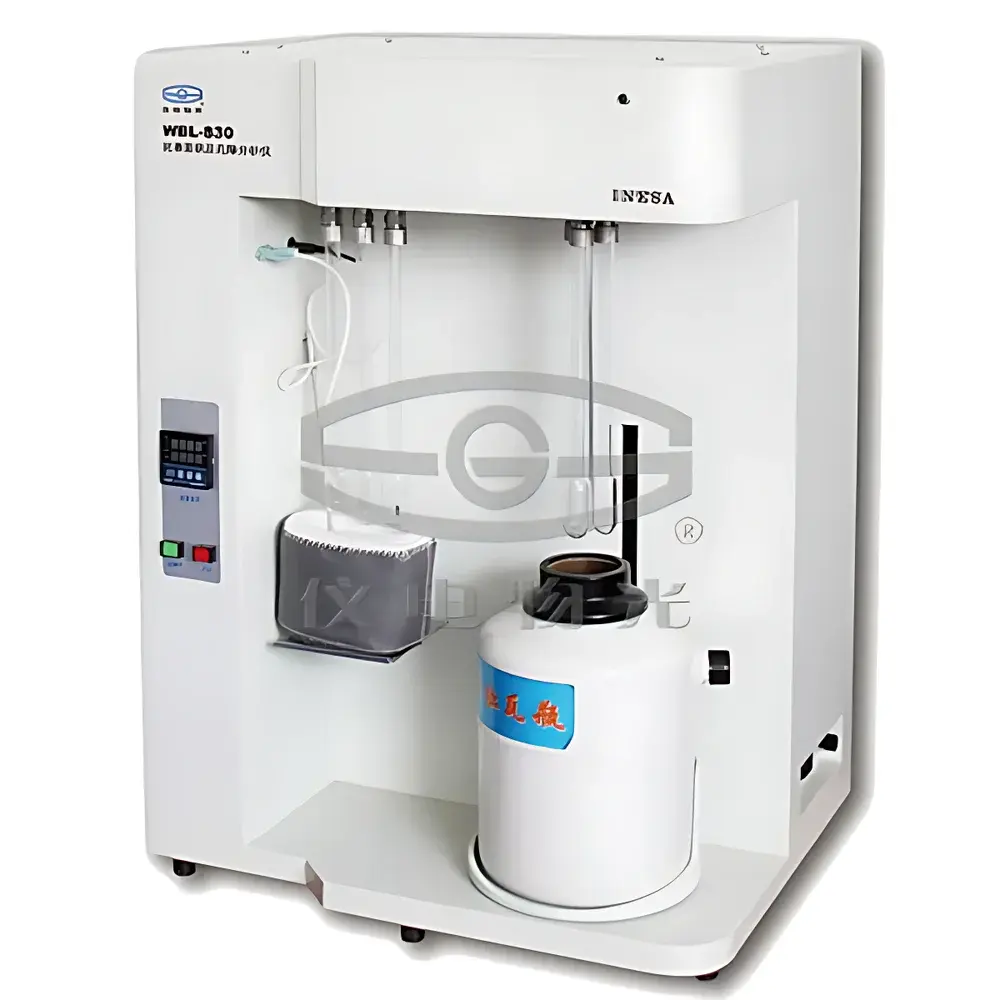
YDWO WBL Series Automated Specific Surface Area and Porosity Analyzer
| Brand | YDWO |
|---|---|
| Origin | Shanghai, China |
| Model | WBL Series |
| Measurement Principle | Static Volumetric Nitrogen Physisorption at 77 K |
| Adsorption Gas | N₂ (default), He |
| P/P₀ Range | 1×10⁻⁶–0.998 |
| Surface Area Range | ≥0.0005 m²/g |
| Pore Size Analysis Range | 3.5–5000 Å |
| Pressure Sensor | Imported absolute pressure transducer, 0–133 kPa, ±0.12% FS |
| Temperature Sensors | PT-100, ±0.1 °C |
| Vacuum System | Imported dual-stage rotary vane pump, ultimate vacuum ≤1.0×10⁻⁴ Torr |
| Dewar Capacity | 2 L metal cryostat, >80 h hold time |
| Sample Stations | 1–3 independent analysis ports (model-dependent) |
| Data Output | BET, Langmuir, BJH, t-plot, D-A, H-K, NLDFT/GCMC pore size distributions, isotherms, total pore volume/surface area |
Overview
The YDWO WBL Series Automated Specific Surface Area and Porosity Analyzer is a high-precision instrument engineered for quantitative characterization of porous and powdered materials using static volumetric nitrogen physisorption at liquid nitrogen temperature (77 K). Based on the fundamental principles of gas adsorption thermodynamics and mass balance under controlled vacuum conditions, the system measures equilibrium gas uptake across a wide relative pressure range (P/P₀ = 1×10⁻⁶ to 0.998) to generate full adsorption–desorption isotherms. These isotherms serve as the primary input for rigorous surface and pore structural analysis in accordance with internationally recognized standards—including ISO 9277 (BET surface area), ISO 15901 (pore size distribution), and GB/T 119587 (Chinese national standard for physical adsorption methods). The analyzer operates on the static capacity method: a known quantity of high-purity nitrogen (99.999%) is introduced into a calibrated sample cell under ultra-high vacuum (≤1.0×10⁻⁴ Torr), and pressure decay is monitored via high-stability absolute pressure transducers. Simultaneous temperature monitoring—using multiple PT-100 sensors embedded in the manifold and cryostat—ensures thermodynamic consistency throughout measurement cycles.
Key Features
- Modular all-stainless-steel vacuum manifold architecture minimizes dead volume and eliminates elastomeric seals, thereby enhancing long-term vacuum integrity and eliminating hydrocarbon contamination risks associated with traditional rubber gaskets.
- Proprietary metal Dewar flask design provides >80 hours of continuous liquid nitrogen retention without refilling—enabling unattended overnight operation while maintaining stable 77 K thermal conditions; eliminates fragility and handling hazards inherent in glass Dewars.
- High-resolution sensing subsystem comprising imported absolute pressure transducers (0–133 kPa, ±0.12% full-scale accuracy) and six independently calibrated PT-100 sensors (±0.1 °C) ensures traceable, reproducible data acquisition across low-pressure and high-coverage regimes.
- Multi-channel sample station configuration (1–3 ports, model-dependent) supports parallel or sequential analysis of heterogeneous samples without cross-contamination, with independent thermal equilibration and pressure control per station.
- Fully automated operation—from outgassing and degassing to adsorption/desorption cycling—is governed by deterministic control logic embedded in the firmware, reducing operator dependency and inter-lab variability.
Sample Compatibility & Compliance
The WBL Series accommodates a broad spectrum of solid-phase materials including but not limited to zeolites, metal–organic frameworks (MOFs), silica gels, alumina catalysts, activated carbons, clays, soils, pharmaceutical excipients, and battery electrode materials. Sample preparation follows ASTM D3663 and ISO 15901 guidelines: degassing under dynamic vacuum (≤1.0×10⁻⁴ Torr) at elevated temperatures (up to 400 °C, optional furnace accessory) ensures removal of physisorbed contaminants prior to analysis. All reported surface areas and pore parameters comply with GLP-aligned data integrity requirements; audit trails, electronic signatures, and user-access controls are configurable to meet FDA 21 CFR Part 11 readiness when integrated with validated software environments. Instrument calibration is traceable to NIST-certified reference materials (e.g., NIST SRM 1990a for surface area verification).
Software & Data Management
The proprietary YDWO SurfaceMaster™ software suite provides end-to-end workflow management—from instrument initialization and method definition to raw data visualization, model-based interpretation, and regulatory-compliant reporting. Supported theoretical models include single-point and multipoint BET, Langmuir, BJH (for meso/macropores), t-plot and αs-plot (micropore analysis), Dubinin–Astakhov (DA), Horvath–Kawazoe (HK), and advanced non-local density functional theory (NLDFT) and grand canonical Monte Carlo (GCMC) kernel libraries for slit-, cylindrical-, and spherical-pore geometries. Isotherm fitting employs weighted nonlinear regression with uncertainty propagation. Export formats include native .ydw, CSV, PDF, and Excel (.xlsx); all reports embed metadata (instrument ID, operator, timestamp, calibration status, raw sensor logs) to satisfy ISO/IEC 17025 documentation requirements.
Applications
This analyzer serves critical quality control and R&D functions across academia and industry. In catalysis research, it quantifies active site accessibility and pore confinement effects governing reaction kinetics. For battery material development, it correlates specific surface area and pore tortuosity with ion transport resistance and SEI formation behavior. In pharmaceutical manufacturing, it verifies batch-to-batch consistency of excipient surface energetics affecting dissolution and blend uniformity. Environmental labs apply it to assess contaminant adsorption capacity of engineered sorbents, while geotechnical engineers use it to characterize clay swelling potential and permeability thresholds. Its compliance with ISO, ASTM, and GB standards ensures data acceptance in peer-reviewed publications and regulatory submissions.
FAQ
What gases are supported for adsorption analysis?
Nitrogen (99.999% purity) is the default adsorbate for surface area and meso/macropore analysis. Helium is used for skeletal density determination; argon and krypton may be employed for low-surface-area or microporous samples upon hardware and software configuration.
Is helium required for routine operation?
No—helium is only necessary when measuring true (helium) density for absolute pore volume calculation. Most standard BET and BJH analyses require nitrogen only.
Can the system perform simultaneous multi-sample analysis?
Yes—the WBL-820 and WBL-830 models support up to three independent sample stations, each with dedicated pressure transducers and thermal regulation, enabling concurrent analysis without compromise in data fidelity.
How is vacuum integrity verified during operation?
Real-time leak rate monitoring is performed before and after each analysis cycle using pressure-rise tests compliant with ISO 15901 Annex B; pass/fail thresholds are user-definable and logged automatically.
Does the software support 21 CFR Part 11 compliance?
Yes—when deployed on validated Windows OS platforms with domain-authenticated user accounts, the software supports role-based access control, electronic signatures, and immutable audit trails meeting FDA requirements for regulated environments.



