
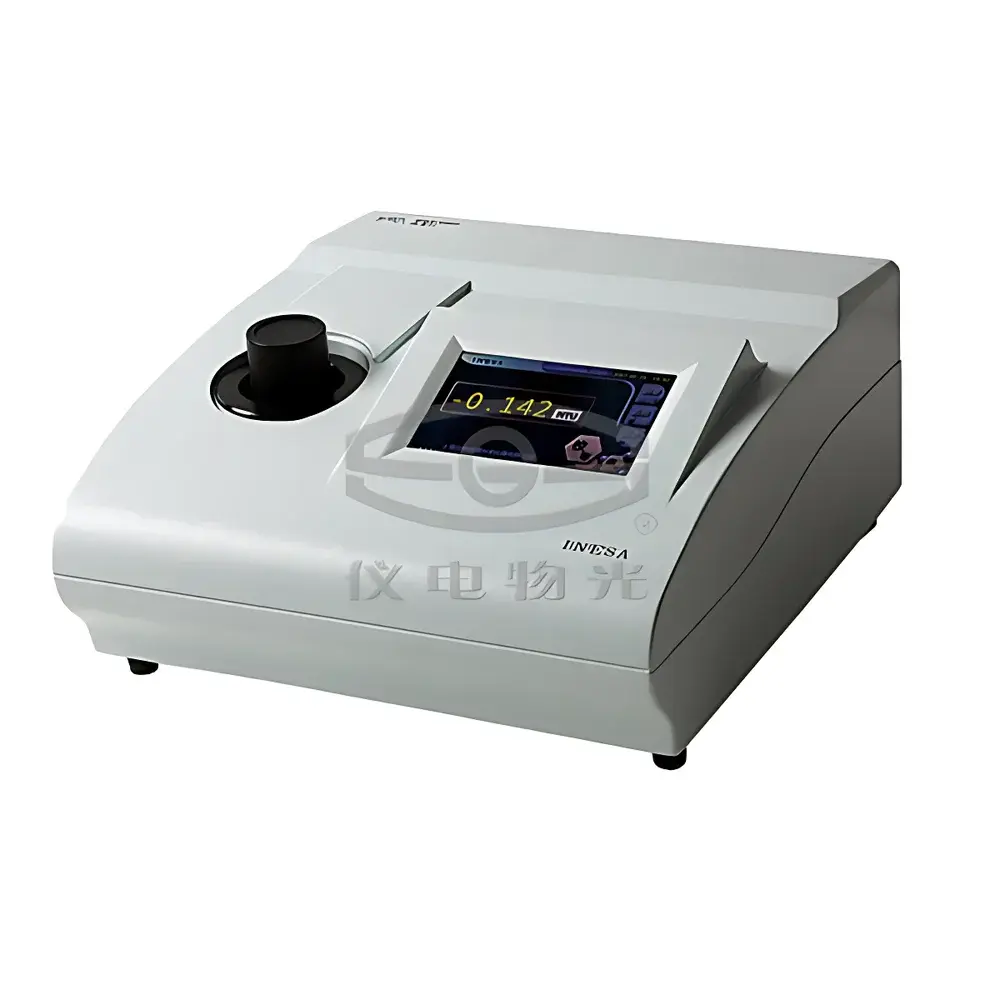
YDWO WGZ Series Benchtop Turbidimeter
| Brand | YDWO |
|---|---|
| Origin | Shanghai, China |
| Model | WGZ-4000 / WGZ-2000 / WGZ-1000 / WGZ-500 / WGZ-200 / WGZ-100 |
| Measurement Range | 0.000–50.00 NTU |
| Resolution | 0.1 NTU |
| Accuracy | ≤ ±6% |
| Light Source | Tungsten-halogen lamp, 400–600 nm |
| Display Units | NTU, FTU, EBC, ASBC |
| Sample Cell | Ø25 mm × 95 mm, 30–40 mL capacity |
| Data Storage | 1000 measurement records |
| Interface | USB port & USB flash drive support |
| Compliance | ISO 7027, HJ 1075–2019, GLP-ready |
| Power Supply | 220 V ± 22 V, 50 Hz ± 1 Hz, 30 W |
| Dimensions | 358 × 323 × 160 mm |
| Net Weight | 6 kg |
Overview
The YDWO WGZ Series Benchtop Turbidimeter is a precision optical instrument engineered for quantitative assessment of turbidity in aqueous and transparent liquid samples via nephelometric (scattered-light) and transmittance-based detection. Operating on the principle of ratio-metric dual-detector measurement—simultaneously capturing forward-scattered and transmitted light at defined angular geometries—the system conforms to ISO 7027:2016, which specifies the use of near-infrared (NIR) or visible light sources with standardized detector placement to minimize color interference and improve reproducibility. Unlike single-beam systems, this dual-signal architecture enables automatic compensation for sample absorbance, particulate settling, and lamp intensity drift, ensuring stable baseline performance across extended operational cycles. Designed for routine quality control and regulatory compliance testing, the WGZ Series delivers traceable, repeatable results in environments where adherence to HJ 1075–2019 (China’s national standard for water quality—turbidity determination) and GLP/GMP documentation requirements is mandatory.
Key Features
- Auto-ranging optical detection across up to four discrete turbidity intervals (e.g., 0.000–50.00 NTU, 50.01–200.0 NTU, etc.), eliminating manual range selection and reducing operator error.
- High-resolution 7-inch color LCD touchscreen interface with intuitive icon-driven navigation, supporting multilingual UI configuration and real-time graphical display of measurement trends.
- Integrated microprocessor-controlled calibration engine enabling up to seven-point calibration using NIST-traceable formazin or polymer standards; supports user-defined calibration curves for non-standard matrices.
- Robust mechanical design featuring thermally stabilized optical path, anti-vibration sample chamber mount, and sealed detector housing to minimize environmental drift under ambient laboratory conditions (15–30 °C).
- Dual-output reporting: simultaneous display of NTU (nephelometric turbidity units), FTU (formazin turbidity units per ISO 7027), EBC (European Brewery Convention), and ASBC (American Society of Brewing Chemists) units—critical for cross-sector validation in beverage, pharmaceutical, and wastewater applications.
- Onboard data management with timestamped storage of 1000 measurement records, including operator ID, calibration history, and environmental metadata—fully compliant with GLP audit trail requirements.
Sample Compatibility & Compliance
The WGZ Series accommodates standard cylindrical glass cuvettes (Ø25 mm × 95 mm, 30–40 mL volume), compatible with both low-turbidity ultrapure water and high-concentration industrial effluents. Its optical architecture minimizes interference from dissolved colorants and fine colloids through spectral bandpass filtering (400–600 nm tungsten-halogen illumination) and ratio-based signal normalization. The instrument meets ISO 7027:2016 for method validation, fulfills HJ 1075–2019 for environmental monitoring in China, and supports FDA 21 CFR Part 11 readiness when paired with validated PC software. All firmware and calibration protocols are documented per ICH Q7 and ISO/IEC 17025 guidelines, facilitating third-party accreditation audits in QC laboratories.
Software & Data Management
Data export is supported via native USB host interface—enabling direct readout from USB flash drives without driver installation—and optional RS-232 or Ethernet modules (sold separately) for LIMS integration. The included YDWO TurbSoft™ desktop application provides full traceability: electronic signatures, version-controlled calibration logs, automated report generation (PDF/CSV), and configurable audit trail filters (e.g., by date range, operator, or measurement ID). All stored records include checksum-verified timestamps, sensor health diagnostics, and flagging of out-of-spec measurements per user-defined acceptance criteria—ensuring alignment with ALCOA+ data integrity principles.
Applications
- Drinking water treatment: verification of filtration efficiency and coagulant dosing control in municipal plants.
- Pharmaceutical manufacturing: USP particulate matter testing of parenteral solutions and cleanroom rinse water.
- Beverage quality assurance: EBC/ASBC-compliant haze analysis in beer, wine, and fruit juices.
- Power generation: monitoring of boiler feedwater and condensate purity per ASTM D5116 and EPRI guidelines.
- Environmental monitoring: field-deployable lab verification of surface water, wastewater influent/effluent, and sedimentation basin performance.
- Chemical process R&D: real-time tracking of emulsion stability, polymer precipitation kinetics, and nanoparticle dispersion homogeneity.
FAQ
Does the WGZ Series comply with international turbidity standards?
Yes—it is certified to ISO 7027:2016 and implements the 90° scattered-light geometry with tungsten-halogen illumination (400–600 nm), satisfying requirements for metrological equivalence with NIST SRM 2000 series standards.
Can the instrument be calibrated with non-formazin standards?
Yes—user-defined calibration curves can be loaded via USB, supporting polymer-based or silica suspension standards for matrix-matched validation in high-color or viscous samples.
Is the data storage function password-protected and audit-trail enabled?
Yes—each record includes immutable timestamps, operator login credentials, and change logs; audit trails are exportable in CSV format with cryptographic hash verification.
What maintenance is required to ensure long-term accuracy?
Annual verification using certified reference standards is recommended; optical windows require cleaning only with lint-free wipes and isopropyl alcohol—no alignment tools or factory recalibration needed under normal use.
Is remote firmware update supported?
Firmware updates are delivered via encrypted USB firmware packages; no network connectivity or cloud dependency is required, preserving air-gapped lab security protocols.




