
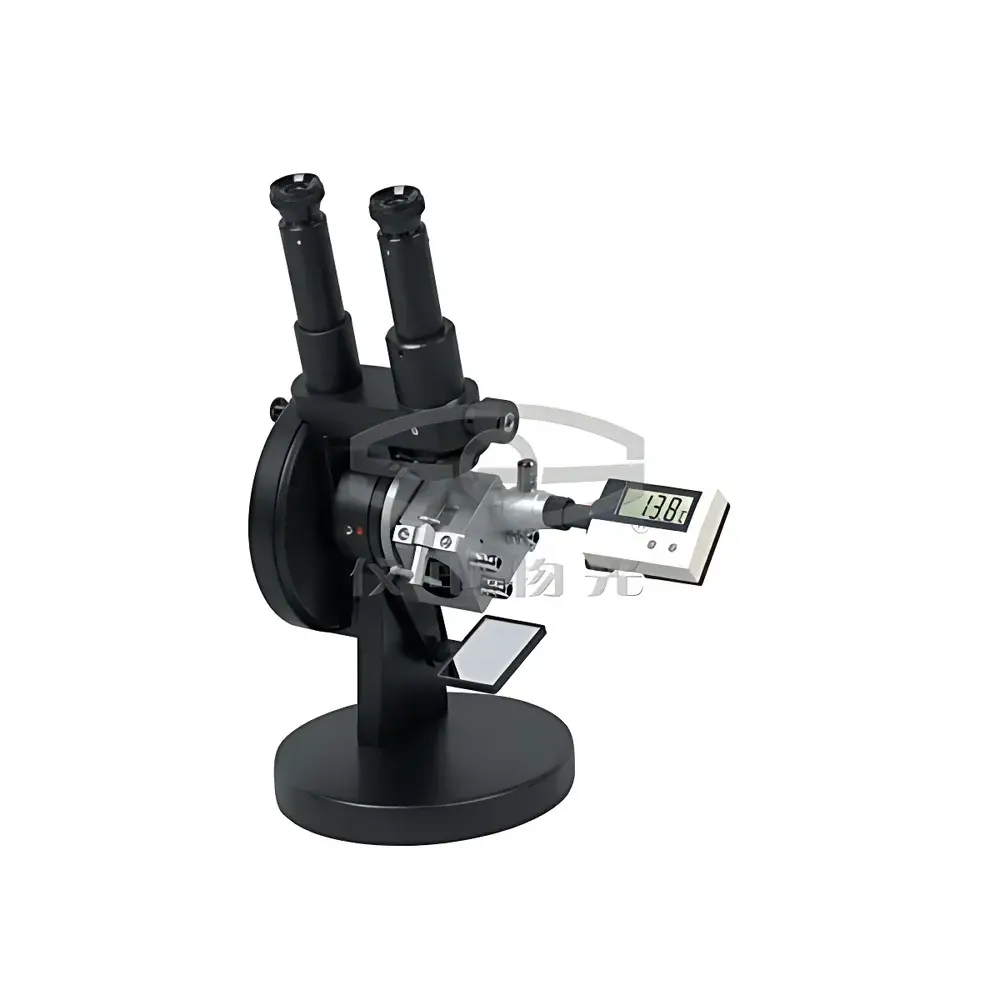
YDWO WYA-2W Abbe Refractometer (Binocular)
| Brand | YDWO |
|---|---|
| Origin | Shanghai, China |
| Model | WYA-2W |
| Product Type | Benchtop Abbe Refractometer |
| Measurement Range (nD) | 1.3000–1.7000 |
| Brix Range | 0–95% |
| Accuracy (nD) | ±0.0003 (estimated reading) |
| Mean Dispersion Display Accuracy | ±0.0005 |
| Temperature Readout | Digital thermometer (external or integrated display) |
| Viewing Method | Binocular observation |
| Dimensions | 160 mm × 140 mm × 100 mm |
| Net Weight | 3 kg |
| Prism Material | Hard optical glass |
| Base Material | Stainless steel |
| Flow Cell | Integrated circulation chamber (compatible with external thermostatic bath) |
| Compliance | Designed to meet general laboratory requirements for refractive index measurement per ISO 2859 and ASTM D1218 |
Overview
The YDWO WYA-2W Abbe Refractometer (Binocular) is a precision optical instrument engineered for manual, high-reproducibility refractive index (nD) and Brix concentration measurements in quality control, academic research, and routine analytical laboratories. Based on the classical Abbe principle—utilizing total internal reflection at the prism-sample interface—the instrument determines nD by aligning the boundary between light and dark fields in the reticle via fine mechanical adjustment of the compensator and focusing eyepiece. Its dual-eyepiece optical path provides enhanced visual comfort and parallax-free observation during extended use, reducing operator fatigue and improving measurement consistency. Unlike digital or automated units, the WYA-2W maintains a fully analog optical train with no electronic sensing elements in the light path, ensuring long-term stability and immunity to electromagnetic interference. The refractometer is calibrated using certified standard reference liquids traceable to NIST SRMs (e.g., distilled water, benzene, bromonaphthalene), and its optical scale is graduated directly in nD units (1.3000–1.7000) and % Brix (0–95%), enabling direct readout without software interpolation.
Key Features
- Binocular viewing system with individually focusable eyepieces for ergonomic, prolonged operation
- High-stability stainless-steel base and precision-machined aluminum housing for vibration damping and thermal inertia
- Hard optical glass prisms (BK7 or equivalent) with scratch-resistant surface finish and low birefringence
- Integrated flow-through cell compatible with external thermostatic circulators (e.g., Polyscience or Huber units) for temperature-controlled measurements at 20 °C, 25 °C, or other user-defined setpoints
- Mechanical vernier scale with 0.0001 resolution for manual estimation; accuracy verified at ±0.0003 nD under ISO 5725-2 repeatability conditions
- Digital temperature display module (separate or embedded) providing real-time sample temperature monitoring adjacent to the prism surface
- No internal batteries or firmware—fully serviceable with standard optical alignment tools and factory calibration procedures
Sample Compatibility & Compliance
The WYA-2W accommodates liquid, semi-liquid, and low-viscosity transparent or translucent samples—including aqueous solutions, organic solvents, essential oils, syrups, and polymer melts—provided they do not chemically attack optical glass or stainless steel surfaces. Sample volume requirement is ≤0.2 mL per measurement. The instrument complies with foundational metrological principles outlined in ISO/IEC 17025 for testing laboratories and supports GLP documentation when used with controlled calibration logs and environmental monitoring records. While not inherently 21 CFR Part 11 compliant (as it lacks electronic audit trails), its analog design ensures unambiguous, human-readable measurement records suitable for FDA-inspected environments where paper-based SOPs remain standard practice. It meets the physical and optical performance criteria referenced in ASTM D1218 (Standard Test Method for Refractive Index of Hydrocarbon Liquids) and ISO 2859 (Sampling Procedures for Inspection by Attributes).
Software & Data Management
The WYA-2W operates independently of proprietary software or drivers. All measurements are recorded manually into laboratory notebooks or LIMS-compatible spreadsheets. Optional accessories include a calibrated digital thermometer probe (PT100 class B) with RS232 output for external data logging, and a USB microscope adapter for photodocumentation of the field-of-view. For regulated environments requiring traceability, users may integrate the instrument into existing QA workflows by pairing it with validated electronic lab notebooks (ELNs) that support handwritten entry verification and signature capture. No firmware updates, cloud connectivity, or cybersecurity protocols apply—eliminating validation overhead associated with embedded electronics.
Applications
- Pharmaceutical excipient QC: Sucrose, glycerol, propylene glycol concentration verification per USP
- Food & beverage analysis: Brix determination in fruit juices, honey, soft drinks, and dairy concentrates
- Chemical manufacturing: Purity assessment of solvents (e.g., ethanol, acetone, toluene) and monomer batches
- Academic teaching labs: Demonstration of dispersion, critical angle, and Cauchy equation fundamentals
- Petrochemical QC: Refractive index screening of lubricants, transformer oils, and biofuel blends
- Essential oil authentication: Detection of adulteration via deviation from published nD reference ranges
FAQ
Does the WYA-2W support automatic temperature compensation (ATC)?
No. ATC is not implemented. Temperature control requires connection to an external thermostatic bath via the integrated flow cell. The digital thermometer provides real-time temperature readout but does not adjust the refractive index scale automatically.
Can the instrument measure opaque or highly colored samples?
No. The Abbe principle requires sufficient light transmission through the sample-prism interface. Turbid, suspended, or deeply absorbing samples will yield indistinct or unmeasurable boundaries.
Is calibration verification possible without certified standards?
While water (nD = 1.3330 at 20 °C) serves as a quick check, full verification and recalibration require NIST-traceable reference liquids with documented uncertainty budgets, per ISO/IEC 17025 Clause 6.6.
What maintenance is required for long-term accuracy?
Monthly cleaning of prism surfaces with lens-grade tissue and anhydrous ethanol; annual mechanical inspection of the compensator gear train and eyepiece collimation; biannual verification against primary standards.
Is the flow cell compatible with all standard recirculating chillers?
Yes—equipped with universal 6 mm OD silicone tubing ports (inlet/outlet), supporting flow rates of 0.3–1.0 L/min and pressure tolerances up to 1.5 bar.




