
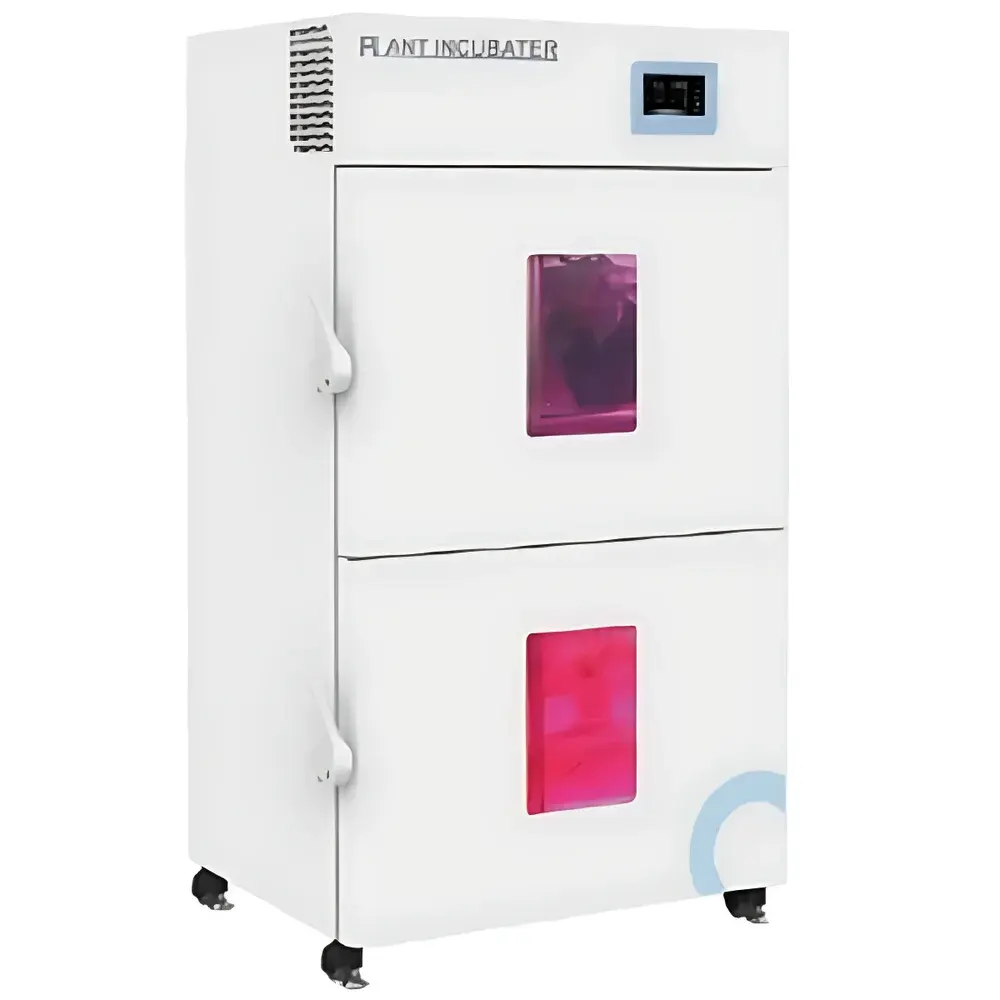
Yi Heng PGC-150 LED Plant Growth Chamber
| Brand | Yi Heng |
|---|---|
| Origin | Shanghai, China |
| Model | PGC-150 |
| Illumination Type | Shelf-integrated LED lighting |
| Light Source | High-efficiency LED array |
| Spectral Range | Photosynthetically Active Radiation (PAR), 400–700 nm |
| Temperature Control Range (dark) | 5–45°C |
| Temperature Control Range (light-on, single-tier) | 10–45°C |
| Temperature Uniformity | ±0.5°C |
| Humidity Control Range (H-series only) | 50–90% RH |
| Humidity Uniformity | ±3% RH at 80% RH |
| Internal Volume | 160 L |
| Interior Dimensions (W×D×H) | 550 × 450 × 650 mm |
| Display | 7-inch capacitive touchscreen controller |
| Refrigerant | R134a |
| Compressor | Industrial-grade hermetic compressor |
| Insulation | Polyurethane foam (≥60 mm thickness) |
| Chamber Material | SUS304 stainless steel interior |
| Airflow Design | Balanced vertical laminar airflow with adjustable shelf spacing |
| Optional Features | CO₂ monitoring (0–1%, 0–2%, or 0–10% range, IR sensor), PAR irradiance feedback control, USB data logging (4 GB internal + USB export), multi-level user access control, SMS alarm system, door safety lock |
Overview
The Yi Heng PGC-150 LED Plant Growth Chamber is an engineered environmental simulation platform designed for controlled-environment plant physiology research, seed germination studies, tissue culture propagation, and model organism cultivation—including Arabidopsis thaliana, algae, and higher plants. It operates on the principle of precise, independent regulation of temperature, relative humidity (in H-series models), photoperiod, spectral quality, and photosynthetic photon flux density (PPFD) within a sealed, contamination-minimized chamber. Unlike conventional incubators relying on broad-spectrum fluorescent or incandescent sources, the PGC-150 integrates a modular, spectrally tunable LED lighting system optimized for photosynthetic efficiency—delivering targeted wavelengths (e.g., 450 nm blue, 525 nm green, 660 nm red, and optionally 730 nm far-red) without significant radiant heating. This enables stable thermal conditions even during extended illumination cycles—a critical requirement for reproducible phenotyping, circadian rhythm assays, and stress-response experiments under GLP-compliant workflows.
Key Features
- Modular LED Illumination System: Shelf-integrated, waterproof LED panels emit calibrated PAR spectra (400–700 nm); standard configuration delivers 400 µmol/m²·s PPFD across three discrete peaks (450/525/660 nm); optional configurations support full-spectrum white, four-band (including 730 nm), or high-intensity single-band modes (up to 1200 µmol/m²·s).
- Precision Environmental Control: Dual-stage refrigeration with R134a refrigerant and electronic expansion valve (EEV) enables cold-balance PID regulation—achieving ±0.5°C temperature stability and ≤0.1°C resolution; SUS304 stainless steel interior ensures corrosion resistance and ease of decontamination.
- Intelligent Touchscreen Controller: 7-inch capacitive display supports multi-segment programming (up to 30 steps per cycle) for time-dependent ramping of temperature, humidity (H-series), light intensity, and photoperiod; real-time graphical trend logging accessible via on-screen interface or USB export.
- Uniform Air Distribution: Optimized vertical airflow architecture with adjustable shelf supports ensures ≤±1.5°C spatial temperature deviation across all levels; low-turbulence circulation preserves delicate explants and avoids desiccation artifacts in tissue culture applications.
- Compliance-Ready Architecture: Built-in hardware redundancy includes dual independent overtemperature cutoffs (mechanical and digital), current/voltage surge protection for all critical components, and password-protected parameter locking—supporting audit readiness for ISO 17025, OECD GLP, and institutional biosafety protocols.
Sample Compatibility & Compliance
The PGC-150 accommodates standard plant growth vessels—including Magenta boxes, Petri dishes, multiwell plates, hydroponic trays, and small-pot systems—within its 160 L working volume and 550 × 450 × 650 mm interior cavity. Its stainless-steel construction and smooth-welded corners meet ISO 14644-1 Class 7 cleanroom compatibility requirements for low-particulate environments. Humidity control (H-series) utilizes ultrasonic humidification paired with a high-stability capacitive RH sensor rated for continuous operation at elevated temperatures—ensuring traceable compliance with ASTM E104-22 (Standard Practice for Maintaining Constant Relative Humidity). Optional CO₂ sensing employs non-dispersive infrared (NDIR) technology, delivering linear response across 0–10% range independent of ambient T/RH drift—aligned with ISO 8573-1 for gas purity monitoring in controlled atmosphere studies.
Software & Data Management
Data integrity is maintained through embedded 4 GB flash memory supporting timestamped storage of all setpoints and sensor readings at user-defined intervals (1 min to 24 h). USB export enables CSV-formatted datasets compatible with MATLAB, R, and JMP for statistical analysis and growth curve modeling. Optional firmware modules support FDA 21 CFR Part 11–compliant electronic signatures via role-based login (Administrator / Operator / Guest), audit trail generation (including parameter changes, alarm events, and door openings), and encrypted data transfer. Remote notification—via GSM-enabled SMS alerts—triggers upon deviation from preset thresholds (e.g., temperature excursion > ±2°C, power failure, door left open >60 s), facilitating unattended overnight operation in core facility settings.
Applications
- Phenotypic screening of transgenic lines under standardized photoperiodic and thermoperiodic regimes
- Optimization of micropropagation protocols for economically important crops (e.g., orchids, strawberries)
- Circadian clock entrainment studies using programmable blue/red/far-red spectral switching
- Abiotic stress modeling—including drought (via humidity ramping), heat shock (stepwise temperature elevation), and light saturation experiments
- Algal biomass production trials requiring tightly regulated PAR intensity and spectral balance
- Pre-acclimation of seedlings prior to greenhouse or field transfer under defined hardening schedules
FAQ
What is the maximum achievable PPFD at the shelf surface?
Standard configuration provides 400 µmol/m²·s across the full PAR band; optional high-intensity modules deliver up to 1200 µmol/m²·s in narrowband (400–700 nm) mode.
Can the chamber maintain humidity during extended light-on cycles?
Yes—the H-series integrates active ultrasonic humidification with closed-loop feedback control, sustaining 50–90% RH stability even at 45°C and 100% illumination duty cycle.
Is CO₂ control available as a factory-installed option?
Yes—three IR-based CO₂ sensor ranges are offered (0–1%, 0–2%, or 0–10%) with automatic solenoid injection and proportional control logic; calibration is traceable to NIST-certified reference gases.
How is temperature uniformity validated across shelves?
Factory validation uses nine-point thermocouple mapping per shelf level per ICH Q5C Annex 2 guidelines; final reports include spatial deviation metrics and uncertainty budgets.
Does the system support integration with building management systems (BMS)?
RS-485 Modbus RTU interface is standard; optional Ethernet/IP or BACnet MS/TP gateways enable centralized HVAC and alarm aggregation in shared laboratory infrastructure.



