
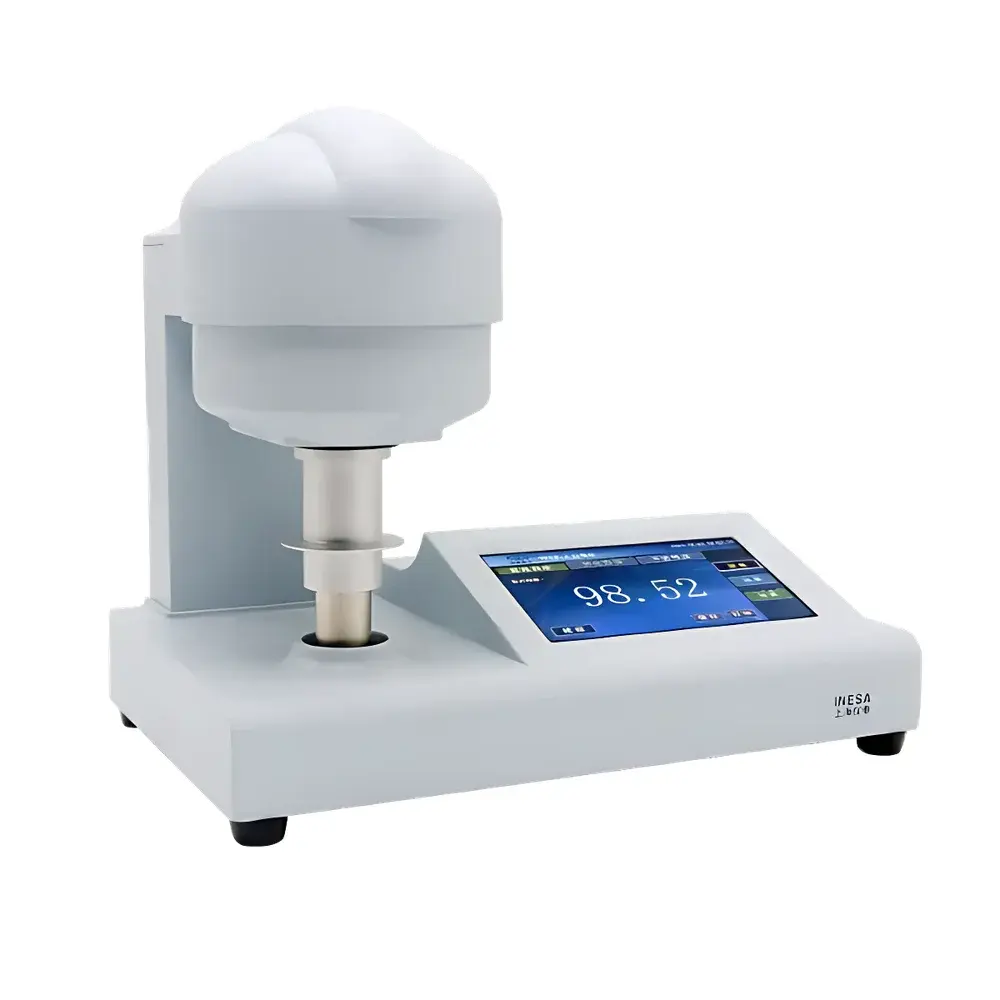
Yidian Woguang WSB-2 Whiteness Meter
| Brand | Yidian Woguang (YDWG) |
|---|---|
| Origin | Shanghai, China |
| Model | WSB-2 |
| Measurement Modes | R457 Blue-light Whiteness, Fluorescent Whiteness, Opacity |
| Illumination Geometry | 45/0 and d/0 compliant |
| Spectral Peak | 457 nm ± 2 nm, FWHM: 45 nm |
| Detector | Silicon Photodiode |
| Aperture | 30 mm |
| Range | 0–150 whiteness units |
| Resolution | 0.01 unit |
| Accuracy | ≤ ±1.0 unit |
| Repeatability | ≤ ±0.2 unit |
| Drift Stability | ≤ ±0.1 unit over 30 min |
| Display | 7-inch color capacitive touchscreen |
| Data Storage | 200 test records |
| Interface | USB host for U-disk export |
| Power | 100–240 V AC, 50/60 Hz, 40 W |
| Dimensions | 360 × 228 × 312 mm |
| Net Weight | 4.8 kg |
Overview
The Yidian Woguang WSB-2 Whiteness Meter is a precision optical instrument engineered for quantitative assessment of whiteness and opacity in solid and powdered materials across industrial quality control and R&D laboratories. It operates on the principle of reflectance photometry under standardized illumination geometries—specifically conforming to both 45/0 (directional illumination, normal viewing) and d/0 (diffuse illumination, normal viewing) configurations as defined in ISO 2470-1, ISO 2471, and ASTM E313. Its core optical system integrates a stabilized blue-light source centered at 457 nm (±2 nm) with a spectral bandwidth of 45 nm (FWHM), enabling accurate determination of the R457 whiteness index—a critical parameter for paper, pulp, starch, pigments, and ceramic raw materials. A secondary fluorescent excitation channel allows simultaneous evaluation of optical brightener response, supporting compliance with GB/T 22427.6, QB/T 2804, and other national standards governing fluorescent whitening agent (FWA) quantification.
Key Features
- Dual-source optical architecture: Independent blue LED (457 nm) and UV-excited fluorescent source for independent R457 and fluorescent whiteness measurements
- Configurable illumination geometry: Switchable 45/0 and d/0 modes via internal optical path selection—no external attachments required
- High-stability silicon photodiode detector with temperature-compensated signal processing to minimize thermal drift
- 7-inch full-color capacitive touchscreen interface with intuitive icon-driven navigation and multilingual UI support (English default)
- Onboard calibration verification using certified ceramic tile standards traceable to NIM (National Institute of Metrology, China)
- Real-time stability monitoring: Automatic baseline drift compensation and 30-minute stability validation per ISO 9276-3
- Rugged aluminum alloy chassis with ESD-safe surface finish and vibration-damped optical bench design
Sample Compatibility & Compliance
The WSB-2 accommodates flat, opaque, or semi-opaque samples up to 30 mm in diameter—including pressed powders (e.g., titanium dioxide, kaolin, calcium carbonate), sheeted materials (paper, film, ceramic tiles), and granular solids (salt, starch, flour). Its 30 mm measurement aperture ensures representative averaging over heterogeneous surfaces while maintaining compatibility with standard sample holders defined in GB/T 1543 (opacity) and GB/T 7974 (pulp whiteness). The instrument meets essential regulatory requirements for routine QC use: it supports audit-ready data logging aligned with GLP principles; its firmware implements immutable timestamping and user-access controls consistent with FDA 21 CFR Part 11 Annex 11 expectations for non-clinical instruments; and all measurement protocols align with referenced Chinese national standards (GB/T, QB/T) as well as harmonized ISO methods for whiteness metrology.
Software & Data Management
Data acquisition and reporting are managed through an embedded real-time operating system with deterministic I/O scheduling. Each measurement record includes: sample ID, operator ID, date/time stamp, illumination mode, measured value(s), instrument serial number, and calibration status flag. Up to 200 records are retained in non-volatile memory with automatic overwrite protection. Export is supported via USB host port to FAT32-formatted USB drives—output files are CSV-compliant with UTF-8 encoding and include header metadata for LIMS integration. Optional thermal printer output provides hard-copy reports with QR-coded traceability links to original digital records. No proprietary software installation is required; exported datasets integrate natively with Excel, JMP, and LabWare LIMS platforms.
Applications
- Quality assurance of paper and board: R457 whiteness, fluorescence intensity, and opacity per GB/T 7974, GB/T 1543, and ISO 2470-1
- Food-grade starch and salt production: Compliance testing per GB/T 22427.6 and GB/T 13025.2 for whiteness thresholds in edible commodities
- Inorganic pigment manufacturing: Batch release testing of TiO2, precipitated calcium carbonate, and talc against GB/T 23774 specifications
- Coatings and plastics R&D: Correlation of R457 values with CIE L*a*b* coordinates and yellowness index (YI) per ASTM D6587
- Ceramic and enamel raw material screening: Quantitative comparison of kaolin, feldspar, and zirconia-based formulations prior to firing
FAQ
Does the WSB-2 comply with international whiteness standards such as ISO 2470 or CIE 152?
Yes—the instrument’s 457 nm spectral bandpass, 45/0 and d/0 optical configurations, and calibration methodology are fully aligned with ISO 2470-1:2019 and CIE Publication 152:2018 for R457 whiteness determination.
Can the WSB-2 measure samples with high fluorescence without interference from ambient light?
The optical enclosure features integrated light-tight baffling and a motorized shutter that isolates the measurement chamber during acquisition, eliminating ambient contribution. Fluorescence mode uses narrowband UV excitation and synchronous detection to suppress stray visible emission.
Is calibration traceable to national metrology institutes?
Factory calibration uses NIM-traceable white ceramic standards (certified reflectance >98.5% at 457 nm). Users receive a calibration certificate with uncertainty budget per ISO/IEC 17025 requirements.
What maintenance is required for long-term accuracy?
Annual verification using supplied calibration tiles is recommended. Optical window cleaning with spectroscopic-grade methanol and lint-free wipes every 200 measurements maintains signal integrity.





