
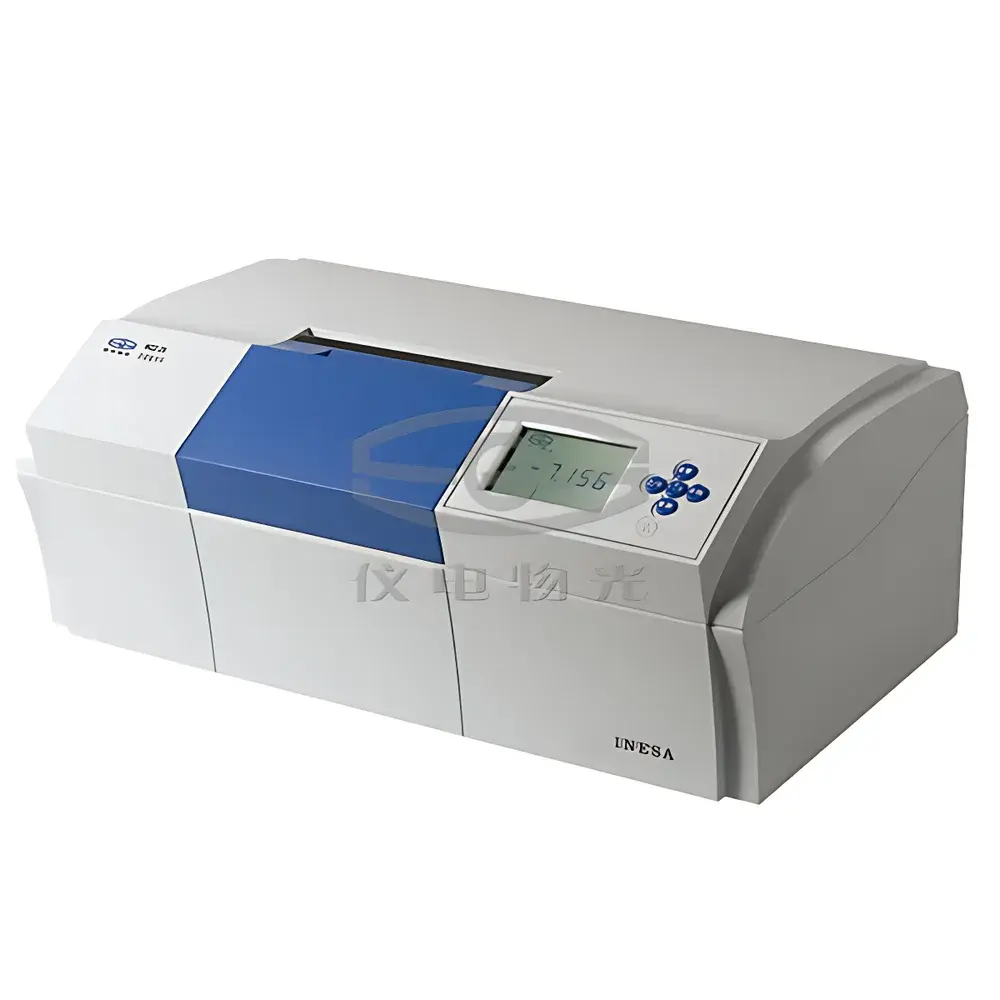
Yidian Woguang WZZ-2B Automatic Polarimeter
| Brand | Yidian Woguang (YDWG) |
|---|---|
| Origin | Shanghai, China |
| Model | WZZ-2B |
| Product Type | Automatic Polarimeter |
| Temperature Control | None |
| Digital Display | Yes |
| Light Source | LED with Interference Filter |
| Wavelength | 589 nm (Sodium D-line) |
| Measurement Range | ±45° (optical rotation) |
| Minimum Resolution | 0.002° |
| Accuracy | ±0.02° (for –15° to +15°), ±0.05° (outside that range) |
| Repeatability (σ) | ≤0.01° |
| Sample Transmittance Requirement | ≥10% |
| Standard Cells | 100 mm and 200 mm path length |
| Interface | RS232 |
| Power Supply | 220 V ±22 V, 50 Hz ±1 Hz, 150 W |
| Dimensions | 605 × 370 × 260 mm |
| Net Weight | 21 kg |
| Accuracy Class | 0.05 |
Overview
The Yidian Woguang WZZ-2B Automatic Polarimeter is a precision optical instrument engineered for the quantitative measurement of optical rotation in optically active substances—primarily used in pharmaceutical quality control, fine chemical synthesis verification, food ingredient analysis, and academic research laboratories. Based on the fundamental principle of polarimetry, the instrument measures the angular deviation of plane-polarized light as it passes through chiral samples, such as sugars (e.g., sucrose, glucose), amino acids, antibiotics (e.g., penicillin), and essential oils. Its core optical design incorporates a stable LED light source coupled with an interference filter centered at 589 nm—the standard sodium D-line wavelength mandated by pharmacopoeial methods including USP , EP 2.2.7, and ChP Section IV. The WZZ-2B employs digital angular encoding and microprocessor-based signal processing to deliver high reproducibility and long-term baseline stability without mechanical zero drift.
Key Features
- High-resolution angular detection with 0.002° minimum readout and ≤0.01° repeatability (standard deviation), meeting ISO 13485-aligned performance expectations for routine QC environments.
- Dual-path standard cell compatibility: supports both 100 mm and 200 mm quartz sample tubes—enabling flexibility across concentration ranges while maintaining compliance with pharmacopoeial cell specifications.
- Backlit 5-inch LCD display with intuitive menu navigation; shows real-time rotation angle, average of up to three sequential measurements, and pass/fail indicators relative to user-defined limits.
- RS232 serial interface for bidirectional communication with LIMS or laboratory PCs; supports ASCII-based data export (angle, timestamp, cell ID) compatible with CSV parsing and audit-ready record generation.
- Robust mechanical architecture: injection-molded ABS housing ensures dimensional consistency, ESD-safe surface finish, and resistance to common lab solvents; net weight (21 kg) provides inherent vibration damping on standard benchtops.
- No external temperature regulation—designed for ambient-stable operation in controlled laboratory environments (20–25°C, <60% RH); consistent thermal mass minimizes short-term thermal drift during batch analysis.
Sample Compatibility & Compliance
The WZZ-2B accommodates clear, low-absorbance liquid samples with minimum transmittance ≥10% at 589 nm—ensuring sufficient photon flux for reliable photodetector signal-to-noise ratio. It is routinely deployed for assay of sucrose in syrups (AOAC 952.03), enantiomeric excess determination in asymmetric synthesis (ASTM E2963-14), and identity testing of L-(+)-tartaric acid per USP-NF monographs. While not equipped with Peltier temperature control, its 0.05-grade accuracy certification aligns with national metrological verification requirements for Class II polarimeters under JJG 536–2015 (China) and serves as a validated reference instrument in GLP-compliant facilities where environmental monitoring logs satisfy traceability criteria.
Software & Data Management
Data acquisition is managed via native firmware with embedded averaging logic and automatic outlier suppression (based on deviation >2σ from mean of three readings). RS232 output delivers time-stamped measurement records—including instrument ID, operator code (manually entered), cell path length, and raw/averaged angle—in fixed-field ASCII format. When integrated with validated third-party software (e.g., LabArchives ELN or custom Python-based parsers), the WZZ-2B supports 21 CFR Part 11-compliant workflows: electronic signatures, audit trails, and immutable data archiving—provided the host system implements appropriate access controls and backup protocols. No proprietary software is bundled; all configuration and calibration parameters are stored in non-volatile memory with battery-backed retention (>10 years).
Applications
- Pharmaceutical QC: Identity and purity testing of chiral APIs per ICH Q5C and pharmacopoeial monographs.
- Sugar industry: Brix-corrected polarization assays for sucrose content in beet/cane extracts and invert syrup blends.
- Flavor & fragrance labs: Quantification of limonene enantiomer ratios in citrus oils to verify botanical origin.
- Academic teaching: Undergraduate physical chemistry labs demonstrating molecular chirality, Fresnel’s theory, and Beer–Lambert law extensions.
- Contract manufacturing: In-process verification of racemization kinetics during peptide coupling or enzymatic resolution steps.
FAQ
Does the WZZ-2B support temperature-controlled measurements?
No. It operates at ambient laboratory temperature only and is not equipped with thermostatic cells or Peltier modules.
Is calibration traceable to NIST or other national standards?
Yes—factory calibration uses quartz rotatory standards certified to ISO/IEC 17025-accredited references; users may perform intermediate verification using supplied sucrose standard solutions.
Can the instrument store measurement history internally?
It retains the last three measurements and their arithmetic mean in volatile RAM but does not provide persistent onboard storage; full traceability requires RS232 logging.
What is the maximum sample turbidity acceptable for reliable readings?
Samples must transmit ≥10% of incident 589 nm light; highly scattering or particulate suspensions require centrifugation or filtration prior to analysis.
Is the 589 nm LED source compliant with pharmacopoeial wavelength tolerance requirements?
Yes—the interference-filtered LED exhibits spectral bandwidth <1 nm FWHM centered at 589.3 nm, satisfying USP and EP 2.2.7 spectral purity criteria.





