
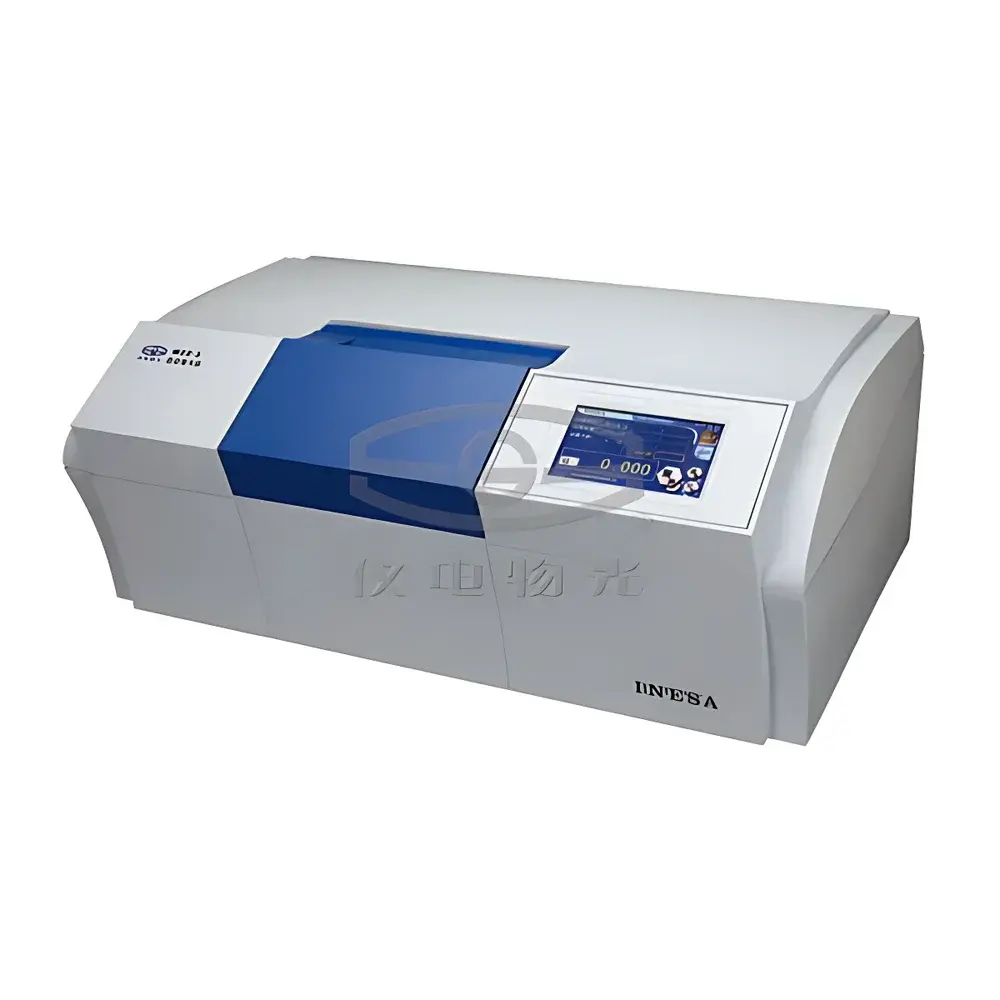
Yidian Woguang WZZ-3 Automatic Polarimeter
| Brand | Yidian Woguang (YDWG) |
|---|---|
| Origin | Shanghai, China |
| Model | WZZ-3 |
| Product Type | Automatic Polarimeter |
| Temperature Control | Not temperature-controlled |
| Display | Digital LCD touchscreen |
| Light Source | LED with 589 nm interference filter (sodium D-line equivalent) |
| Measurement Range | ±45° (optical rotation), ±120°Z (saccharimetric scale) |
| Minimum Resolution | 0.001° (optical rotation), 0.001°Z |
| Accuracy | ±(0.01 + 0.05% of reading)° (optical rotation) |
| Repeatability (std. dev. δ) | ≤0.003° |
| Sample Transmittance Requirement | ≥10% |
| Interface | USB & RS232 |
| Power Supply | 220 V ±10%, 50 Hz ±1 Hz, 150 W |
| Dimensions (L×W×H) | 605 × 370 × 260 mm |
| Net Weight | 21 kg |
| Accuracy Class | 0.05 |
Overview
The Yidian Woguang WZZ-3 Automatic Polarimeter is a precision optical instrument engineered for quantitative measurement of optical rotation in optically active substances. It operates on the principle of photoelectric automatic null-balance detection—where incident polarized light passes through a sample cell, and the analyzer rotates until minimum light intensity is detected at the photodetector, establishing the equilibrium point corresponding to the sample’s specific rotation angle. This method eliminates parallax and observer-dependent bias inherent in manual polarimeters, delivering high reproducibility and traceable angular measurements aligned with classical polarimetric metrology standards. Designed for routine quality control and research applications in pharmaceutical, food, chemical, and academic laboratories, the WZZ-3 delivers calibrated optical rotation values in degrees (°), specific rotation ([α]), concentration (g/100 mL), and saccharimetric scale (°Z), all derived from a single, stable 589 nm LED light source approximating the sodium D-line emission—ensuring compatibility with historical reference data and pharmacopoeial methods (e.g., USP , EP 2.2.7).
Key Features
- Photoelectric auto-balancing optical system ensures drift-free, operator-independent measurement with no mechanical vernier or manual alignment required.
- Four selectable measurement modes: optical rotation (°), specific rotation ([α]), concentration (g/100 mL), and saccharimetric scale (°Z), each computed in real time using built-in calibration constants and user-input parameters (path length, concentration, temperature).
- High-resolution 0.001° angular resolution and ≤0.003° repeatability (standard deviation) support statistically robust replicate analysis; up to six consecutive measurements can be automatically executed and averaged with standard deviation reporting.
- Full-color capacitive touchscreen interface enables intuitive navigation, parameter configuration, and real-time waveform visualization during balance acquisition.
- Dual communication interfaces (USB 2.0 and RS232) facilitate seamless integration into laboratory networks and enable bidirectional data exchange with LIMS or custom QA/QC software platforms.
- Compliant with general-purpose electrical safety requirements (IEC 61010-1) and designed for continuous operation under ambient laboratory conditions (15–30 °C, 30–80% RH non-condensing).
Sample Compatibility & Compliance
The WZZ-3 accommodates standard 100 mm and 200 mm path-length sample tubes (supplied), supporting both aqueous and organic solvent-based solutions with minimum transmittance ≥10% at 589 nm. It is suitable for measuring chiral compounds including sucrose, glucose, fructose, amino acids, antibiotics (e.g., penicillin G), steroids, and synthetic enantiomers. While not equipped with active temperature regulation, its thermal mass and low-power LED source minimize short-term thermal drift—making it appropriate for environments where ambient temperature remains stable within ±2 °C over measurement cycles. The instrument meets the accuracy class 0.05 specification per JJG 536–2015 (Chinese National Verification Regulation for Polarimeters), and its measurement methodology aligns with ISO 13871:2000 (Optics and optical instruments — Polarimeters — Performance requirements and testing methods). Though not 21 CFR Part 11 compliant out-of-the-box, audit-trail-capable data export (CSV/TXT) supports GLP/GMP-aligned documentation workflows when paired with validated SOPs.
Software & Data Management
Data acquisition, storage, and export are managed directly via the onboard touchscreen UI. All measurements—including raw angle, computed concentration, timestamp, operator ID (manually entered), and tube identification—are stored internally with configurable retention (up to 1,000 records). Export options include USB flash drive (FAT32 formatted) and serial transmission to external PCs. Output files contain structured columns: Date, Time, Mode, Reading (° or °Z), Avg. Std. Dev., Path Length (mm), Temp (°C, user-entered), and Notes. Optional thermal printer (CK NT-T24S, impact dot-matrix) provides immediate hardcopy output compliant with internal QA record-keeping requirements. No proprietary PC software is required; however, ASCII-formatted logs are compatible with Excel, Python pandas, or LabVIEW for statistical process control (SPC) and trend analysis.
Applications
- Pharmaceutical QC: Determination of enantiomeric purity and assay of optically active APIs (e.g., levofloxacin, ibuprofen, chloramphenicol) per USP/EP monographs.
- Sugar industry: Rapid quantification of sucrose content in beet/cane juice, syrups, and refined sugar products using °Z scale with NIST-traceable calibration standards.
- Academic research: Kinetic studies of enzymatic hydrolysis (e.g., invertase activity via α-D-glucose → β-D-fructose conversion), chiral catalyst screening, and polymer helicity assessment.
- Food & beverage: Verification of honey adulteration (via polarization deficit), authenticity testing of fruit juices, and monitoring of fermentation progress in wine and dairy production.
- Chemical manufacturing: Batch release testing of chiral intermediates and verification of asymmetric synthesis yield and stereoselectivity.
FAQ
Does the WZZ-3 support temperature-controlled measurements?
No—the instrument lacks integrated Peltier or water-jacketed cell holders. Users must pre-equilibrate samples and maintain stable ambient lab temperature (±2 °C) for optimal accuracy.
Is the 589 nm LED source spectrally equivalent to a sodium lamp?
Yes—the LED is coupled with a narrow-band interference filter centered at 589.3 nm (FWHM <2 nm), meeting the spectral bandwidth requirement specified in pharmacopoeial polarimetry methods.
Can measurement data be exported to LIMS systems?
Yes—via RS232 or USB, using ASCII-delimited text format compatible with most LIMS ingestion protocols; no driver installation required.
What is the maximum allowable sample turbidity or absorbance?
Samples must transmit ≥10% of incident 589 nm light; highly scattering or deeply colored solutions require dilution or filtration prior to analysis.
Is calibration traceable to national standards?
Factory calibration uses quartz rotatory standards certified to NIM (National Institute of Metrology, China); users may perform intermediate verification with sucrose reference solutions traceable to NIST SRM 84e.



