
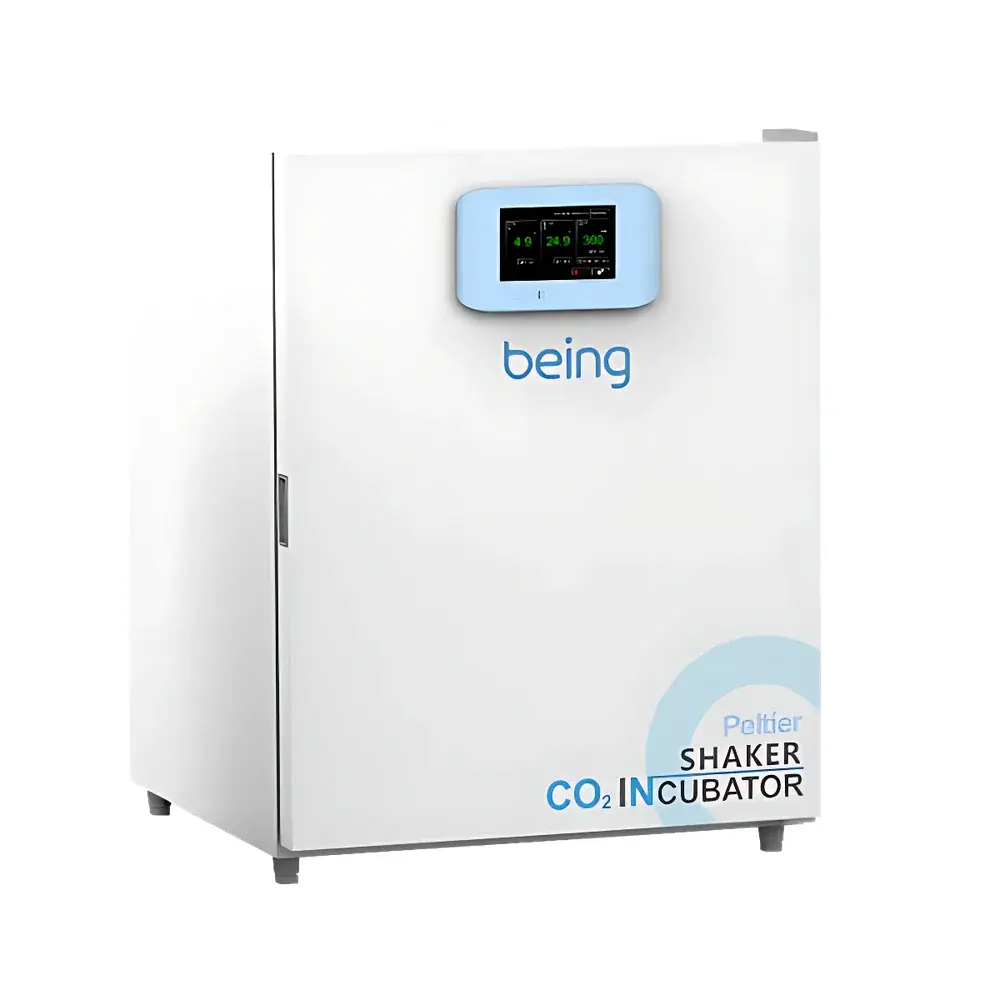
Yiheng BIOS-101E Semiconductor-Cooled CO₂ Incubated Shaker
| Brand | Yiheng |
|---|---|
| Origin | Jiangsu, China |
| Manufacturer Type | OEM Manufacturer |
| Country of Origin | China |
| Model | BIOS-101E |
| Cooling Method | Peltier Thermoelectric Cooling |
| Temperature Range | 10–65 °C |
| Temperature Accuracy | ±0.1 °C |
| Temperature Uniformity | ≤±0.5 °C (@37 °C) |
| Chamber Dimensions (W×D×H) | 420×480×610 mm |
| External Dimensions (W×D×H) | 725×680×800 mm |
Overview
The Yiheng BIOS-101E Semiconductor-Cooled CO₂ Incubated Shaker is an integrated life science platform engineered for precision-controlled cell culture under dynamically agitated conditions. It combines three core functionalities—CO₂-regulated humidified incubation, thermoelectric temperature control, and orbital shaking—within a single compact footprint. Unlike conventional compressor-based systems, the BIOS-101E employs solid-state Peltier elements for active cooling and heating, enabling bidirectional thermal regulation without refrigerants or mechanical compressors. This architecture supports stable operation across a broad ambient temperature range while maintaining low acoustic noise and minimal heat dissipation into laboratory environments. The system operates on the principle of infrared (IR)-based real-time CO₂ feedback control, coupled with Pt100-sensed chamber temperature monitoring and closed-loop humidity regulation. Designed for adherence to GLP-compliant workflows, it serves as a primary tool in mammalian cell line expansion, suspension culture optimization, microbial fermentation studies, hybridoma development, and oxygen-sensitive hypoxic/anoxic research when equipped with optional O₂ control.
Key Features
- Peltier thermoelectric cooling/heating system: Delivers rapid temperature response, energy efficiency (≥85% lower power draw vs. compressor-based units), and zero refrigerant emissions.
- Infrared CO₂ sensor (IR-type): Provides long-term stability, immunity to cross-sensitivity from humidity/temperature drift, and recovery to setpoint (e.g., 5% CO₂) within ≤3 minutes after 30-second door opening.
- Optional zirconia-based O₂ sensor: Enables programmable O₂ control from 1–90%, supporting normoxic, hypoxic, hyperoxic, and microaerophilic culture protocols.
- Triple-eccentric-axis balanced drive mechanism: Ensures uniform orbital motion across full load capacity; maintains consistent RPM distribution regardless of flask position or mass asymmetry.
- Integrated 90 °C high-humidity sterilization cycle: Autoclave-grade decontamination of internal surfaces, sensors, fans, shelves, and brackets—validated to eliminate bacteria, fungi, mycoplasma, and spores.
- HEPA filtration (ISO Class 5 compliant) + 0.3 µm microbial filter on CO₂ inlet: Maintains sterile intra-chamber air quality and prevents exogenous contamination during gas supply.
- Multi-tier permission management: Administrator / Operator / Guest access levels with password-protected parameter locking, audit-trail-capable operation logs, and configurable user privileges.
Sample Compatibility & Compliance
The BIOS-101E accommodates standard tissue culture vessels including flasks (T25–T225), deep-well plates, roller bottles, and Erlenmeyer flasks up to 5 L via interchangeable stainless-steel platforms and universal clamping fixtures. All wetted components—including interior chamber, shelves, and door gasket—are constructed from electropolished 304 stainless steel with radius-corner geometry for cleanability and corrosion resistance. The unit complies with IEC 61010-1 (Safety Requirements for Electrical Equipment for Measurement, Control, and Laboratory Use) and meets electromagnetic compatibility standards per EN 61326-1. While not certified for medical device use, its design aligns with ISO 13485-aligned manufacturing practices and supports FDA 21 CFR Part 11 readiness when paired with validated software configurations and electronic signature modules.
Software & Data Management
A 7-inch capacitive touchscreen interface provides intuitive menu navigation with bilingual (English/Chinese) language support and context-sensitive help prompts. Real-time data—including temperature, CO₂ concentration, humidity, RPM, O₂ level (if installed), and sterilization status—is logged at user-defined intervals and stored internally. USB flash drive export enables portable backup of time-stamped datasets (.csv format) for offline analysis. Optional RS485 serial communication supports integration into centralized lab information management systems (LIMS) or SCADA networks using Modbus RTU protocol. For remote oversight, the optional mobile application delivers push notifications for alarm events (e.g., CO₂ deviation >±0.3%, door-open duration >60 s), live parameter streaming, and historical trend visualization—functionality requiring local network configuration and TLS-secured cloud relay.
Applications
- Mammalian suspension cell culture (CHO, HEK293, hybridomas) requiring precise pH buffering via CO₂ and continuous agitation for nutrient/gas exchange.
- Microbial bioprocess development—including E. coli, S. cerevisiae, and filamentous fungi—under controlled O₂ tension and thermal gradients.
- Stem cell expansion protocols demanding strict environmental consistency and minimized shear stress through optimized orbital amplitude and frequency.
- Drug metabolism studies involving hepatocyte co-cultures where simultaneous CO₂ regulation and gentle mixing preserve metabolic activity.
- Hypoxia modeling in cancer biology research using programmable O₂ setpoints down to 1% to mimic tumor microenvironments.
- Quality control testing of biologics under accelerated stability conditions combining elevated temperature, CO₂, and agitation.
FAQ
What is the maximum recommended flask size for orbital shaking?
Standard operation supports up to 5 L Erlenmeyer flasks on the largest available platform; optimal performance is achieved with fill volumes between 10–25% of vessel capacity.
Does the BIOS-101E support GLP-compliant data integrity requirements?
Yes—when configured with audit trail logging, electronic signatures, and secure user authentication, it fulfills core ALCOA+ principles for raw data retention and traceability.
How does the Peltier cooling system compare to compressor-based alternatives in terms of service life?
Solid-state Peltier modules exhibit no moving parts or lubricants, resulting in mean time between failures (MTBF) exceeding 50,000 hours under continuous duty cycles.
Is external humidification required for long-term cell culture?
No—the integrated ultrasonic humidifier maintains ≥90% RH at 37 °C without supplemental water reservoirs or external steam generators.
Can the unit be validated for IQ/OQ/PQ protocols?
Yes—Yiheng provides factory calibration certificates, sensor traceability documentation (NIST-traceable Pt100 and IR CO₂ sensors), and customizable validation support packages upon request.




