
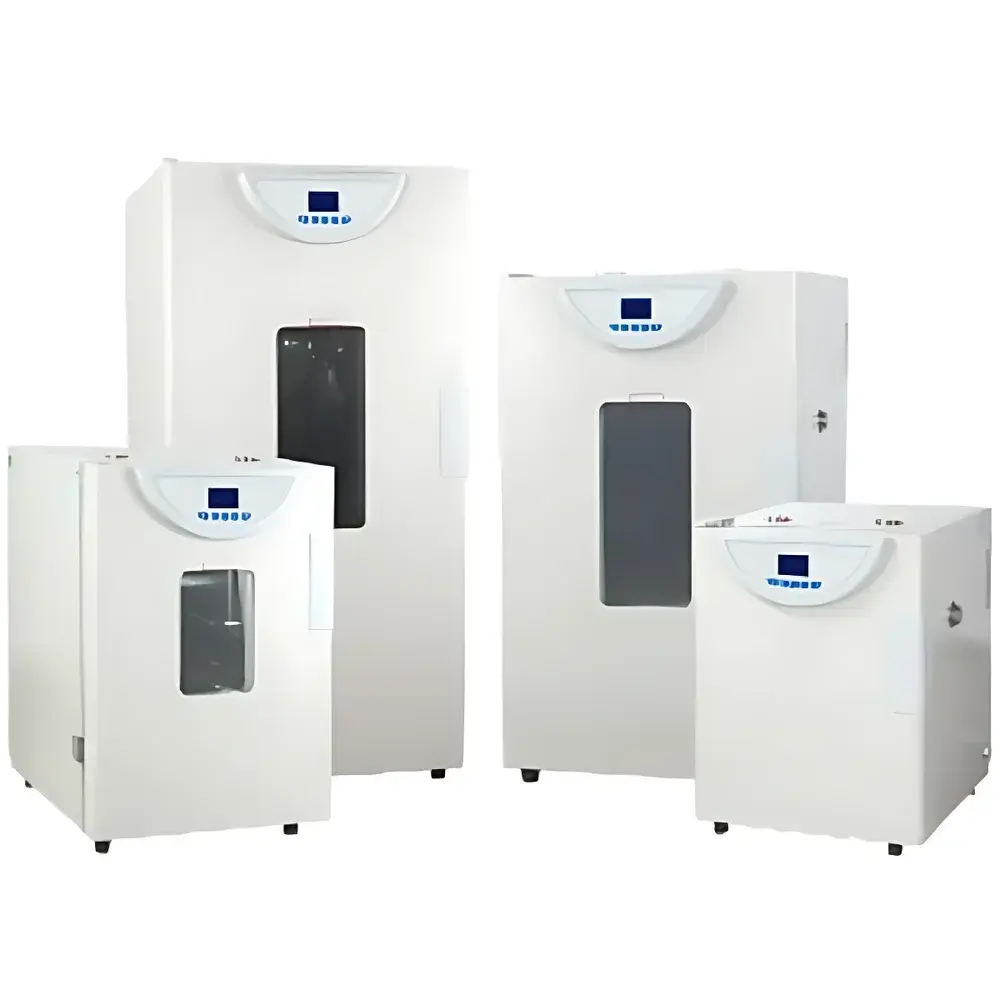
Yiheng BPG Series Precision Forced-Air Drying Oven (BPG9040A, BPG9070A, BPG9140A, BPG9240A, BPG9420A)
| Brand | Yiheng |
|---|---|
| Origin | Shanghai, China |
| Instrument Type | Precision Forced-Air Drying Oven |
| Temperature Range | RT+10°C to 200°C (optionally up to 250°C) |
| Temperature Uniformity | ±2.5% (at 100°C test point) |
| Temperature Fluctuation | ±1°C |
| Temperature Resolution | 0.1°C |
| Working Environment | 5–40°C |
| Interior Material | Mirror-Finish Stainless Steel |
| Heating Method | Forced-Air Convection |
| Chamber Volume | 40 L / 80 L / 150 L / 250 L / 400 L |
| Interior Dimensions (W×D×H mm) | 350×300×400 / 400×320×550 / 500×380×750 / 600×450×900 / 1000×510×800 |
| Exterior Dimensions (W×D×H mm) | 505×655×600 / 550×660×750 / 655×715×980 / 755×785×1130 / 1140×850×1080 |
| Power Input | 850 W / 1100 W / 1550 W / 2050 W / 3000 W |
| Standard Shelving | 2 / 3 / 3 / 4 / 4 stainless steel adjustable shelves |
| Optional Features | Programmable 15-segment/30-step controller, RS-485/USB data export, thermal printer interface, independent over-temperature alarm system, 25 mm diameter access port (left side), viewing window (BPG9070A and larger models) |
Overview
The Yiheng BPG Series Precision Forced-Air Drying Ovens are engineered for laboratory-grade thermal processing tasks requiring stable temperature control, uniform heat distribution, and long-term operational reliability. Utilizing a robust forced-air convection architecture with a high-efficiency axial fan and optimized airflow ducting, these ovens ensure consistent thermal homogeneity across the entire working chamber—critical for applications such as moisture content determination, polymer curing, pharmaceutical stability testing, and pre-sterilization drying of glassware and instrumentation components. Designed in compliance with general laboratory safety and performance expectations, the BPG series meets foundational requirements for ISO/IEC 17025-accredited laboratories performing routine thermal validation, though formal qualification (IQ/OQ/PQ) documentation is user-responsible. The ovens operate within a standard temperature range of RT+10°C to 200°C, with an optional extended configuration supporting up to 250°C for specialized material conditioning protocols.
Key Features
- Mirror-finish stainless steel interior chamber with seamless, radius-rounded corners—resistant to corrosion, easy to clean, and compatible with repeated exposure to solvents and aqueous residues.
- Large backlit LCD display presenting real-time temperature, setpoint, elapsed time, and system status in a single-view interface; menu-driven navigation supports intuitive parameter adjustment without technical training.
- Adjustable stainless steel shelving system—shelves slide on precision rails and can be repositioned or fully removed to accommodate irregularly shaped or oversized samples.
- Standard 25 mm diameter access port located on the left chamber wall—enables integration with external sensors, thermocouples, or purge gas lines without compromising chamber integrity.
- Independent dual-limit temperature protection circuitry—provides hardware-level over-temperature cutoff and audible/visual alarm activation, meeting baseline safety expectations under IEC 61010-1.
- Optional microprocessor-based programmable controller supporting up to 15 segments and 30 steps, with individual ramp rate, dwell time (1 min to 99 h 59 min), and fan speed settings per segment.
Sample Compatibility & Compliance
The BPG series accommodates a broad spectrum of sample types—including powders, granules, thin-film coatings, ceramic substrates, and sterilized labware—without risk of cross-contamination or thermal degradation due to its inert stainless steel construction and absence of internal organic insulation materials. Chamber volume options (40 L to 400 L) allow scalable deployment from benchtop QC labs to centralized preparation facilities. While not certified to specific FDA 21 CFR Part 11 requirements out-of-the-box, the optional USB and RS-485 interfaces support traceable data logging when paired with validated third-party software compliant with ALCOA+ principles. Temperature uniformity (±2.5% at 100°C) and fluctuation (±1°C) align with common internal SOPs for non-GMP drying processes; users performing GLP or GMP-regulated work must conduct site-specific mapping and periodic recalibration per ISO 17025 Clause 6.5.
Software & Data Management
Data acquisition and reporting are supported via three optional pathways: (1) direct connection to a thermal printer for hard-copy time-temperature profiles; (2) RS-485 serial interface for integration into building-wide SCADA or LIMS platforms using Modbus RTU protocol; and (3) USB port enabling local storage of timestamped temperature logs onto standard FAT32-formatted USB drives. All logged data includes date/time stamps, setpoint history, actual chamber temperature, and error codes—facilitating retrospective analysis and audit readiness. No proprietary software is bundled; users deploy industry-standard tools (e.g., LabVIEW, MATLAB, or Excel-compatible CSV parsers) for post-processing. Audit trail functionality requires external configuration and is not embedded in the oven’s firmware.
Applications
- Moisture loss-on-drying (LOD) assays per USP and ASTM D2298 for pharmaceutical excipients and food-grade powders.
- Curing of epoxy resins, silicone encapsulants, and printed circuit board (PCB) solder masks under controlled ramp-and-soak profiles.
- Drying of filter papers, chromatography media, and gravimetric sample pans prior to analytical weighing.
- Pre-conditioning of reference standards and calibration artifacts in metrology labs prior to dimensional or mass characterization.
- Stabilization of hygroscopic reagents and desiccant regeneration in synthetic chemistry workflows.
FAQ
What is the maximum allowable operating temperature for the BPG9420A model?
The standard configuration supports up to 200°C; an optional high-temperature variant extends the upper limit to 250°C—subject to verification of gasket and sensor specifications at time of order.
Can the oven be validated for ISO 17025-compliant thermal mapping?
Yes—the chamber geometry, airflow design, and temperature stability characteristics support formal thermal mapping per ISO/IEC 17025 Annex A.3; however, users must perform qualification using NIST-traceable probes and documented procedures.
Is the viewing window available on all models?
No—the transparent tempered glass observation window is factory-installed only on BPG9070A and larger models (BPG9140A, BPG9240A, BPG9420A).
Does the oven support remote monitoring via Ethernet or Wi-Fi?
No native Ethernet or Wi-Fi capability is integrated; remote supervision requires external gateway devices connected via the RS-485 interface.
What maintenance intervals are recommended for optimal performance?
Biannual inspection of fan bearings, cleaning of air intake filters, and verification of door seal integrity are advised. Calibration of the main temperature sensor should occur annually against a reference thermometer per ISO/IEC 17025 Clause 6.5.



