
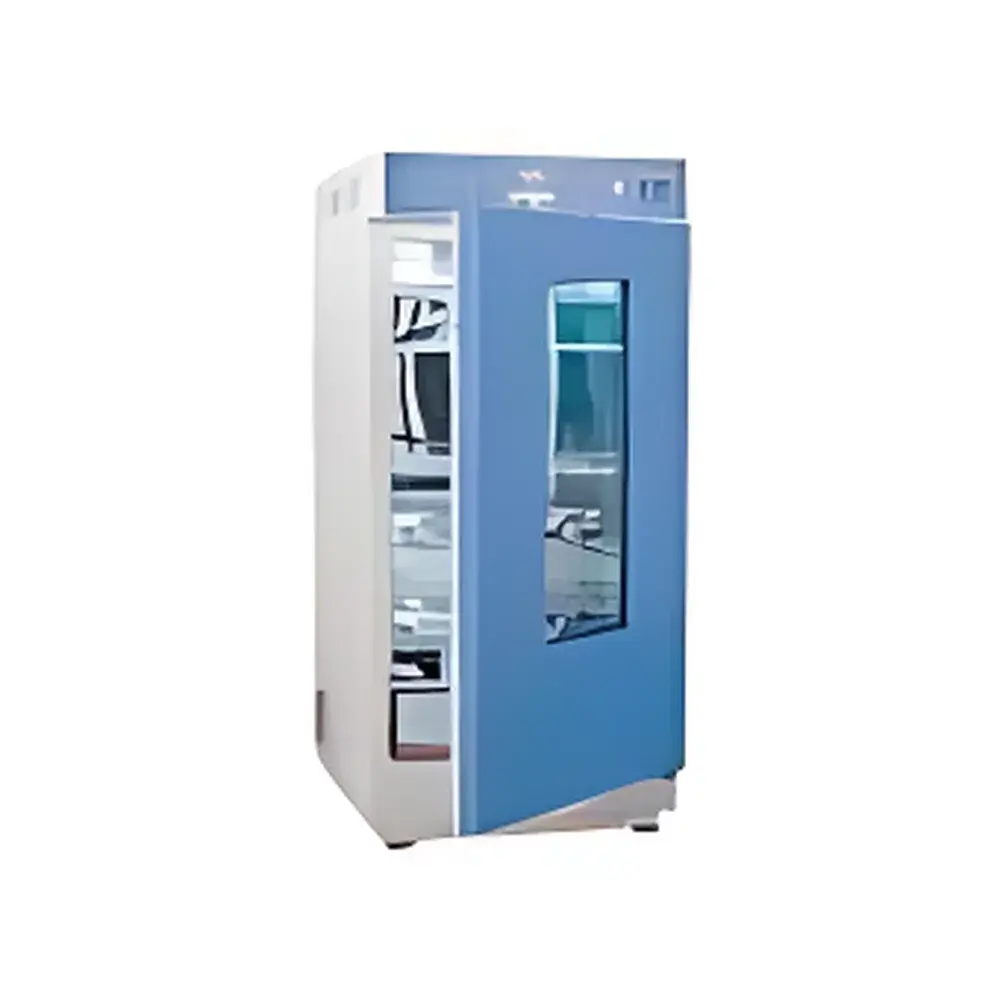
Yiheng MJ-150-I / MJ-150F-I / MJ-150-II Mold Incubator
| Brand | Yiheng |
|---|---|
| Origin | Shanghai, China |
| Control Method | Mechanical Buttons (MJ-150-I), LCD Controller (MJ-150F-I), Microprocessor-Based Temp & Humidity Control (MJ-150-II) |
| Air Circulation | Forced Convection |
| Temperature Range | 0–60 °C |
| Temperature Fluctuation | ±0.5 °C (high temp), ±1.0 °C (low temp) |
| Temperature Uniformity | ±1.5 °C at 25 °C |
| Capacity | 150 L |
| External Dimensions (W×D×H) | 600×630×1360 mm |
| Internal Dimensions (W×D×H) | 503×470×808 mm |
| Refrigerant | R134a (MJ-150F-I & MJ-150-II only) |
| Power Supply | AC 220 V, 50 Hz |
| Input Power | 600 W (MJ-150-I), 680 W (MJ-150F-I), 2250 W (MJ-150-II) |
| Standard Shelving | 3 adjustable stainless-steel shelves |
| Optional Features | Independent over-temperature alarm, RS485 interface, thermal printer output, Φ25 mm test port (MJ-150-II only) |
Overview
The Yiheng MJ-150-I, MJ-150F-I, and MJ-150-II Mold Incubators are precision-engineered environmental chambers designed specifically for the controlled cultivation, isolation, and preservation of fungi, yeasts, molds, and other mesophilic microorganisms. These units operate on a forced-air convection principle—employing a high-efficiency circulation fan and optimized internal airflow geometry—to ensure uniform thermal distribution throughout the chamber volume. Unlike general-purpose incubators, the MJ series integrates features critical to mycological applications: UV germicidal irradiation (standard), corrosion-resistant mirror-finish stainless-steel interior (electropolished 304 grade), and semi-circular corner design to eliminate microbial harborage zones and facilitate ISO-compliant cleaning protocols. The MJ-150-II variant extends functionality with integrated humidity control (60–85% RH), enabling studies requiring defined water activity (aw) conditions—such as spore germination kinetics, hyphal growth under sub-saturated vapor pressure, or stability testing of fungal cultures per USP and EP 2.6.12.
Key Features
- Mirror-polished 304 stainless-steel interior with seamless, radius-corner construction—meets FDA-recommended cleanability standards for microbiological containment.
- UV-C sterilization lamp (254 nm) mounted in the chamber ceiling, programmable for automated pre-cycle decontamination (cycle duration configurable via controller).
- High-efficiency hermetic compressor (Embraco or Panasonic, model-dependent) using R134a refrigerant—compliant with Montreal Protocol Annex A Group II substance regulations and EPA SNAP-approved for laboratory use.
- Intelligent fan-speed modulation: motor speed dynamically adjusts based on setpoint deviation and door-open events, minimizing sample desiccation and thermal overshoot during recovery.
- Dual-stage over-temperature protection: primary microprocessor control + independent mechanical cut-out switch—certified to IEC 61000-6-2/6-4 for electromagnetic immunity and EN 61010-1:2010 safety compliance.
- MJ-150-II includes a capacitive humidity sensor (±5% RH accuracy, 20–80% RH range) and steam-humidification system with anti-scale heating element and condensate drainage path.
Sample Compatibility & Compliance
These incubators support standard microbiological consumables including Petri dishes (90 mm and 150 mm), multi-well plates (6–96-well), slant tubes, stab cultures, and Erlenmeyer flasks up to 1 L. The MJ-150-II’s optional Φ25 mm side port (left-mounted) permits real-time monitoring of internal parameters (e.g., CO2, O2, or humidity) using external probes without compromising chamber integrity. All models comply with ISO 14644-1 Class 8 (100,000) cleanroom-compatible operation when used with validated cleaning SOPs. They are routinely deployed in GLP-regulated environments for BOD5 analysis (ASTM D5210), antimicrobial susceptibility testing (CLSI M38-A3), and pharmaceutical environmental monitoring per EU GMP Annex 1 and WHO TRS 992.
Software & Data Management
While the MJ-150-I uses a basic mechanical thermostat, the MJ-150F-I and MJ-150-II feature embedded microcontroller-based systems supporting data logging via RS485 Modbus RTU protocol (compatible with LabVIEW, SCADA, and DeltaV). Optional thermal printer output provides time-stamped hardcopy records of temperature (and humidity for MJ-150-II) at user-defined intervals—supporting 21 CFR Part 11 audit-trail requirements when paired with compliant electronic lab notebook (ELN) software. Data retention spans ≥30 days at 1-minute resolution; exported CSV files include UTC timestamps, sensor IDs, and status flags (e.g., “door_open”, “uv_active”, “alarm_triggered”).
Applications
- Regulatory microbiology: Enumeration of Aspergillus, Penicillium, and Candida spp. per USP , Ph. Eur. 2.6.12, and JP 4.05.
- Environmental monitoring: Settle plate and air sampler incubation in cleanrooms and aseptic processing suites.
- Biochemical oxygen demand (BOD) testing: Standard 5-day incubation at 20 °C per ISO 5815-1 and APHA 5210B.
- Antifungal efficacy testing: Time-kill assays under controlled RH gradients (MJ-150-II).
- Plant pathology research: Inoculation and disease progression studies on agar-based media at species-specific optimal temperatures.
- Vaccine stability assessment: Long-term storage of fungal adjuvant candidates under accelerated aging conditions (ICH Q1A).
FAQ
What is the difference between MJ-150-I, MJ-150F-I, and MJ-150-II?
The MJ-150-I uses a mechanical temperature controller with LED display; the MJ-150F-I upgrades to an LCD interface with programmable ramp-soak profiles and data logging; the MJ-150-II adds full humidity control (60–85% RH), a dedicated humidification system, and a test port.
Is UV sterilization continuous or cycle-based?
UV operation is manually initiated or scheduled—no automatic daily cycle is built-in; exposure duration is user-configurable (1–120 min) to prevent polymer degradation of chamber components.
Can these incubators be validated for GMP use?
Yes—IQ/OQ documentation templates are available upon request; temperature mapping (per ASTM E2297) and humidity uniformity validation (for MJ-150-II) can be performed using NIST-traceable sensors.
What maintenance is required for long-term reliability?
Compressor oil level inspection every 24 months; UV lamp replacement every 8,000 hours; condensate tray cleaning weekly; stainless-steel interior wiped with 70% ethanol after each use.
Does the MJ-150-II support remote monitoring via Ethernet or Wi-Fi?
No—only RS485 serial communication is natively supported; third-party gateways (e.g., Moxa EDS-G205A) may enable TCP/IP bridging with proper network segmentation per IEC 62443-3-3.
Related Products




