
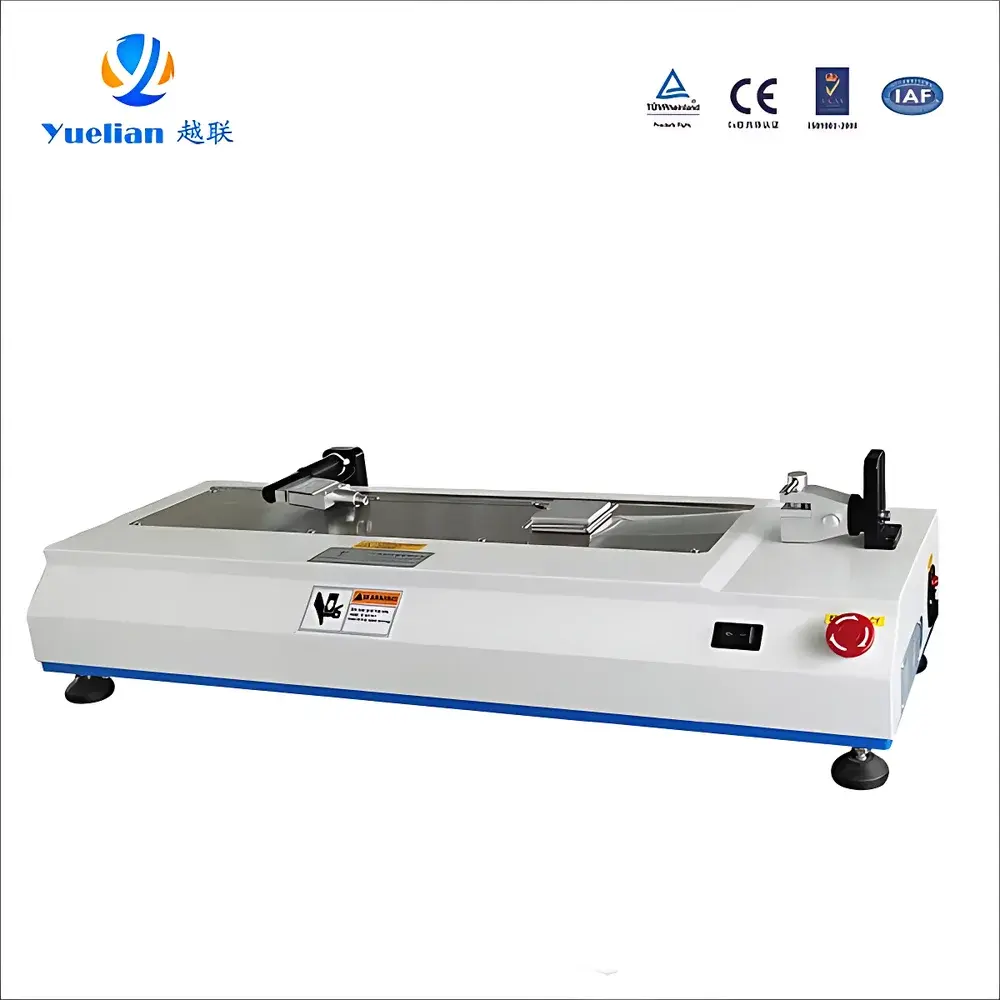
YL-1103F Coefficient of Friction Tester (Yuelian)
| Brand | Yuelian |
|---|---|
| Origin | Guangdong, China |
| Manufacturer Type | Authorized Distributor |
| Country of Origin | China |
| Model | YL-1103F |
| Load Cell Capacity Options | 10 N, 20 N |
| Test Speed Range | 0–600 mm/min |
| Test Travel Distance | 150 mm (6 in) |
| Test Platform Dimensions | 130 mm × 280 mm (5 in × 11 in) |
| Machine Dimensions (W×H×D) | 700 mm × 230 mm × 280 mm |
| Net Weight | 20 kg |
| Power Supply | AC 220 V |
| Compliance | ASTM D1894, GB/T 10006, ISO 8295 |
| Software Control | PC-based test software (optional accessory) |
Overview
The YL-1103F Coefficient of Friction Tester is an electromechanical instrument engineered for precise and repeatable measurement of static (μs) and kinetic (μk) coefficients of friction between two solid surfaces under controlled normal force and relative motion. It operates on the fundamental principle of horizontal pull testing: a sled or specimen of defined geometry and mass is pulled across a fixed reference surface at a regulated speed, while a high-accuracy load cell simultaneously records the peak (static) and sustained (dynamic) tangential force required to initiate and maintain motion. The coefficient of friction is calculated in real time as the ratio of measured frictional force to applied normal load. Designed specifically for quality control laboratories, packaging R&D facilities, and polymer film manufacturers, the YL-1103F adheres strictly to internationally recognized test methodologies—most notably ASTM D1894 (Standard Test Method for Static and Kinetic Coefficients of Friction of Plastic Film and Sheeting), ISO 8295 (Plastics — Film and Sheetings — Determination of the Coefficient of Friction), and GB/T 10006 (Chinese national standard for plastic films and sheets). Its modular architecture supports rapid sample setup and minimizes operator-induced variability.
Key Features
- Real-time digital display of both static and kinetic COF values immediately upon test completion—no manual calculation required.
- Dual-load-cell configuration with selectable capacities (10 N and 20 N) to accommodate low-friction films (e.g., PE, PP) and higher-resistance materials (e.g., laminated structures, coated papers).
- Precision-controlled motorized drive system enabling continuous speed adjustment from 0 to 600 mm/min, meeting the full velocity range specified in ASTM D1894 (typically 150 mm/min ± 5 mm/min for standard compliance).
- Test platform sized at 130 mm × 280 mm (5 in × 11 in) provides ample area for standardized 63.5 mm × 63.5 mm (2.5 in × 2.5 in) sleds and allows edge-effect mitigation during lateral motion.
- Integrated mechanical stop and calibrated travel limit of 150 mm (6 in) ensure consistent displacement per test cycle, critical for repeatability across multi-batch validation protocols.
- Robust aluminum alloy frame with vibration-dampening base ensures mechanical stability during high-speed traversals and eliminates parasitic signal noise in force transduction.
Sample Compatibility & Compliance
The YL-1103F is validated for use with flexible packaging substrates including biaxially oriented polypropylene (BOPP), low-density polyethylene (LDPE), polyester (PET), metallized films, paperboard laminates, and adhesive tapes. Specimen preparation follows ASTM D1894 guidelines: samples are conditioned at 23 °C ± 2 °C and 50 % RH ± 5 % RH for ≥40 hours prior to testing. The instrument’s physical dimensions and sled interface geometry conform to ISO 8295 Annex A specifications. All force measurements trace to NIST-calibrated standards via certified load cell documentation. The system supports GLP-compliant operation when paired with optional audit-trail-enabled software, fulfilling documentation requirements for ISO/IEC 17025-accredited labs.
Software & Data Management
An optional Windows-compatible PC software package is available for comprehensive test automation, data logging, and report generation. The software enables programmable test sequences (e.g., multiple speed ramps, dwell periods, repeated cycles), automatic COF calculation per ASTM algorithms, statistical analysis (mean, SD, CV%), and export to CSV or PDF formats. When configured with electronic signature and user access controls, the software satisfies FDA 21 CFR Part 11 requirements for electronic records and signatures in regulated environments. Raw force–displacement curves are stored with timestamps and operator metadata, supporting full traceability during internal audits or regulatory inspections.
Applications
- Quality assurance of food, pharmaceutical, and consumer goods packaging films for slip performance and stackability.
- Formulation development of anti-block additives, silicone coatings, and surface treatments for extruded films.
- Validation of printing ink adhesion and surface energy modifications on roll-to-roll substrates.
- Comparative evaluation of friction behavior before and after sterilization (e.g., gamma, ETO) in medical packaging.
- Root-cause analysis of jamming or misfeed events in high-speed filling and labeling lines.
FAQ
Does the YL-1103F meet ASTM D1894 requirements for sled mass and surface finish?
Yes—the standard 200 g sled (with optional 500 g variant) and ground steel test bed comply with dimensional and material specifications outlined in Section 6.1 and Annex A of ASTM D1894.
Can the instrument be used for reverse-direction friction testing (e.g., film-on-film with opposing lay directions)?
Yes—sample orientation is fully configurable; the test platform accommodates bidirectional mounting of both sled and substrate per ISO 8295 Clause 7.2.
Is calibration certification included with shipment?
Each unit ships with a factory calibration certificate referencing NIST-traceable deadweight standards; annual recalibration is recommended per ISO/IEC 17025 Clause 6.6.
What environmental conditions are required for compliant testing?
Testing must be conducted in a temperature- and humidity-controlled room per ASTM D618: 23 °C ± 2 °C and 50 % RH ± 5 % RH, with conditioning duration ≥40 hours.
Is the load cell internally compensated for temperature drift?
Yes—the 10 N and 20 N semiconductor strain-gauge load cells incorporate thermal zero-shift compensation across 10–35 °C operating range.



