
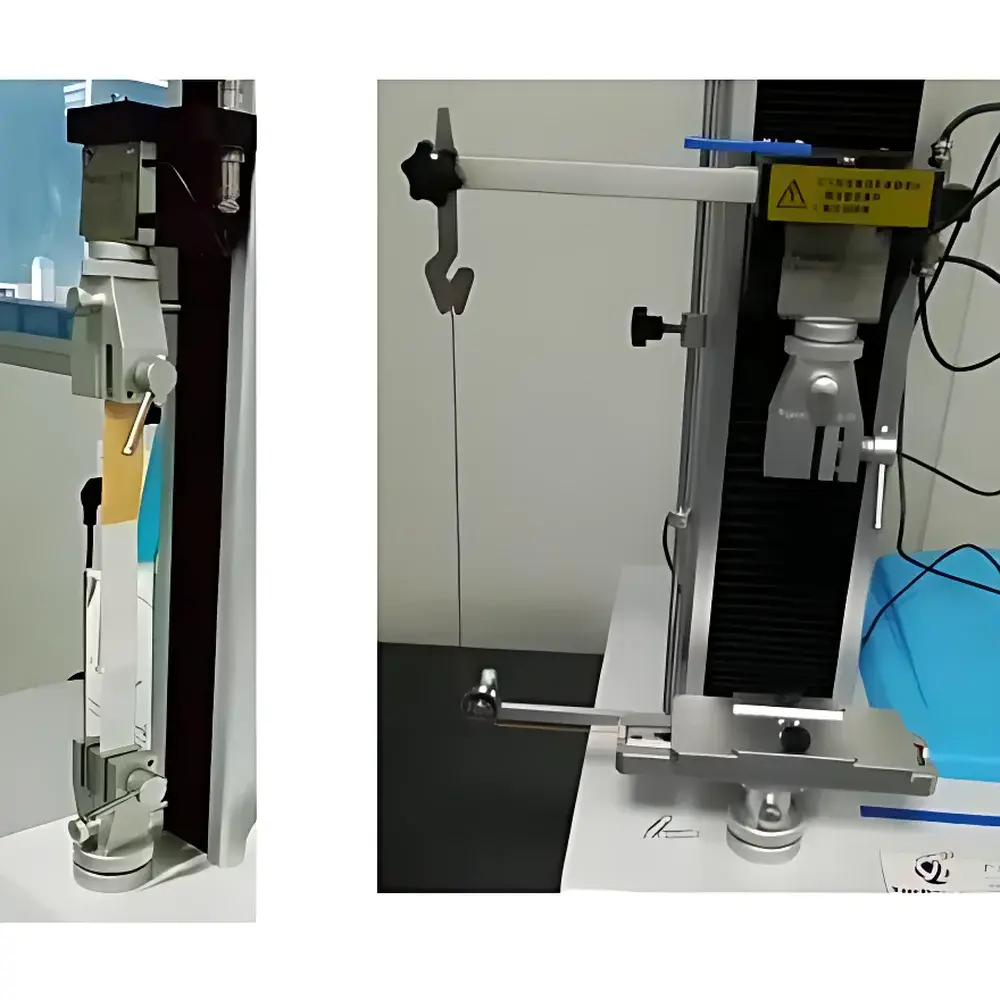
YL-S71 Yuelian Universal Testing Machine for Tensile, Peel, and Release Force Measurement
| Brand | Yuelian |
|---|---|
| Model | YL-S71 |
| Type | Electromechanical Universal Testing Machine |
| Load Capacity Options | 10 N to 5 kN (dual-range configuration available) |
| Drive System | AC Servo Motor with Precision Ball Screw Transmission |
| Effective Travel | 700 mm |
| Speed Range | 0.01–500 mm/min (customizable) |
| Force Resolution | 1/500,000 full scale |
| Force Accuracy | Better than ±0.5% of reading |
| Position Resolution | 1/500,000 mm |
| Data Acquisition Rate | 50 Hz |
| Test Space Width | 140 mm |
| Dimensions (W×D×H) | 520 × 590 × 1325 mm |
| Net Weight | 50 kg |
| Power Supply | 220 V, 50–60 Hz, 400 W |
| Compliance | Designed to support ASTM D882, D3330, D903, ISO 11339, ISO 8510-2, GB/T 2790–2792, and other standard methods for tensile, peel, and release force testing |
Overview
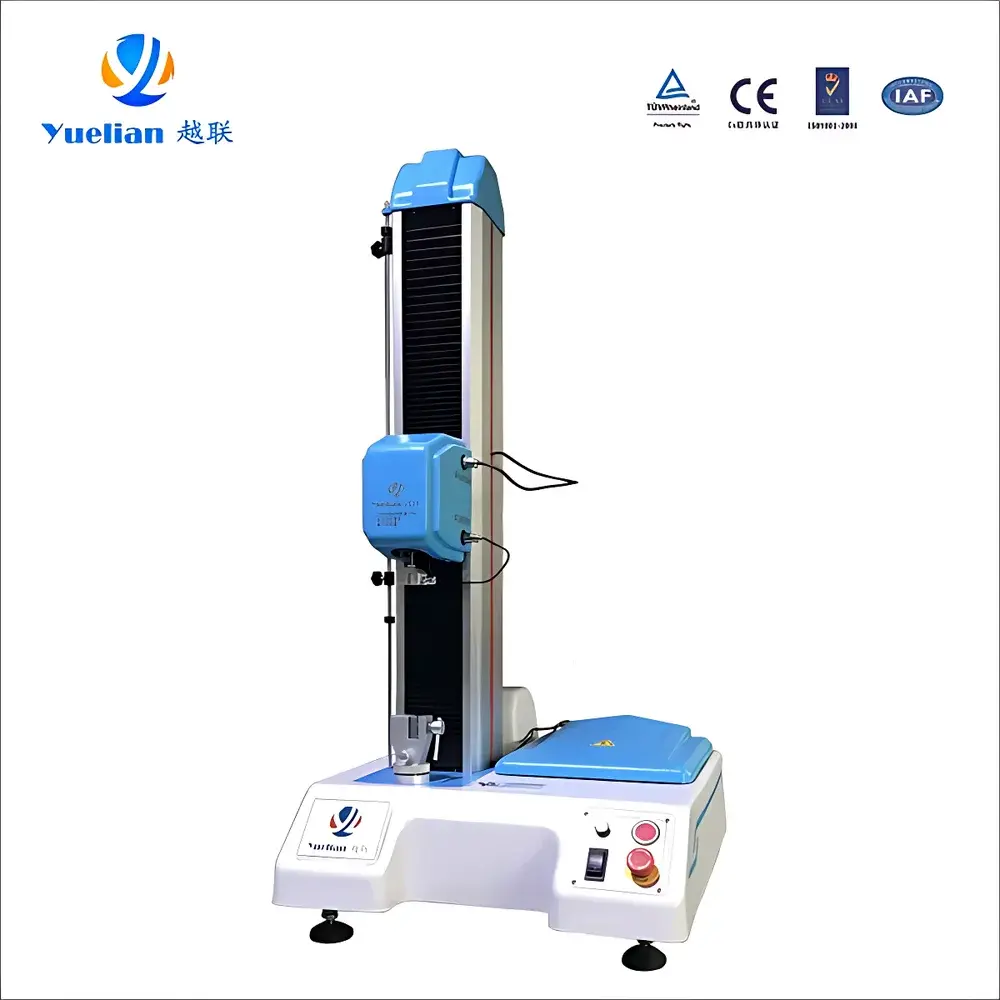
The YL-S71 Yuelian Universal Testing Machine is an electromechanical static testing system engineered for precision measurement of mechanical properties under uniaxial loading conditions. It operates on the principle of controlled displacement or load application via a high-resolution servo-driven ball screw actuator, enabling reproducible force–displacement–time data acquisition across a wide range of materials—from thin polymer films and pressure-sensitive adhesives to elastomeric foams, composite laminates, and finished consumer goods. Its modular architecture supports standardized test configurations including tensile strength, 90° and 180° peel adhesion, release force (liner peel), shear resistance, tear propagation, puncture resistance, and cyclic compression—making it suitable for R&D laboratories, quality control departments, and contract testing facilities operating under GLP, ISO/IEC 17025, or internal GMP-aligned protocols.
Key Features
- AC servo motor coupled with preloaded precision ball screw for smooth, low-backlash motion control and high positional repeatability
- Aluminum extrusion guard housing with sandblasted and anodized silver finish; ABS injection-molded enclosure with durable electrostatic spray coating
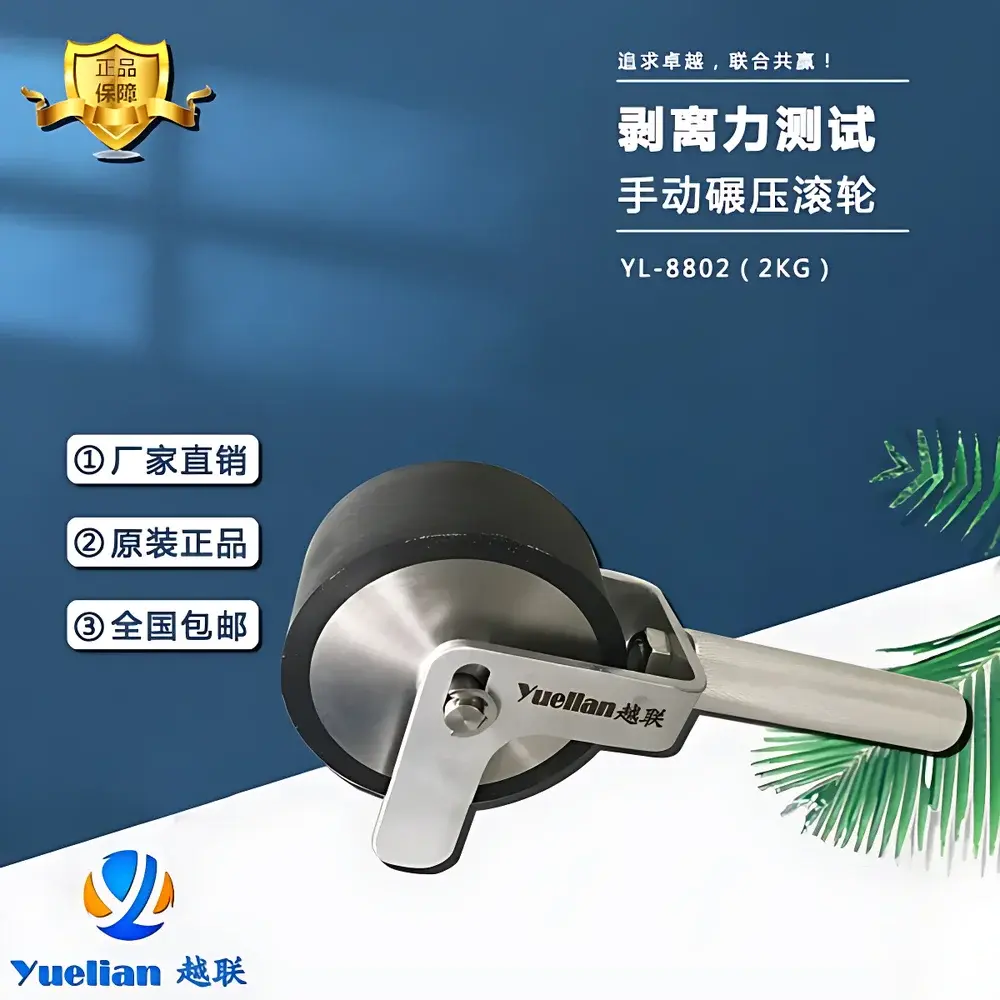
- Quick-release tooling interface enabling rapid interchange of grips, peel fixtures, puncture probes, and custom jigs without recalibration
- Integrated safety system featuring mechanical overload cutoff, programmable upper/lower travel limits, emergency stop button, and automatic fracture detection with post-failure return-to-start
- Multi-curve real-time display: simultaneous visualization of force vs. displacement, force vs. time, displacement vs. time, and stress vs. strain—with dynamic zoom, pan, crosshair cursor, and point extraction tools
- Advanced statistical engine supporting up to 7 user-defined analysis intervals, 40 manual data points, and 120 auto-sampled points per test; outputs include max/min/mean values, trimmed mean (excluding top/bottom 5%), median, standard deviation, population SD, and process capability index (CPK)
Sample Compatibility & Compliance
The YL-S71 accommodates specimens ranging from micro-thin adhesive tapes (≥25 µm thick) to rigid structural components (≤140 mm wide × 700 mm active travel). Standard fixtures include pneumatic wedge grips, roller-type peel arms (for 90°/180° configurations), floating roller assemblies for liner release testing, and flat-faced platens for compression and bending. The system is routinely deployed in compliance with ASTM D3330 (peel adhesion of pressure-sensitive tapes), ASTM D903 (bond strength of adhesive joints), ISO 11339 (adhesive tape peel resistance), ISO 8510-2 (peel tests for laminated materials), and GB/T 2790–2792 (Chinese national standards for peel and release force). All test methods are configurable within the software to meet audit-ready documentation requirements per FDA 21 CFR Part 11 (electronic records/signatures) when paired with validated PC hardware and user access controls.
Software & Data Management
The proprietary Windows-based control and analysis suite provides full method definition, test execution, and post-processing capabilities. Users define multi-step test profiles—including ramp-hold-relax cycles, speed transitions, conditional triggers (e.g., “stop at 50 N”), and auto-return logic—with nested loops supported for fatigue or hysteresis evaluation. Raw data exports to CSV or XLSX formats; graphical overlays allow side-by-side comparison of up to eight historical datasets. Audit trail logging captures operator ID, timestamp, parameter changes, calibration events, and pass/fail decisions. Optional USB or RS-232 connectivity enables integration into LIMS environments. Extension modules support extensometer input (via optional digital two-point extensometer) for true strain measurement compliant with ISO 527 and ASTM D638.
Applications
- Adhesive development: quantifying peel initiation force, steady-state peel resistance, and release liner separation energy
- Packaging validation: evaluating seal integrity of flexible pouches, blister lidding, and medical device pouches
- Automotive interiors: measuring bond durability of trim adhesives, foam-to-substrate lamination, and gasket compression set
- Medical devices: assessing tensile strength of suture materials, peel strength of sterile barrier packaging, and puncture resistance of IV bag films
- Electronics manufacturing: verifying solder joint shear strength, flex circuit peel adhesion, and thermal interface material bond reliability
- Textiles and nonwovens: determining seam strength, fabric tear propagation (Elmendorf), and elastic recovery under cyclic loading
FAQ
What load capacity options are available for the YL-S71 model?
The YL-S71 supports selectable capacities from 10 N up to 5 kN; dual-range sensor configurations are available to extend dynamic range without sacrificing resolution at low forces.
Is the system compatible with external extensometers?
Yes—optional digital two-point extensometers can be connected via dedicated analog/digital input channels for direct strain measurement during tensile or compression testing.
Can test methods be saved and reused across different operators?
All test configurations—including control mode, speed profile, trigger conditions, and analysis settings—are stored as reusable method files with version timestamps and user attribution.
Does the software support electronic signatures and audit trails for regulated environments?
When deployed on a validated Windows platform with role-based access control and time-stamped event logging, the system meets core requirements of 21 CFR Part 11 for electronic records and signatures.
What certifications does the YL-S71 carry for international use?
The unit complies with CE marking requirements (EMC Directive 2014/30/EU and Low Voltage Directive 2014/35/EU); factory calibration certificates traceable to NIST or equivalent national metrology institutes are provided upon request.



