
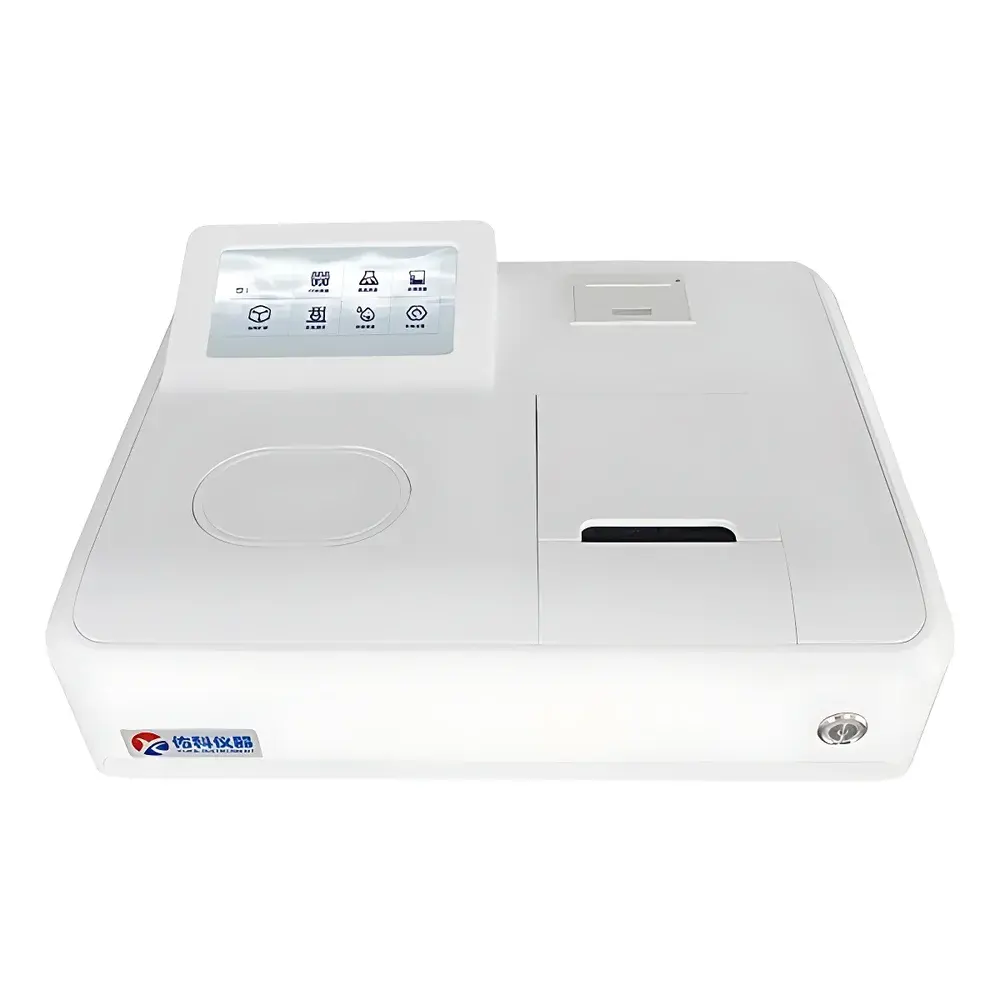
Yoke ITS2004 Multi-Parameter Water Quality Analyzer
| Brand | Yoke |
|---|---|
| Origin | Shanghai, China |
| Manufacturer Type | Direct Manufacturer |
| Product Category | Domestic |
| Model | ITS2004 |
| Price Range | USD 1,400–4,200 (FOB Shanghai) |
| Instrument Type | Benchtop Laboratory Water Quality Analyzer |
| Measurable Parameters | COD, Ammonia-Nitrogen (NH₃-N), Total Phosphorus (TP), Total Nitrogen (TN) |
| Wavelength Accuracy | ±0.5 nm |
| Display | 5.6-inch Color TFT Touchscreen |
| Data Storage | ≥5,000 records (5 factory curves + 195 user-expandable calibration curves) |
| Data Interfaces | USB 2.0, RS-232 |
| Light Source | Cold LED with Narrow-Band Interference Filters (Lifespan: ≥100,000 h) |
| Processor | ARM9 Core |
| Internal Memory | 512 MB Flash |
| Calibration Flexibility | User-Defined Multi-Segment Calibration Curves (Adjustable K-coefficients) |
| Reagent Compatibility | Pre-mixed Lab-YY Certified Reagent Kits |
| Regulatory Alignment | ASTM D1253, ISO 6060 (COD), ISO 7150-1 (NH₃-N), ISO 6878 (TP), ISO 11905-1 (TN), HJ/T 399–2007, HJ 535–2009, HJ 671–2013, HJ 636–2012 |
Overview
The Yoke ITS2004 Multi-Parameter Water Quality Analyzer is a benchtop spectrophotometric instrument engineered for precise, standardized quantification of four critical water quality parameters—Chemical Oxygen Demand (COD), Ammonia-Nitrogen (NH₃-N), Total Phosphorus (TP), and Total Nitrogen (TN)—in municipal wastewater, surface water, groundwater, and industrial effluent samples. It operates on the principle of absorbance-based photometry, utilizing narrow-band interference filters and cold LED light sources to isolate specific analytical wavelengths (e.g., 620 nm for COD, 420 nm for NH₃-N, 700 nm for TP, and 220/275 nm dual-wavelength for TN). The system implements standardized digestion and colorimetric reaction protocols aligned with Chinese environmental monitoring standards (HJ series) and internationally recognized methods (ISO and ASTM), ensuring methodological traceability and inter-laboratory comparability. Designed for routine compliance testing in accredited environmental labs, regulatory agencies, and university research facilities, the ITS2004 delivers stable optical performance, low maintenance overhead, and full audit readiness for GLP/GMP-aligned workflows.
Key Features
- 5.6-inch high-resolution color TFT touchscreen with intuitive graphical user interface (GUI), supporting multi-language menu navigation and context-sensitive operation prompts
- Dual-wavelength UV-Vis photometric engine with ±0.5 nm wavelength accuracy and <0.001 AU photometric repeatability (at 1.0 AU)
- Integrated thermal printer enabling immediate hardcopy output of current measurements, calibration logs, and stored datasets—fully traceable without external peripherals
- ARM9-based embedded architecture with 512 MB flash memory and real-time operating system (RTOS), enabling rapid data processing and seamless multi-parameter switching
- Cold LED illumination system with >100,000-hour operational lifetime and minimal thermal drift—eliminating lamp replacement cycles and warm-up delays
- Expandable calibration framework: preloaded with 5 factory-certified curves and support for up to 195 user-defined, segmented calibration curves with adjustable slope (K) and intercept coefficients
- Comprehensive data management: stores ≥5,000 measurement records with timestamp, operator ID, method ID, and raw absorbance values; supports CSV export via USB mass storage mode
- Optimized optical path design featuring high-stability interference filters and precision cuvette alignment—reducing stray light and improving signal-to-noise ratio across all detection ranges
Sample Compatibility & Compliance
The ITS2004 accepts standard 10 mm or 30 mm rectangular quartz or high-transmission plastic cuvettes (supplied with optional cuvette holder adapter). Sample volume requirements range from 2.5 mL (for NH₃-N and TP) to 5.0 mL (for COD and TN), compatible with both manual and semi-automated sample handling. All detection methodologies comply with national and international regulatory frameworks: COD analysis follows HJ/T 399–2007 (equivalent to ISO 6060 and ASTM D1253); NH₃-N uses HJ 535–2009 (aligned with ISO 7150-1); TP adheres to HJ 671–2013 (ISO 6878); and TN conforms to HJ 636–2012 (ISO 11905-1). The instrument’s firmware and calibration log structure support audit trails required under CNAS-CL01:2018 and ISO/IEC 17025:2017 laboratory accreditation criteria.
Software & Data Management
The embedded firmware provides full local control without PC dependency. All calibration data, measurement history, and method configurations are stored in non-volatile memory with automatic timestamping and operator tagging (via configurable user accounts). USB 2.0 host port enables direct export of datasets in comma-separated value (CSV) format for LIMS integration or statistical analysis in Excel, R, or Python environments. RS-232 serial interface supports remote command control (SCPI-like syntax) for automated batch testing in multi-instrument lab setups. Audit logs retain calibration verification events, firmware updates, and critical parameter changes—satisfying basic FDA 21 CFR Part 11 requirements for electronic records when paired with institutional SOPs for user authentication and record retention.
Applications
- Routine monitoring of influent and effluent streams in municipal wastewater treatment plants (WWTPs)
- Environmental field laboratories conducting surface water quality assessments per national monitoring network protocols
- Industrial pretreatment verification for electroplating, food processing, and pharmaceutical manufacturing facilities
- Academic teaching labs performing standard method validation exercises and student-led water chemistry experiments
- Third-party testing organizations delivering certified reports for discharge permit compliance (e.g., China’s Pollutant Discharge Permit System)
- Research applications requiring reproducible baseline characterization of nutrient loading and organic pollution indices
FAQ
Does the ITS2004 support automatic wavelength selection for different parameters?
Yes—the instrument auto-selects optimal wavelengths based on the selected test method (e.g., 620 nm for COD, 420 nm for NH₃-N) without manual filter changes.
Can calibration curves be exported or backed up externally?
Calibration curve parameters (including segment breakpoints and K-coefficients) can be saved to USB drive in encrypted binary format; CSV export of measurement data is fully supported.
Is the instrument compatible with third-party reagents beyond Lab-YY kits?
While optimized for Lab-YY certified reagents, users may implement custom reagent protocols provided they validate linearity, LOD/LOQ, and recovery against reference materials per ISO/IEC 17025 Clause 5.4.
What is the recommended maintenance schedule?
No routine optical alignment is required; annual verification of wavelength accuracy and photometric linearity using NIST-traceable neutral density filters is advised.
Does the ITS2004 meet GLP documentation requirements?
It provides timestamped, operator-tagged records and full calibration history—sufficient for GLP-compliant labs when integrated into documented QA/QC procedures and change control systems.
Related Products







