
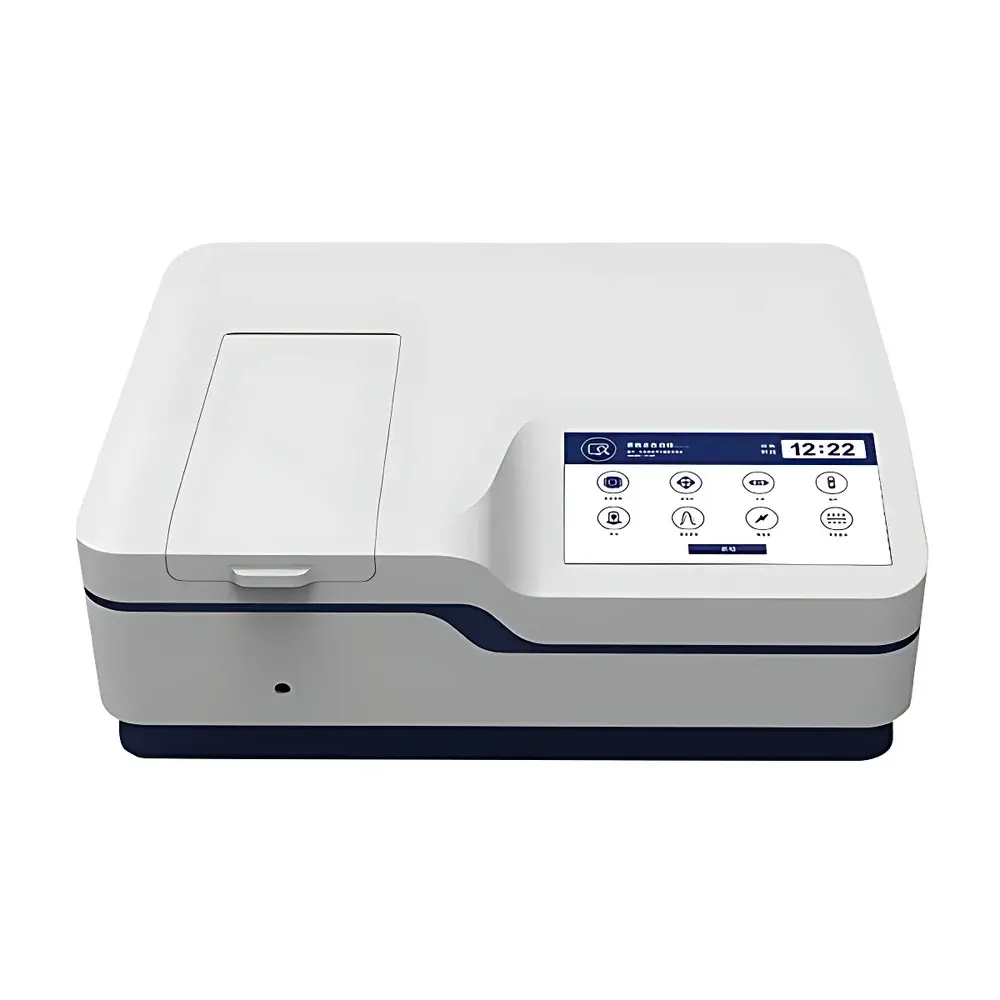
Yoke T3200 Touchscreen UV-Vis Spectrophotometer
| Brand | Yoke |
|---|---|
| Origin | Shanghai, China |
| Manufacturer Type | OEM Manufacturer |
| Instrument Type | Domestic (PRC-made) |
| Model | T3200 |
| Price Range | USD 4,200 – 7,000 |
| Optical Design | Pseudo-Double-Beam |
| Detector | Photodiode Array (PDA) |
| Wavelength Range | 190–1100 nm |
| Wavelength Scanning | Motorized Auto-Scan |
| Spectral Bandwidth | 2 nm |
| Wavelength Accuracy | ±0.3 nm |
| Stray Light | ≤0.05% at 220 nm |
Overview
The Yoke T3200 Touchscreen UV-Vis Spectrophotometer is a benchtop analytical instrument engineered for precision absorbance and transmittance measurements across the ultraviolet, visible, and near-infrared spectral regions (190–1100 nm). It operates on a pseudo-double-beam optical architecture—employing a single light source with beam-splitting and time-multiplexed reference/sample path detection—to deliver high photometric stability and reduced baseline drift without the complexity of true dual-optical-path systems. The instrument integrates a high-efficiency Czerny-Turner monochromator with an imported deuterium lamp (UV) and tungsten-halogen lamp (VIS-NIR), coupled to a high-sensitivity photodiode array detector. This configuration ensures rapid spectral acquisition, excellent signal-to-noise ratio, and robust long-term repeatability—critical for quantitative analysis in regulated and research environments.
Key Features
- 10.1-inch capacitive touchscreen display (1024 × 800 resolution) enabling full standalone operation: spectrum scanning, kinetic assays, multi-wavelength quantitation, and standard curve generation without external PC connectivity.
- Embedded ARM12 high-performance processor with 8 GB internal flash memory—capable of storing up to 5,000 individual measurement records or 500 calibration curves.
- Modular optical design featuring suspended optical bench construction and reinforced aluminum baseplate to minimize mechanical vibration-induced wavelength shift or photometric error.
- Patented optoelectronic signal detection system (Chinese Patent No. ZL 2010 2 0562320.3) optimized for low-noise analog-to-digital conversion and enhanced thermal stability.
- Dual-layer chassis architecture physically isolates optical pathways from electronic circuitry, eliminating electromagnetic interference and improving photometric reproducibility.
- Multiple data export options: USB drive (supports .csv, .qua, .txt, .bmp), RS-232C serial port (for thermal printer integration), and USB HOST interface for peripheral device expansion.
- Self-diagnostic firmware with real-time fault detection—including lamp status, wavelength encoder calibration, and detector saturation monitoring—to ensure operational integrity prior to measurement.
Sample Compatibility & Compliance
The T3200 accommodates standard 10 mm pathlength cuvettes (glass, quartz, or plastic) and supports optional accessories including an 8-position rotating automatic cuvette changer (patent-pending alignment mechanism ensuring consistent beam centering) and an integrated flow cell module for continuous sample introduction. Its photometric accuracy (±0.3% T) and wavelength fidelity (±0.3 nm across full range; ±0.1 nm at 656.1 nm hydrogen line) meet performance benchmarks aligned with ISO 9001 manufacturing controls and are suitable for method validation under GLP and GMP frameworks. While not pre-certified to FDA 21 CFR Part 11, the instrument’s audit-trail-capable firmware (with timestamped user log entries and immutable data storage) provides foundational traceability required for regulated QC laboratories in pharmaceutical, food safety, and environmental testing applications.
Software & Data Management
All instrument control, data acquisition, and analysis functions are executed natively within the embedded Linux-based operating system. No proprietary software installation is required on host computers—data files export directly in industry-standard formats (.csv for spreadsheet analysis, .bmp for report embedding, .qua for spectral archiving in ASCII-compatible format). The system supports direct import/export to Microsoft Excel and common LIMS platforms via flat-file transfer. Internal memory management includes automatic file versioning, user-defined folder organization, and password-protected administrator mode for method locking and parameter restriction—facilitating compliance with laboratory SOPs and personnel access control policies.
Applications
- Quantitative determination of nucleic acid and protein concentration (A260/A280 ratios) in molecular biology workflows.
- Pharmaceutical assay development and dissolution testing per USP and EP 2.9.3 guidelines.
- Colorimetric enzyme kinetics (e.g., ELISA, LDH, ALP) with programmable time-scan and rate calculation.
- Water quality analysis: nitrate, phosphate, COD, and heavy metal ion (e.g., Cr(VI), Fe2+) quantification using APHA-compliant methods.
- Food and beverage QA: caffeine, anthocyanin, carotenoid, and preservative (e.g., benzoic acid) content verification.
- Materials science: thin-film transmittance/absorbance profiling and bandgap estimation of semiconductor coatings.
FAQ
Is the T3200 compliant with FDA 21 CFR Part 11?
The instrument does not include electronic signature functionality or built-in audit trail generation required for full Part 11 compliance; however, its immutable internal storage, timestamped user logs, and exportable raw data support manual compliance implementation when paired with validated laboratory procedures.
Can the T3200 perform kinetic measurements?
Yes—it supports time-scan mode with adjustable interval (0.1–999.9 s), enabling real-time monitoring of enzymatic reactions, chemical kinetics, and photostability studies.
What cuvette types are supported?
Standard 10 mm square cuvettes made of quartz (190–2500 nm), high-quality optical glass (340–2500 nm), or disposable polystyrene (340–800 nm); custom pathlength cells (e.g., 1 mm, 5 mm) may be used with appropriate calibration.
Does the instrument require external PC software for basic operation?
No—all core functions—including spectrum acquisition, quantitative analysis, and method recall—are fully accessible via the integrated touchscreen interface without any external computer dependency.
How is wavelength accuracy verified during routine use?
Users may perform periodic verification using NIST-traceable holmium oxide or didymium oxide filters; the instrument’s self-test mode includes automated wavelength calibration confirmation at key emission lines (e.g., 361.2 nm, 418.5 nm, 536.2 nm).



