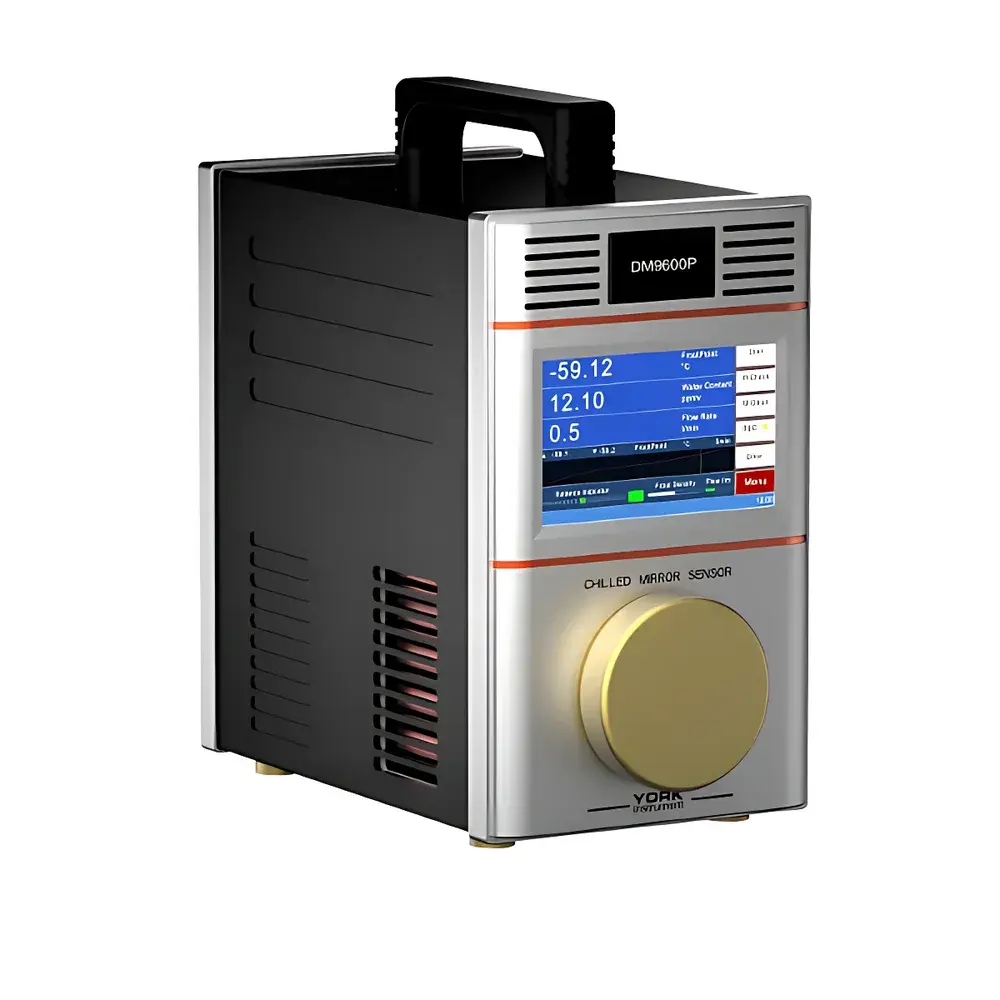
York Instruments DM9600P Cold Mirror Precision Dew Point Analyzer
| Brand | York Instruments |
|---|---|
| Origin | Beijing, China |
| Manufacturer Type | Manufacturer |
| Model | DM9600P |
| Measurement Principle | Chilled-mirror hygrometry |
| Display | 7-inch capacitive touchscreen LCD with bilingual (EN/CN) UI |
| Control System | Digital fuzzy logic control with auto-balance dew point stabilization algorithm |
| Communication Interfaces | RS-485, USB 2.0 |
| Data Storage | SD card slot (up to 32 GB, FAT32 formatted) |
| Compliance | Designed per ISO 8503-1 (surface profile), ASTM E104 (controlled humidity environments), and aligned with calibration traceability requirements of ISO/IEC 17025 |
Overview
The York Instruments DM9600P Cold Mirror Precision Dew Point Analyzer is an optoelectronic hygrometer engineered for direct, primary-standard measurement of dew point temperature in process gases and compressed air systems. It operates on the fundamental physical principle of chilled-mirror condensation: a polished, thermoelectrically cooled mirror surface is dynamically regulated until the onset of condensate formation is detected via high-sensitivity optical reflectance monitoring. At this thermodynamic equilibrium point—where vapor pressure equals saturation pressure—the mirror temperature is recorded as the true dew point temperature (°C or °F). Unlike indirect sensor technologies (e.g., capacitive or aluminum oxide sensors), the DM9600P delivers absolute measurement traceable to the International Temperature Scale (ITS-90) without drift-induced recalibration cycles. Its design targets laboratories and industrial QA/QC environments requiring metrologically defensible data under variable flow rates (0.5–10 L/min), pressures (ambient to 1.6 MPa), and gas matrices including N₂, CO₂, natural gas, SF₆, and purified instrument air.
Key Features
- 7-inch capacitive touchscreen interface with context-sensitive, icon-driven navigation and real-time graphical trend display
- Bilingual firmware (English/Chinese) supporting field-switchable language without reboot
- Digital fuzzy logic temperature control architecture enabling sub-0.1°C thermal stability at the mirror surface during dynamic equilibrium acquisition
- Integrated auto-balance dew point stabilization system that suppresses overshoot and accelerates settling time—typical response < 90 seconds from dry to saturated conditions
- Multi-parameter concurrent output: dew point temperature, relative humidity (calculated), gas temperature, pressure (optional external transducer input), and mirror status (clean/contaminated/fogged)
- Dual-mode communication architecture: isolated RS-485 Modbus RTU for SCADA integration and USB 2.0 CDC-class virtual COM port for PC-based configuration and live data streaming
- Onboard SD card logging (FAT32, up to 32 GB) supporting timestamped CSV export compliant with 21 CFR Part 11 audit trail prerequisites when used with validated software
Sample Compatibility & Compliance
The DM9600P accommodates non-corrosive, particle-free gas streams with particulate filtration recommended upstream (≤0.3 µm filter). It is validated for use with inert gases (Ar, He, N₂), hydrocarbon-rich streams (natural gas, refinery off-gas), insulating gases (SF₆), and medical-grade air per ISO 8573-1:2010 Class 2 purity requirements. Mirror contamination detection algorithms provide real-time diagnostic feedback to ensure measurement integrity. The analyzer meets electromagnetic compatibility requirements per IEC 61326-1:2020 and is constructed to IP54 ingress protection standards. While not certified for hazardous areas, it may be deployed in Zone 2 classified environments when installed with appropriate barrier systems. Calibration documentation supports ISO/IEC 17025-accredited labs through NIST-traceable reference standards (e.g., Rotronic HC2-IC, MBW 373 or equivalent primary dew point generators).
Software & Data Management
The DM9600P includes embedded firmware v3.2+ with built-in data structuring logic compliant with ASTM E2917-21 Annex A1 for hygrometer validation reports. Optional YorkLink™ PC software (Windows 10/11, 64-bit) enables remote parameter configuration, real-time waveform visualization, automated calibration certificate generation, and GLP-compliant electronic signature workflows. All logged datasets include embedded metadata: operator ID, instrument serial number, calibration due date, ambient conditions, and cryptographic hash for data integrity verification. Audit trail records capture user actions, parameter changes, and system events with UTC timestamps—fully exportable as PDF or XML for regulatory submission.
Applications
- Petrochemical refining: moisture monitoring in liquefied petroleum gas (LPG), ethylene feedstock, and hydrogen purification loops
- Power generation: SF₆ moisture analysis in high-voltage circuit breakers and GIS enclosures per IEC 60480
- Pharmaceutical manufacturing: compressed air qualification per ISO 8573-1 and EU GMP Annex 1 requirements
- Aviation fuel handling: detection of free water and dissolved moisture in Jet A-1 prior to turbine injection
- National metrology institutes: reference standard transfer and inter-laboratory comparison studies
- Research laboratories: low-temperature phase behavior studies of gas hydrates and clathrate formation thresholds
FAQ
What is the typical measurement range for the DM9600P?
The standard configuration covers −60 °C to +20 °C dew point, extendable to −70 °C with optional cryogenic cooling module.
Does the DM9600P require periodic mirror cleaning?
Yes—mirror maintenance frequency depends on sample cleanliness; the unit logs cumulative exposure hours and triggers visual alerts when optical degradation exceeds 5% reflectance loss.
Can the DM9600P operate continuously under pressurized flow?
Yes, with optional pressure-rated inlet manifold (rated to 1.6 MPa); pressure compensation is applied automatically when a calibrated transducer is connected.
Is firmware upgrade supported in-field?
Yes, via USB drive or over RS-485 using signed .bin files; all updates preserve user calibration constants and historical logs.
How is measurement uncertainty quantified?
Total expanded uncertainty (k=2) is ±0.2 °C for dew point between −20 °C and +10 °C, based on type B evaluation per GUM (JCGM 100:2008) and validated against NPL reference dew point cells.