
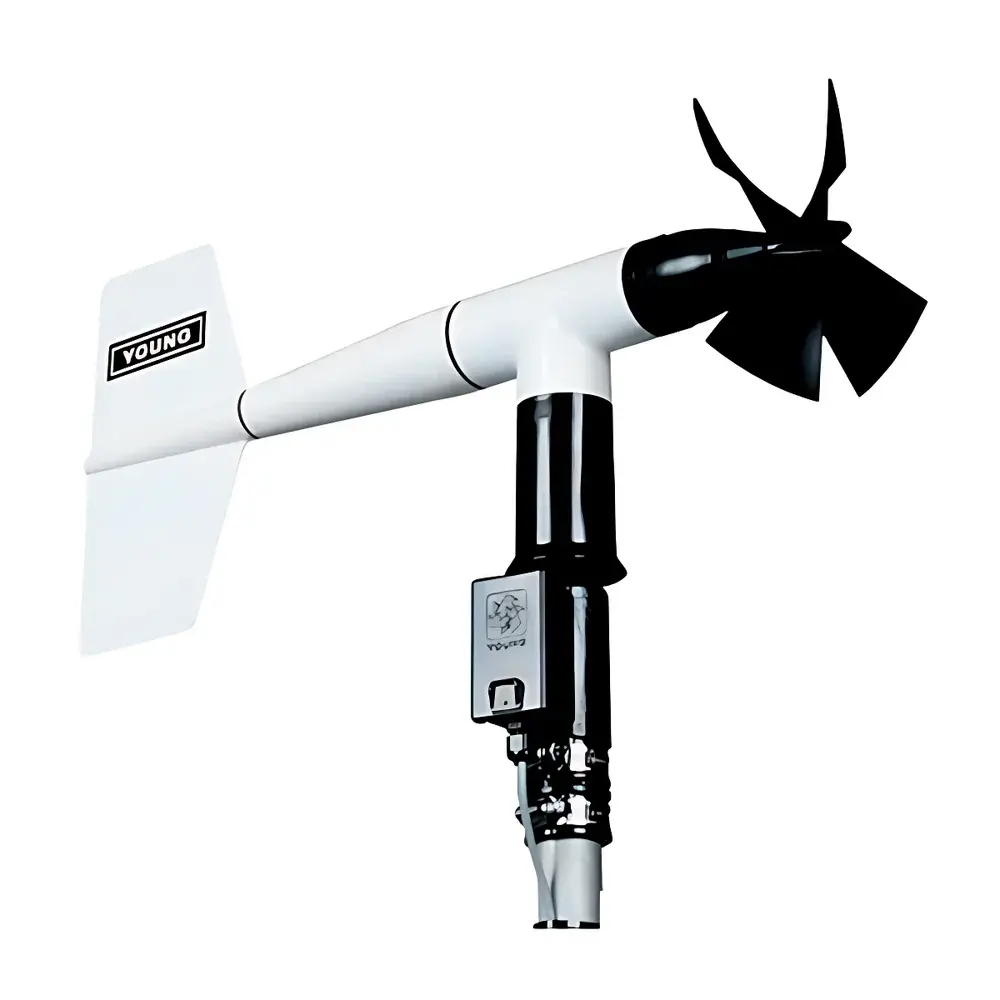
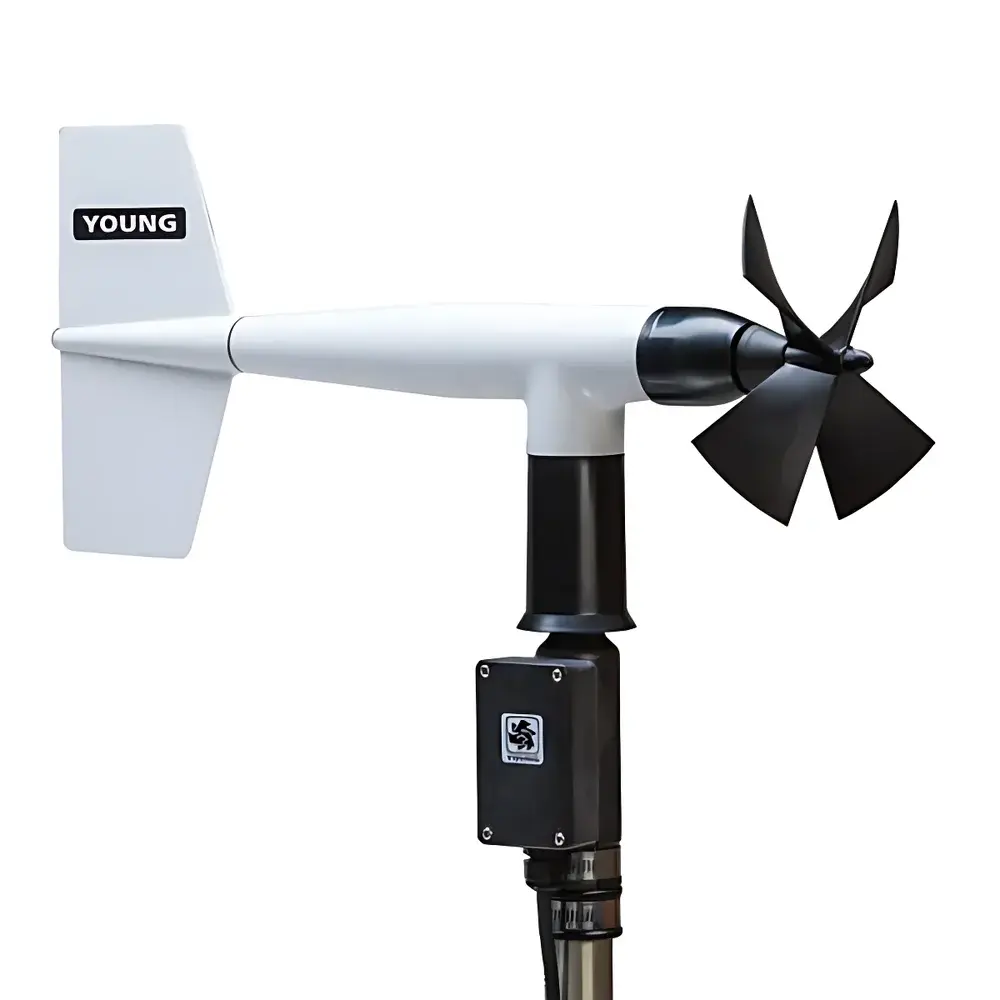
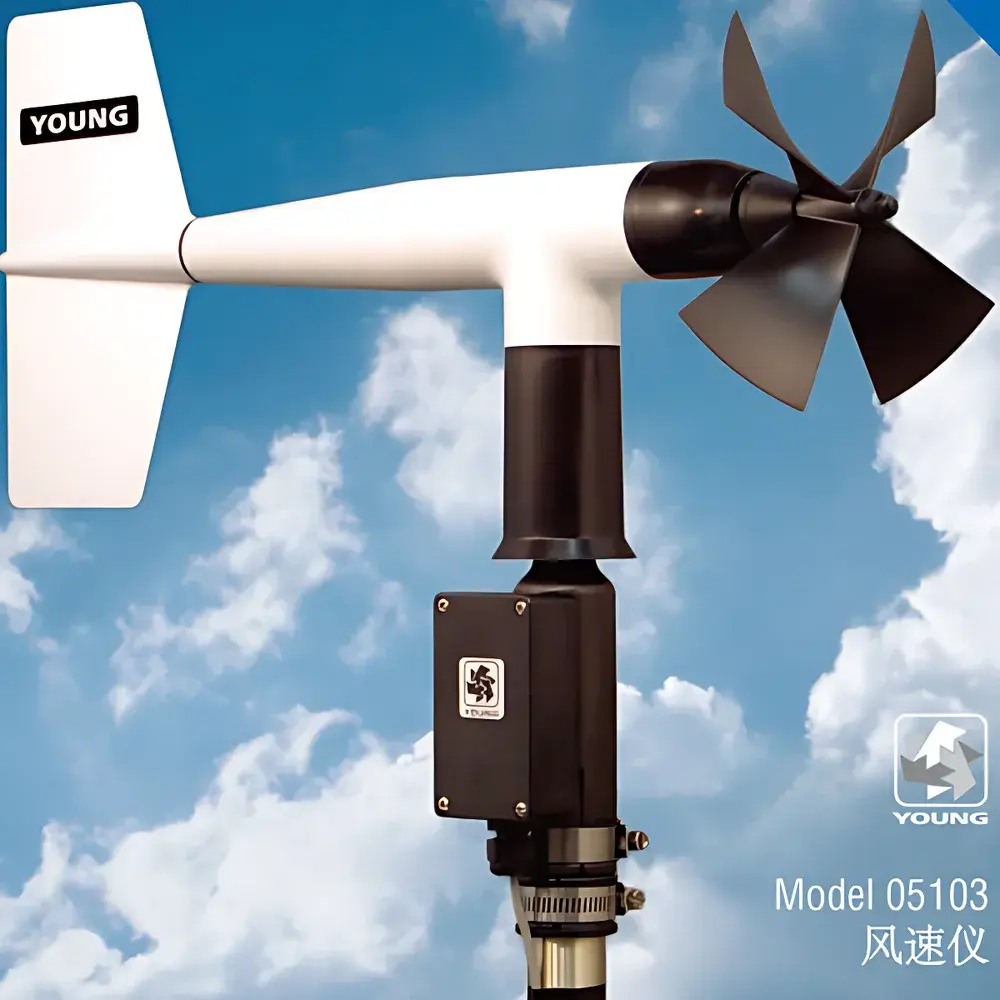
R.M. Young 05103 High-Performance Propeller Anemometer
| Brand | R.M. Young |
|---|---|
| Origin | USA |
| Model | 05103 |
| Instrument Type | Propeller Anemometer |
| Resolution | 0.1 m/s |
| Measurement Range | 0–100 m/s |
| Accuracy | ±0.3 m/s or ±1% of reading |
| Operating Temperature | −50°C to +50°C |
| Relative Humidity Range | 0–100% RH |
| Startup Wind Speed (Propeller) | 1.0 m/s |
| Startup Wind Speed (Vane) | 1.1 m/s |
| Wind Direction Range | 360° mechanical, 355° electronic (5° dead zone) |
| Wind Direction Accuracy | ±3° |
| Output Options | AC pulse (3 pulses/rev), 0–5 VDC (05103V), or 4–20 mA (05103L) |
| Power Supply | 15 VDC (sensor only) |
| Housing Material | UV-stabilized polymer with stainless steel and anodized aluminum hardware |
| Bearing Type | Precision stainless steel ball bearings |
| Mounting | Standard 1-inch NPT pipe thread |
| Weight | 1.0 kg (sensor), 2.3 kg (shipping) |
Overview
The R.M. Young 05103 High-Performance Propeller Anemometer is a precision-engineered meteorological sensor designed for long-term, unattended wind speed and direction measurement in demanding environmental monitoring applications. Based on proven electromagnetic induction and potentiometric transduction principles, the 05103 delivers high reproducibility and minimal drift across its full operational range. Its four-blade propeller rotates in response to wind flow, generating an AC sine wave signal whose frequency is linearly proportional to wind speed—eliminating wear-prone slip rings and brushes to ensure mechanical longevity. The integrated vane assembly employs a low-aspect-ratio tail fin mounted on a sealed, high-cycle conductive plastic potentiometer (10 kΩ, ±0.25% linearity, >50 million rotations), providing robust angular position sensing. All electronics—including transient protection, cable termination, and optional signal conditioning—are housed within a weatherproof junction box. Designed for compliance with WMO observational standards and compatible with Class I and II meteorological networks, the 05103 serves as a primary reference-grade sensor in climate stations, air quality monitoring networks, wind resource assessment, and industrial safety systems.
Key Features
- Propeller-based wind speed sensing with electromagnetic AC pulse output (3 pulses per revolution), enabling direct frequency-to-speed conversion without analog drift.
- High-fidelity vane design with optimized aerodynamic inertia and damping characteristics: lag distance of 1.3 m and damping ratio of 0.3, ensuring faithful tracking of rapidly changing wind vectors.
- UV-resistant polymer housing with stainless steel shafts, anodized aluminum brackets, and precision stainless steel ball bearings—engineered for corrosion resistance in coastal, industrial, and arctic environments.
- Integrated signal conditioning options: 05103V (0–5 VDC calibrated output, 8–24 VDC powered, 5 mA draw at 12 VDC) and 05103L (4–20 mA loop-powered output, 8–30 VDC, up to 40 mA), both supporting extended cable runs and EMI resilience.
- Standard 1-inch NPT mounting interface and alignment ring for repeatable orientation during maintenance or recalibration—critical for directional data continuity in long-term studies.
- Extended environmental tolerance: fully functional from −50°C to +50°C and 0–100% RH, validated per IEC 60068-2 environmental stress testing protocols.
Sample Compatibility & Compliance
The 05103 is compatible with all standard data loggers accepting TTL-level pulse inputs, analog voltage (0–5 VDC), or 4–20 mA current loops—including Campbell Scientific CR series, Onset HOBO, Delta-T Devices GP1, and generic SCADA-compatible controllers. Its mechanical and electrical design conforms to IEC 61000-4 immunity standards (ESD, surge, fast transient burst) and meets IP65 ingress protection when properly installed with supplied gaskets. While not certified under ISO/IEC 17025 for calibration traceability out-of-box, the sensor is fully compatible with NIST-traceable field calibration procedures per ASTM D5096 and WMO Guide to Meteorological Instruments and Methods of Observation (CIMO Guide, Chapter 8). It supports GLP-compliant deployment when paired with audit-trail-capable data acquisition systems meeting FDA 21 CFR Part 11 requirements for electronic records.
Software & Data Management
No proprietary software is required for basic operation; raw pulse, voltage, or current outputs integrate natively into industry-standard DAQ platforms. For advanced configuration and diagnostics, R.M. Young provides the free *Young Sensor Utility* (Windows/macOS), which enables firmware verification, zero-offset validation, and output scaling verification. When deployed in networked environmental monitoring systems, the 05103’s stable analog and pulse outputs support time-synchronized sampling at user-defined intervals (1 Hz to 10 Hz typical), enabling calculation of gust factors, turbulence intensity (σu/U), and vector-averaged wind direction per WMO-recommended methodologies. Data streams are fully compatible with cloud platforms such as ThingSpeak, AWS IoT Core, and custom MQTT-based telemetry architectures.
Applications
- Long-term climatological monitoring at national weather service stations and research observatories.
- Wind energy site assessment and turbine control feedback loops requiring high dynamic response.
- Industrial stack emission monitoring where wind vector data informs dispersion modeling (e.g., EPA AERMOD input).
- Offshore platform and marine buoy deployments—when specified as model 05106 (marine variant with waterproof bearing grease and armored cable).
- Urban air quality networks integrating meteorological context for PM2.5/NOx trend analysis.
- Fire weather forecasting systems requiring reliable low-wind threshold detection (startup speed: 1.0 m/s).
FAQ
What is the minimum wind speed the 05103 can reliably detect?
The propeller starts rotating at ≥1.0 m/s; measurable output is consistent above this threshold. Below 1.0 m/s, output falls below signal-to-noise floor for most DAQ systems.
Can the 05103 be used in salt-laden marine environments?
Yes—model 05106 is the marine-rated version, featuring corrosion-inhibiting bearing lubricant and a sealed, reinforced cable exit instead of the standard junction box.
Is calibration certificate included with purchase?
A factory calibration report (including wind tunnel test data at multiple speeds and directions) is provided. NIST-traceable calibration services are available separately through R.M. Young’s accredited metrology lab.
How does the vane’s 5° electronic dead zone affect data accuracy?
The 5° open sector (355° electronic range vs. 360° mechanical) reflects physical wiper contact limits in the potentiometer—not a performance limitation. Directional resolution remains ≤0.1°, and interpolation algorithms in compliant DAQ firmware fully compensate for the gap.
What is the expected service life under continuous outdoor exposure?
Based on accelerated aging tests and field data from >15-year installations, mean time between failures exceeds 10 years when maintained per R.M. Young’s recommended biannual inspection protocol (bearing lubrication check, housing seal integrity, cable strain relief inspection).
Related Products







