
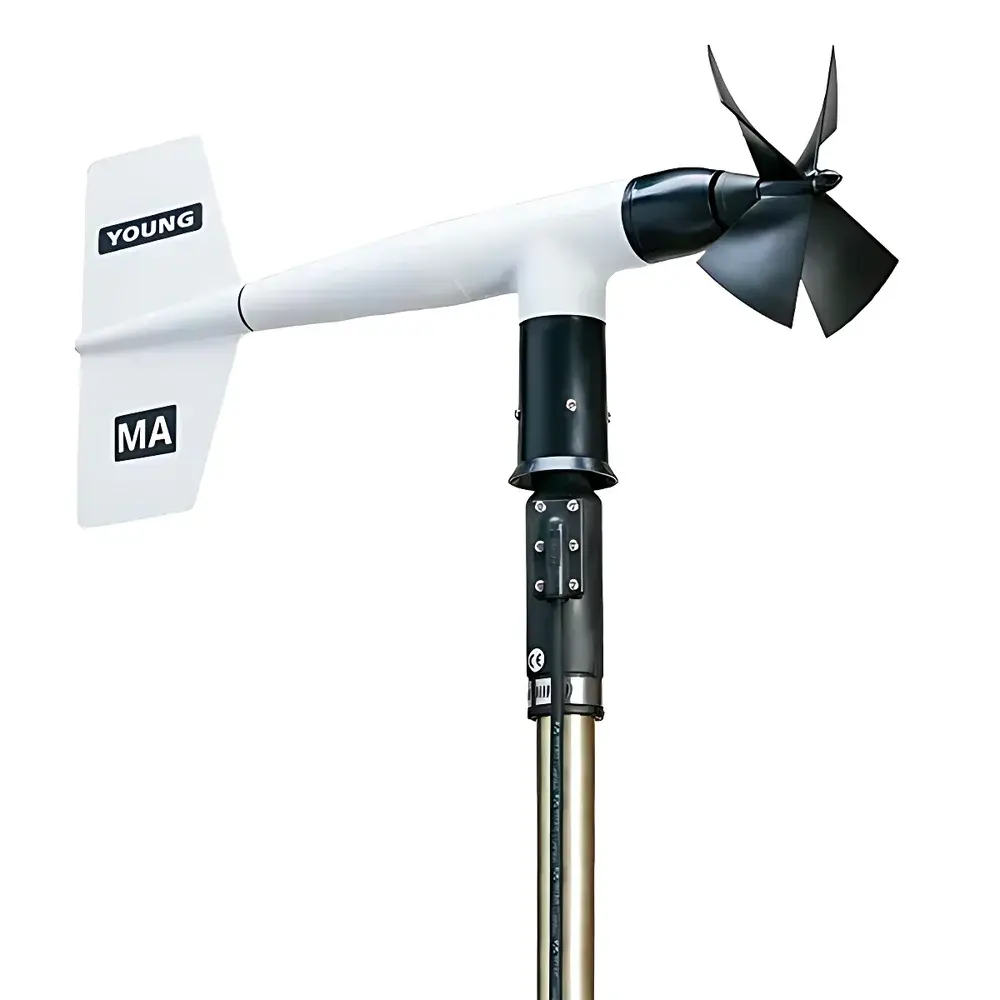
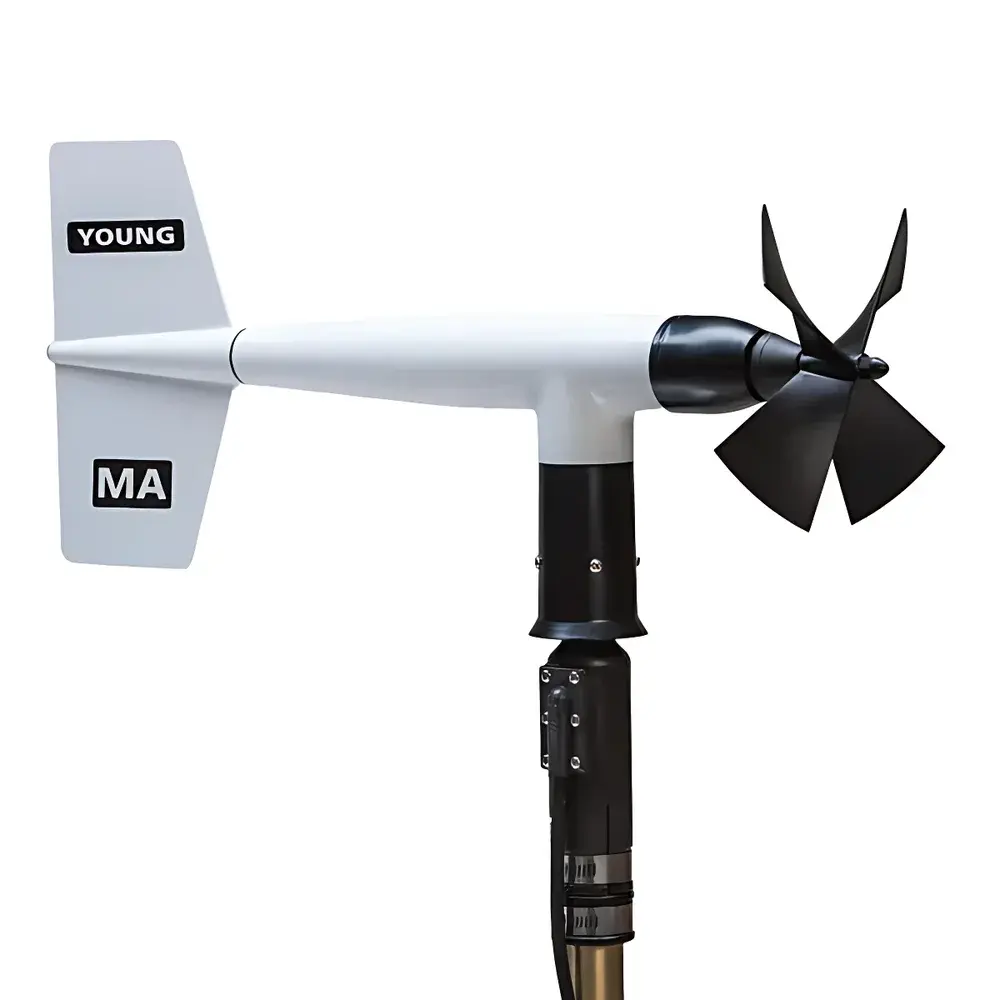
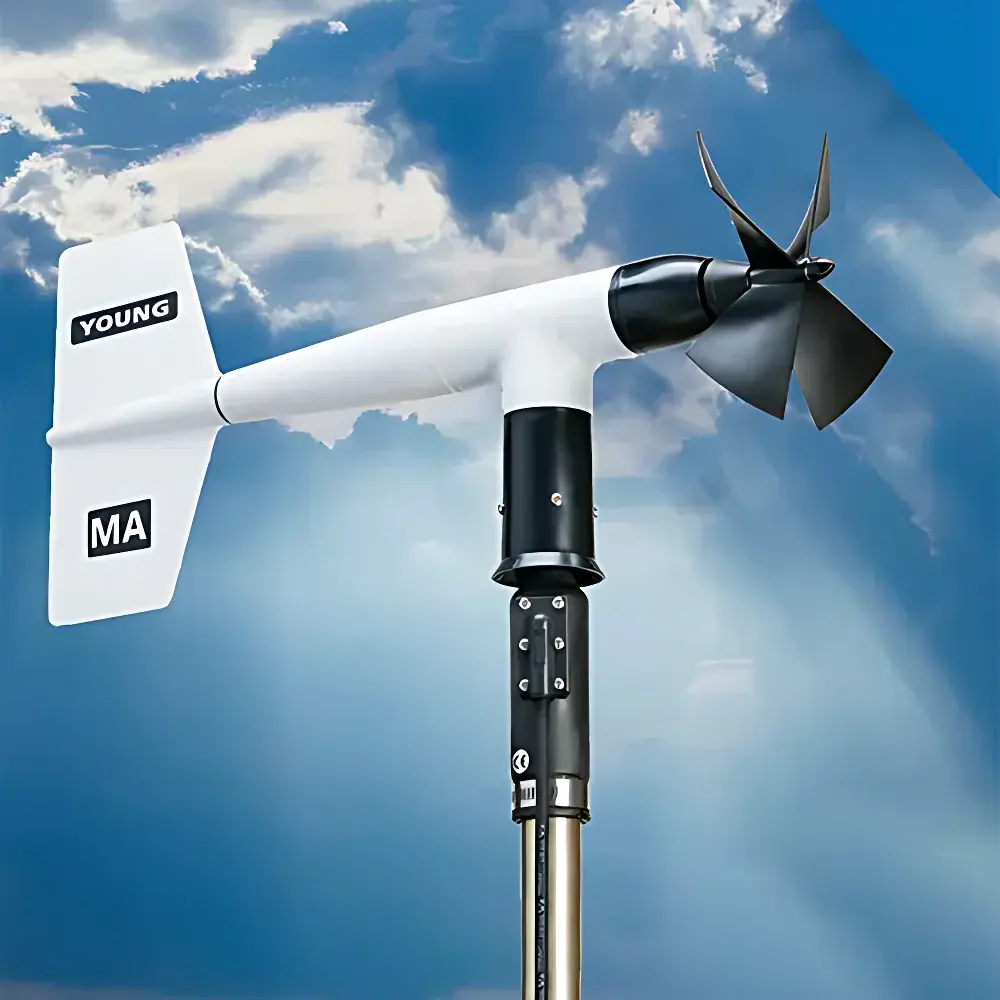
R.M. Young 05106 Propeller Anemometer & Vane Wind Direction Sensor
| Brand | R.M. Young |
|---|---|
| Origin | USA |
| Model | 05106 |
| Instrument Type | Propeller Anemometer |
| Resolution | 0.1 m/s |
| Measurement Range | 0–100 m/s |
| Accuracy | ±3% of reading or ±0.3 m/s (whichever is greater) |
| Operating Temperature | −50°C to +60°C |
| Relative Humidity Range | 0–100% RH |
| Wind Direction Range | 360° mechanical, 355° electronic (5° dead zone) |
| Wind Direction Accuracy | ±3° |
| Startup Wind Speed | 1.0 m/s (propeller), 1.1 m/s (vane) |
| Output | Magnetic pulse (3 pulses/rev) for wind speed |
| Power Supply | 15 VDC excitation (sensor) |
| Dimensions | 55 cm length × 37 cm height × 18 cm propeller diameter |
| Mounting | Standard 1-inch NPT pipe thread |
| Weight | 1.0 kg (sensor only), 2.3 kg (shipping) |
Overview
The R.M. Young 05106 Propeller Anemometer & Vane Wind Direction Sensor is an industrial-grade, marine-optimized environmental monitoring instrument engineered for long-term deployment in extreme outdoor and offshore conditions. It operates on two independent physical principles: electromagnetic induction for wind speed measurement and precision potentiometric angular transduction for wind direction determination. The four-blade propeller rotates in response to airflow, generating a clean AC pulse signal (3 pulses per revolution) proportional to rotational velocity—free from mechanical wear due to the absence of slip rings or electrical contacts. Simultaneously, the molded vane aligns with wind flow, and its angular position is translated into a linear analog voltage output via a hermetically sealed, conductive-plastic 10 kΩ potentiometer rated for 50 million rotations. This dual-sensor architecture ensures high reproducibility, minimal hysteresis, and stable zero-point behavior across decades of continuous operation.
Key Features
- Marine-grade corrosion resistance: All structural components—including housing, shaft, vane, and mounting hardware—are fabricated from UV-stabilized engineering polymers and passivated stainless steel alloys.
- Ceramic bearing system: Ultra-durable ceramic ball bearings replace conventional steel bearings, delivering superior wear resistance and immunity to saltwater-induced pitting and galvanic corrosion.
- No-contact wind speed sensing: Electromagnetic pickup eliminates sliding contacts, ensuring maintenance-free operation and signal integrity over extended exposure to saline aerosols and particulate-laden air.
- High-fidelity directional transduction: Sealed potentiometer with 0.25% linearity tolerance and full 360° mechanical rotation enables precise sector-based wind rose analysis and turbulence characterization.
- Modular signal conditioning: Optional interface modules (05603C and 05631C) provide calibrated, low-impedance analog outputs compatible with SCADA, data loggers, and PLC systems—supporting both voltage (0–5 VDC) and current-loop (4–20 mA) transmission standards.
- Robust mechanical design: Optimized aerodynamic vane geometry and low-inertia propeller yield fast dynamic response (distance constant: 2.7 m for propeller; 1.3 m for vane) and minimal overshoot under turbulent flow conditions.
Sample Compatibility & Compliance
The 05106 is designed for continuous, unattended operation in open-air environments including coastal meteorological stations, offshore oil platforms, wind resource assessment sites, and atmospheric boundary-layer research towers. Its materials and sealing meet IP66 ingress protection requirements and comply with ASTM D5096 (Standard Practice for Calibration of Anemometers) and IEC 61400-12-1 (Wind turbine power performance testing). While not certified for safety-critical aviation applications, it satisfies general-purpose environmental monitoring requirements under ISO 16074:2014 (Wind measurement instrumentation—Performance testing of cup and propeller anemometers). The sensor’s operating temperature range (−50°C to +60°C) supports deployment in Arctic research stations and desert solar farms alike.
Software & Data Management
The 05106 produces raw analog and pulse signals that integrate seamlessly with industry-standard data acquisition platforms—including Campbell Scientific CR-series loggers, HOBO UX120, Onset U30, and National Instruments DAQ systems. When paired with the 05603C or 05631C interface modules, output signals are pre-calibrated and traceable to NIST-traceable wind tunnel standards. These modules include built-in temperature compensation and provide stable excitation for the potentiometer, minimizing drift during diurnal thermal cycling. For regulatory-compliant deployments (e.g., EPA ambient air monitoring or GLP-aligned field studies), users may configure audit trails and calibration metadata within their host software—though the sensor itself does not implement FDA 21 CFR Part 11 electronic signature functionality, as it is a passive transducer without embedded firmware or memory.
Applications
- Long-term climatological monitoring at NOAA, WMO, and national meteorological service stations
- Offshore wind farm site assessment and turbine wake characterization
- Boundary-layer turbulence profiling in atmospheric science campaigns
- Industrial stack emission dispersion modeling and fence-line monitoring
- Wildfire behavior prediction and fire weather forecasting networks
- Validation of numerical weather prediction (NWP) model outputs and satellite-derived wind products
FAQ
What is the minimum wind speed required to initiate rotation of the propeller?
The propeller starts rotating reliably at 1.0 m/s; below this threshold, output pulses cease and the sensor reports zero wind speed.
Can the 05106 be used in freezing rain or rime ice conditions?
Yes—the ceramic bearings and non-hygroscopic polymer housing resist ice adhesion and maintain rotational freedom down to −50°C, though periodic visual inspection is recommended in persistent icing environments.
Is the 05106 compatible with Modbus or SDI-12 communication protocols?
No—the sensor provides only analog voltage or pulse outputs; protocol conversion requires external signal conditioners or smart data loggers with built-in Modbus/SDI-12 support.
How often does the 05106 require recalibration?
R.M. Young recommends annual field verification against a reference anemometer per ASTM D5096; full laboratory recalibration is advised every 2–3 years for mission-critical applications.
Does the 05631C interface support HART protocol?
No—the 05631C delivers a standard 4–20 mA analog output only; HART-enabled versions are not offered by R.M. Young for this product line.







