
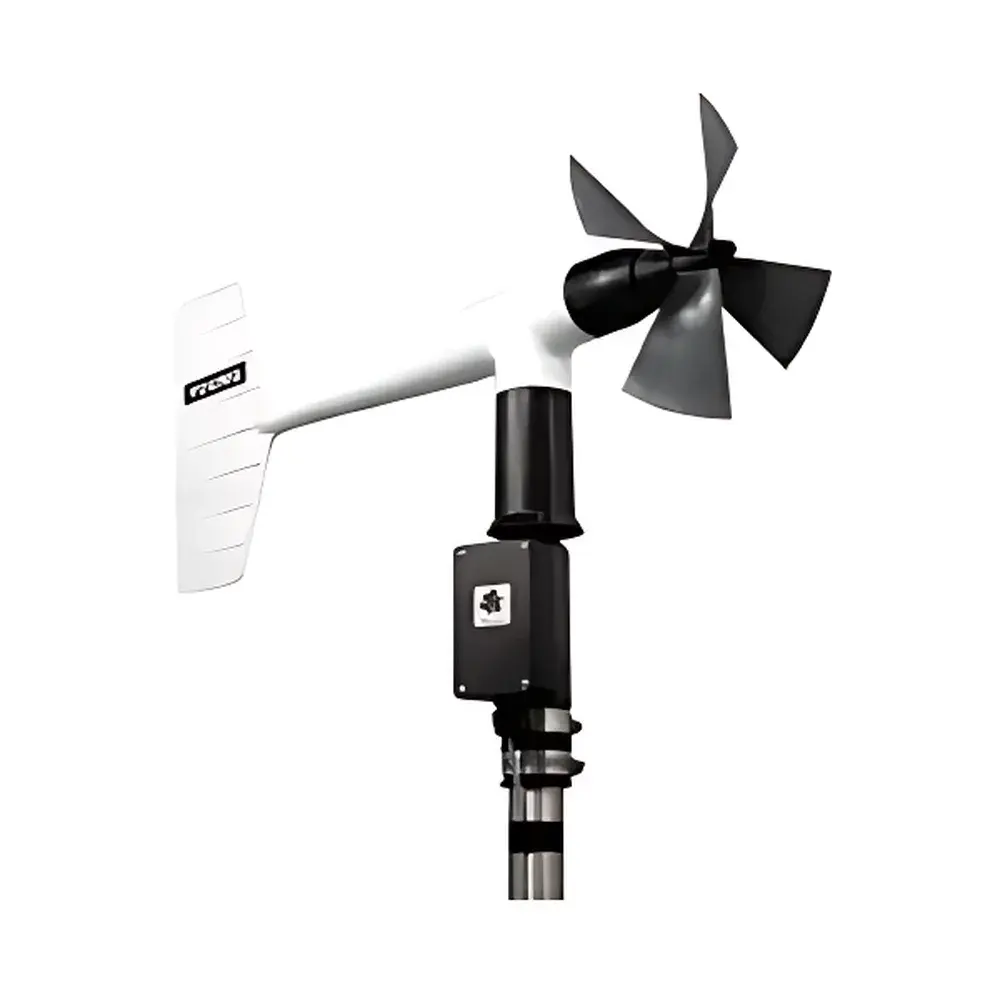
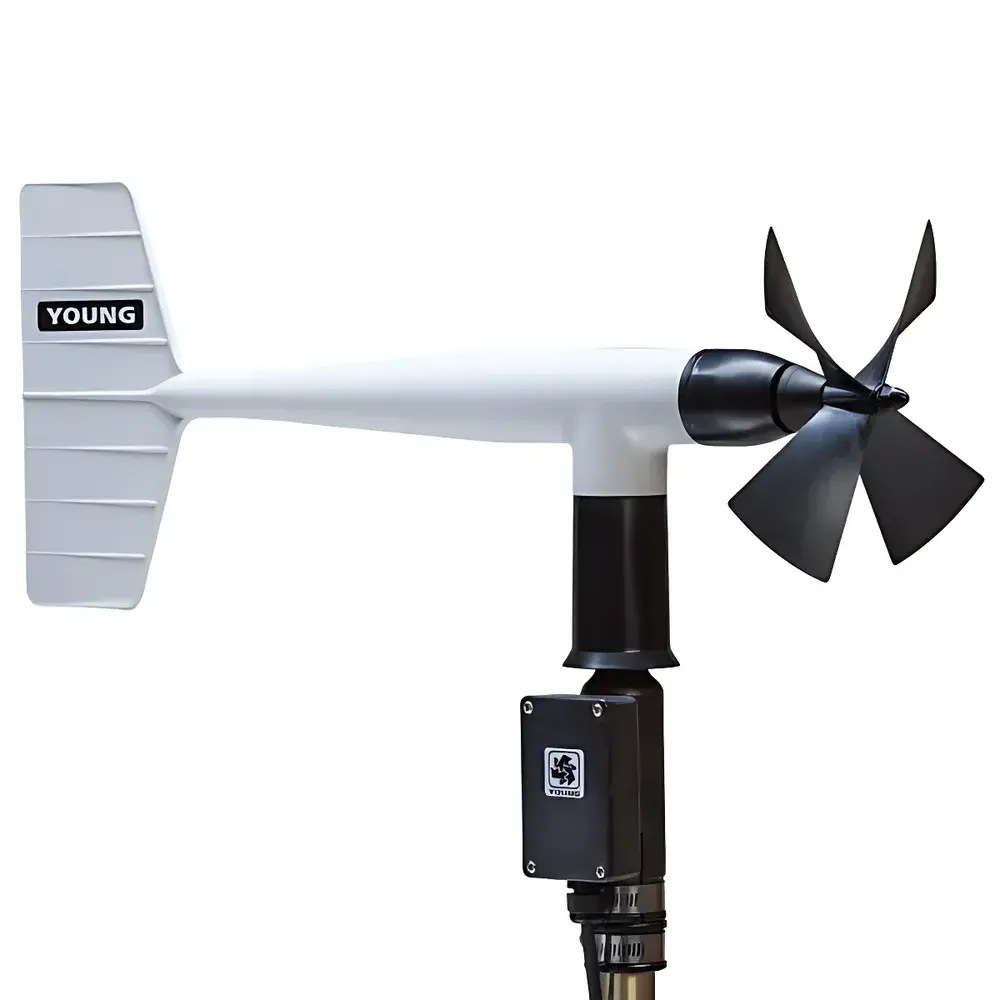
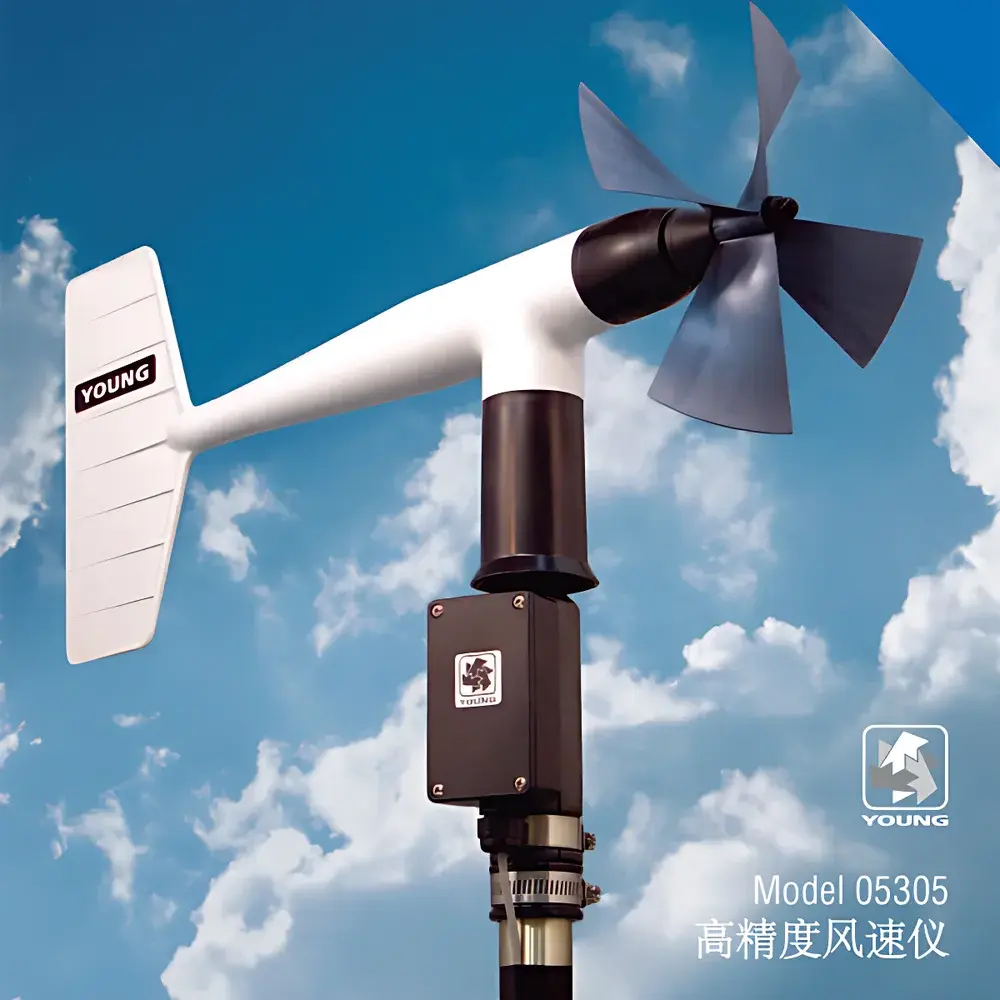
R.M. Young 05305 Precision Cup Anemometer & Vane Wind Sensor
| Brand | R.M. Young |
|---|---|
| Origin | USA |
| Model | 05305 |
| Instrument Type | Cup Anemometer & Wind Vane Sensor |
| Resolution | 0.1 m/s |
| Measurement Range | 0–50 m/s (wind speed), 0–360° (wind direction) |
| Accuracy | ±0.2 m/s or ±1% of reading (wind speed), ±3° (wind direction) |
| Startup Wind Speed | 0.4 m/s (cup), 0.5 m/s (vane) |
| Operating Temperature | −50°C to +50°C |
| Operating Humidity | 0–100% RH |
| Output Options | AC pulse (3 pulses/rev), 0–5 VDC, or 4–20 mA |
| Housing Material | UV-stabilized polymer with stainless steel and anodized aluminum hardware |
| Bearing Type | Precision stainless steel ball bearings |
| Compliance | EPA PSD Guidelines, NRC RG 1.23, ANSI/ANS-18.1 |
Overview
The R.M. Young 05305 Precision Cup Anemometer & Vane Wind Sensor is a rigorously engineered environmental monitoring instrument designed for long-term, high-fidelity wind measurement in regulatory-grade meteorological networks, air quality monitoring stations, nuclear facility siting programs, and atmospheric research applications. It operates on the fundamental principle of mechanical transduction: wind-induced rotation of a three-cup rotor generates a proportional AC sine-wave voltage signal via magnetic induction—eliminating slip rings and brushes to ensure maintenance-free operation and signal integrity over decades. Simultaneously, a low-inertia, aerodynamically balanced wind vane rotates about a precision conductive-plastic potentiometer, producing a linear DC voltage output directly correlated to azimuthal orientation. This dual-sensor architecture delivers synchronized, time-aligned wind speed and direction data with minimal phase lag—critical for turbulence analysis, flux calculations, and dispersion modeling.
Key Features
- High-resolution cup anemometer with 0.1 m/s resolution and ±0.2 m/s absolute accuracy across the full 0–50 m/s range, validated per ISO 17025-accredited calibration protocols.
- Optimized aerodynamic design featuring lightweight carbon-fiber thermoplastic (CFT) cups and a low-drag aluminum vane—reducing inertia and improving response to transient gusts.
- Robust mechanical architecture: sealed stainless steel ball bearings, UV-resistant polymer housing, and corrosion-resistant anodized aluminum and stainless steel fasteners for deployment in coastal, industrial, and arctic environments.
- Three standardized output configurations: raw AC pulse (3 pulses per revolution), calibrated 0–5 VDC (model 05305V), or noise-immune 4–20 mA current loop (model 05305L), enabling seamless integration with SCADA systems, dataloggers (e.g., Campbell Scientific CR series), and PLC-based control infrastructure.
- Integrated transient protection and cable termination within an IP65-rated junction box—designed for field reliability under lightning-prone or high-EMI conditions.
- Mounting compatibility with standard 1-inch NPT pipe (34 mm OD), facilitating rapid installation on towers, masts, or building rooftops without custom fabrication.
Sample Compatibility & Compliance
The 05305 is certified for continuous outdoor exposure across extreme climatic regimes—from −50°C polar installations to humid tropical zones (0–100% RH non-condensing). Its mechanical design conforms to the performance criteria outlined in U.S. Environmental Protection Agency’s Prevention of Significant Deterioration (PSD) monitoring guidance, Nuclear Regulatory Commission Regulatory Guide 1.23 (Meteorological Monitoring for Nuclear Power Plants), and ANSI/ANS-18.1 (Standard for Meteorological Monitoring at Nuclear Facilities). The sensor meets GLP-compliant data traceability requirements when paired with Part 11–compliant data acquisition systems; its analog outputs support audit-ready calibration records, including NIST-traceable certificate documentation upon request. No firmware or software updates are required—the device operates as a passive, analog transducer with no embedded microprocessors or memory.
Software & Data Management
As a purely analog transducer, the 05305 does not include onboard firmware or proprietary software. Instead, it interfaces transparently with industry-standard data loggers (e.g., Campbell Scientific, Onset HOBO, Delta-T Devices), SCADA platforms (e.g., Ignition, Siemens Desigo), and laboratory DAQ systems (e.g., National Instruments). Signal conditioning—such as filtering, scaling, and unit conversion—is performed externally, ensuring full user control over sampling rate, averaging intervals (e.g., 1-second gusts vs. 10-minute means), and metadata tagging. All output variants support linear scaling per manufacturer-provided transfer functions (e.g., 0–5 VDC = 0–50 m/s; 0–5 VDC = 0–360°), enabling direct ingestion into time-series databases (InfluxDB, TimescaleDB) or GIS-integrated environmental dashboards. Calibration certificates include full uncertainty budgets compliant with ISO/IEC 17025.
Applications
- Air quality monitoring networks requiring EPA-compliant wind inputs for receptor modeling and source attribution.
- Nuclear power plant meteorological safety systems, where redundancy, long-term stability, and regulatory audit readiness are mandated.
- Wind resource assessment for distributed energy projects—particularly in low-wind-speed or complex terrain sites where low startup threshold (<0.4 m/s) and dynamic response (distance constant: 2.1 m) are decisive.
- Urban climate studies and boundary-layer research, where synchronized speed/direction data enables calculation of turbulent kinetic energy, vertical fluxes, and vortex shedding characteristics.
- Industrial stack emission compliance monitoring, integrated with continuous emission monitoring systems (CEMS) to correlate plume dispersion with real-time wind vectors.
FAQ
What is the minimum wind speed the 05305 can reliably detect?
The cup rotor starts rotating at 0.4 m/s; reliable quantification begins at ≥0.5 m/s, consistent with WMO Class 1 anemometer specifications.
Does the 05305 require external power for basic pulse output?
No—the AC pulse output is self-generating via magnetic induction. Only the 05305V and 05305L variants require excitation voltage (8–24 VDC or 8–30 VDC, respectively).
Can the sensor be used in salt-laden marine environments?
Yes. The housing, fasteners, and bearings are selected for marine-grade corrosion resistance; annual visual inspection and cleaning are recommended per IEC 60721-3-5 severity class 5M3.
Is NIST-traceable calibration included with purchase?
A factory calibration certificate with uncertainty budget is provided. NIST-traceable recalibration services are available through R.M. Young’s ISO/IEC 17025-accredited metrology lab.
How is directional accuracy maintained over time?
The conductive plastic potentiometer exhibits 50 million cycle durability; no zero drift compensation is required under normal operating conditions.
Related Products







