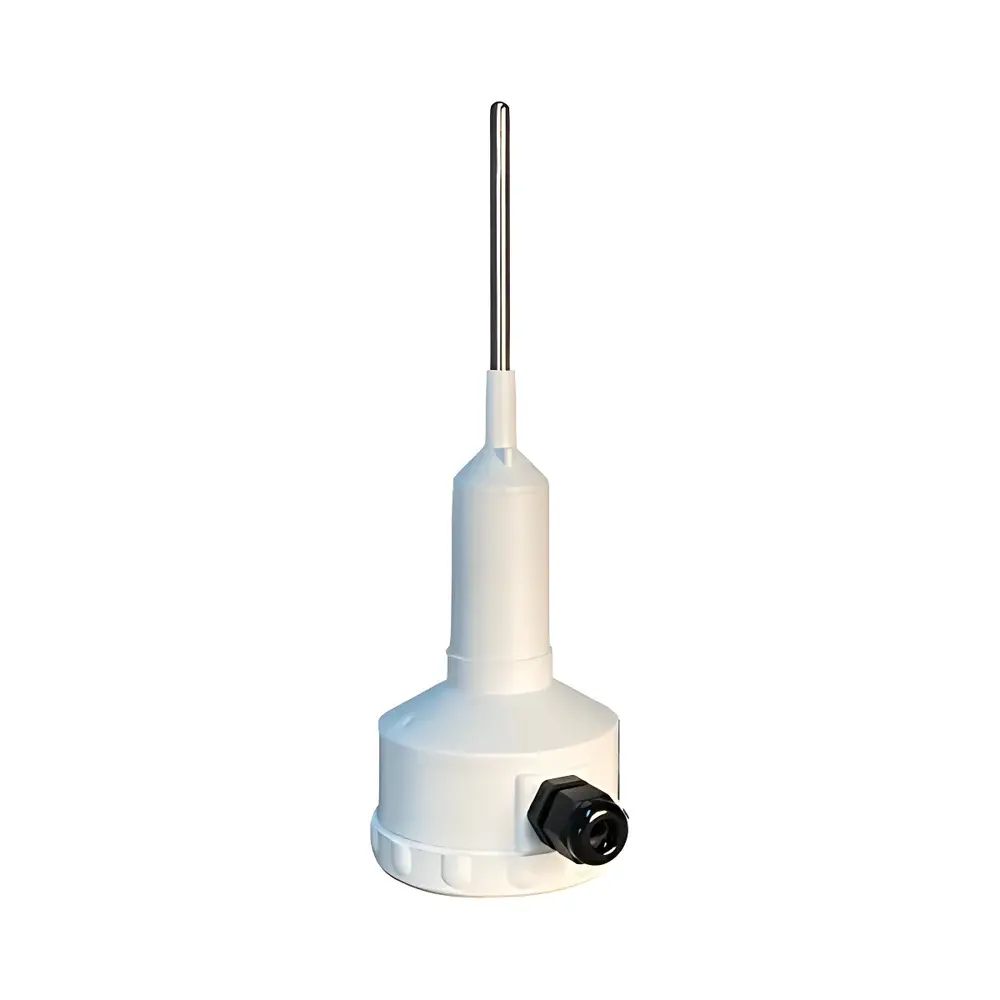
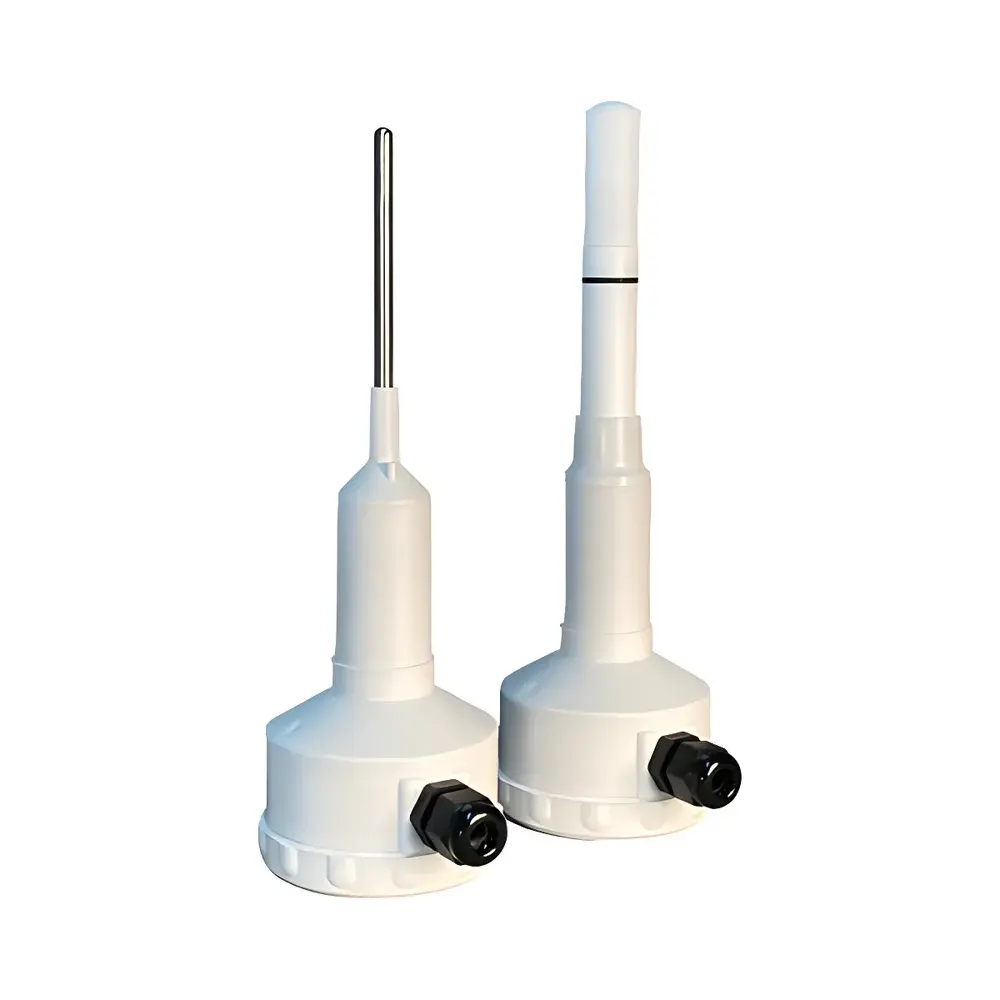
R.M. Young 41342 Platinum RTD Temperature Sensor
| Brand | R.M. Young |
|---|---|
| Origin | USA |
| Model | 41342 |
| Measurement Range | −50 to +50 °C |
| Accuracy (at 0 °C) | ±0.3 °C (standard), ±0.1 °C (optional) |
| Time Constant | 42 s (with 43408 radiation shield) |
| Sensor Type | 1000 Ω Pt RTD, 4-wire configuration |
| Output Options | Resistance (41342), 0–1 VDC (41342VC), 4–20 mA (41342LC) |
| Calibration | Selectable °C or °F |
| Recommended Radiation Shield | 43502 (aspirated) or 41003P (multi-plate passive) |
| Recommended Cable | 2-pair shielded, 22 AWG (P/N 18641) |
Overview
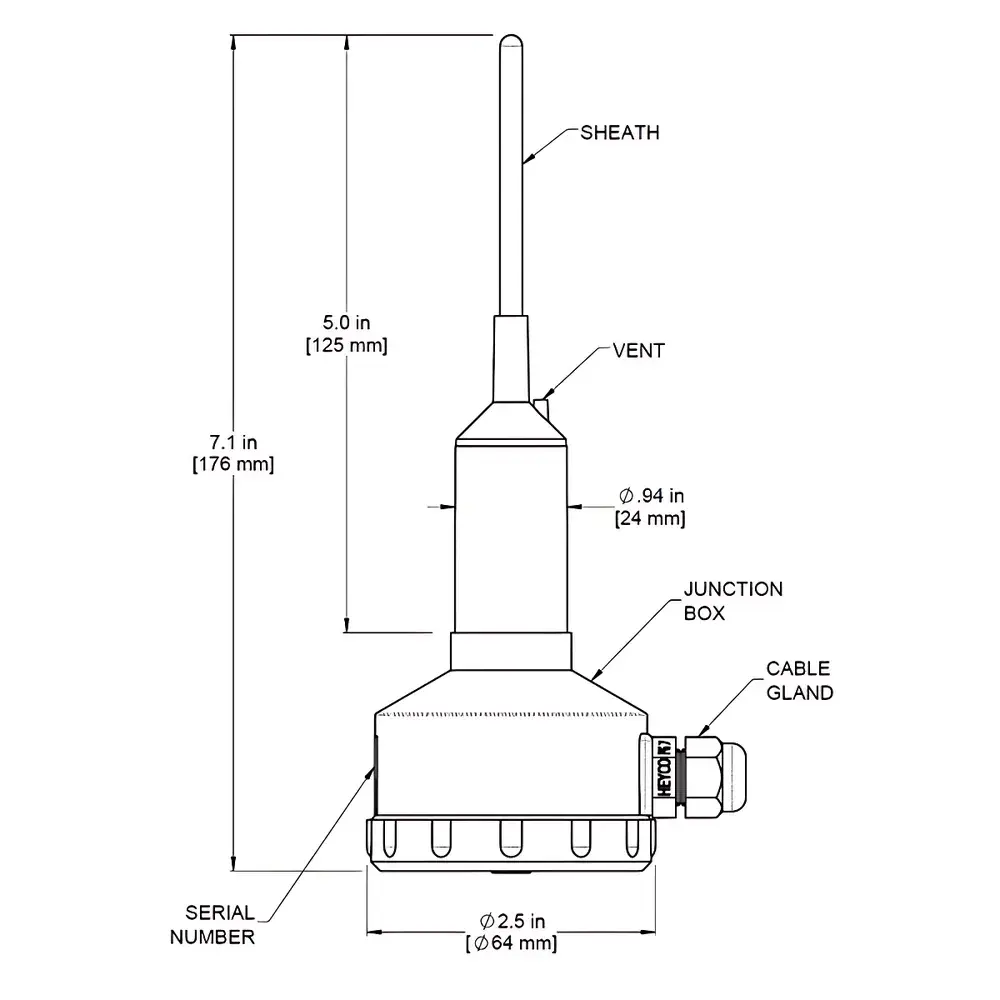
The R.M. Young 41342 is a high-stability, precision platinum resistance thermometer (Pt1000) engineered for meteorological and environmental monitoring applications where long-term accuracy, low drift, and robust physical integration are critical. Based on the IEC 60751 Class A tolerance standard for platinum RTDs, the sensor employs a 4-wire Kelvin connection to eliminate lead resistance error—ensuring traceable, laboratory-grade temperature measurement in field-deployed conditions. Its active sensing element is hermetically sealed within a stainless steel probe housing and mounted inside a weatherproof, UV-stabilized junction box rated to IP66. Designed explicitly for compatibility with R.M. Young’s family of naturally aspirated and fan-aspirated radiation shields—including the multi-plate 41003P and the active 43502—the 41342 delivers optimal thermal equilibrium under solar loading and wind-induced convective cooling. The sensor operates over a validated range of −50 °C to +50 °C, with standard accuracy of ±0.3 °C at 0 °C; an optional high-accuracy variant achieves ±0.1 °C at the same reference point, suitable for calibration transfer or reference-grade network nodes.
Key Features
- 1000 Ω platinum RTD sensor per IEC 60751 Class A specifications, with 4-wire configuration for uncompensated lead resistance elimination
- Weatherproof, NEMA 4X-rated junction box with integrated cable gland and terminal block for field termination
- Thermally optimized probe geometry designed for minimal radiation error when installed in YOUNG 41003P or 43502 radiation shields
- Three configurable output variants: 41342 (raw resistance), 41342VC (0–1 VDC analog voltage), and 41342LC (4–20 mA current loop)
- Selectable factory calibration in either Celsius or Fahrenheit, with documented as-found/as-left data available upon request
- Time constant of 42 seconds when used with the 43408 passive radiation shield—validated per WMO Guide to Meteorological Instruments and Methods of Observation (CIMO Guide, Chapter 4)
Sample Compatibility & Compliance
The 41342 is intended for ambient air temperature measurement in unobstructed outdoor environments, conforming to World Meteorological Organization (WMO) siting requirements for Class I and Class II stations. It is compatible with all R.M. Young radiation shields designed for passive or aspirated thermal shielding—including the multi-plate 41003P (natural convection), 43502 (fan-aspirated), and legacy 43408 models. The sensor meets UL 508A industrial control panel requirements for enclosure rating and complies with CE marking directives for electromagnetic compatibility (EMC Directive 2014/30/EU) and low-voltage safety (LVD Directive 2014/35/EU). For installations requiring regulatory audit trails, the 41342LC and 41342VC variants support integration into systems compliant with FDA 21 CFR Part 11 when paired with appropriate data acquisition hardware and software validation protocols.
Software & Data Management
While the 41342 is an analog transducer without embedded intelligence, its linear resistance–temperature relationship (per Callendar–Van Dusen equation) enables seamless integration with industry-standard data loggers—including Campbell Scientific CR series, Onset HOBO RX3000, and Delta-T DL2e—via dedicated RTD input channels or signal conditioning modules. When configured with 4–20 mA or 0–1 VDC outputs, it interfaces directly with PLCs, SCADA systems, and building management controllers supporting standard analog I/O. Calibration coefficients and temperature conversion algorithms are provided in both polynomial and lookup-table formats, supporting implementation in Python, MATLAB, LabVIEW, or custom firmware. All factory calibration reports include uncertainty budgets traceable to NIST SRM 1750a (Standard Platinum Resistance Thermometer).
Applications
- Ambient air temperature monitoring in national weather networks and automated surface observing systems (ASOS/AWOS)
- Climate research stations requiring multi-year stability and inter-sensor comparability
- Environmental compliance monitoring for EPA Title V facilities and ISO 14001-certified operations
- Calibration reference points in metrology labs performing field instrument verification
- Integration into agrometeorological networks for evapotranspiration modeling and frost warning systems
- Supporting GLP/GMP environmental monitoring programs in pharmaceutical manufacturing and cold chain validation
FAQ
What is the recommended mounting configuration for optimal thermal performance?
Mount the 41342 exclusively within a WMO-compliant radiation shield—preferably the 41003P (multi-plate passive) or 43502 (fan-aspirated)—to minimize solar radiation error and ensure representative ambient air sampling.
Can the 41342 be calibrated in-house using standard equipment?
Yes, the 4-wire RTD design allows for direct resistance measurement with a calibrated digital multimeter or precision ohmmeter; however, full system calibration—including shield interaction effects—requires controlled environmental chamber testing per ISO/IEC 17025 procedures.
Is the 41342 suitable for sub-zero operation in polar environments?
Yes, the sensor is rated for continuous operation from −50 °C to +50 °C, and its stainless steel probe and epoxy-sealed junction box maintain mechanical integrity and electrical insulation down to −55 °C.
How does the time constant vary across different radiation shields?
The stated 42-second time constant applies specifically to use with the 43408 shield; with the aspirated 43502, the effective time constant reduces to approximately 15–20 seconds due to forced airflow enhancing thermal response.
Does R.M. Young provide NIST-traceable calibration certificates?
Yes, optional NIST-traceable calibration certificates—documenting measurement uncertainty, drift history, and environmental test conditions—are available upon order with part number suffix “-CAL”.