
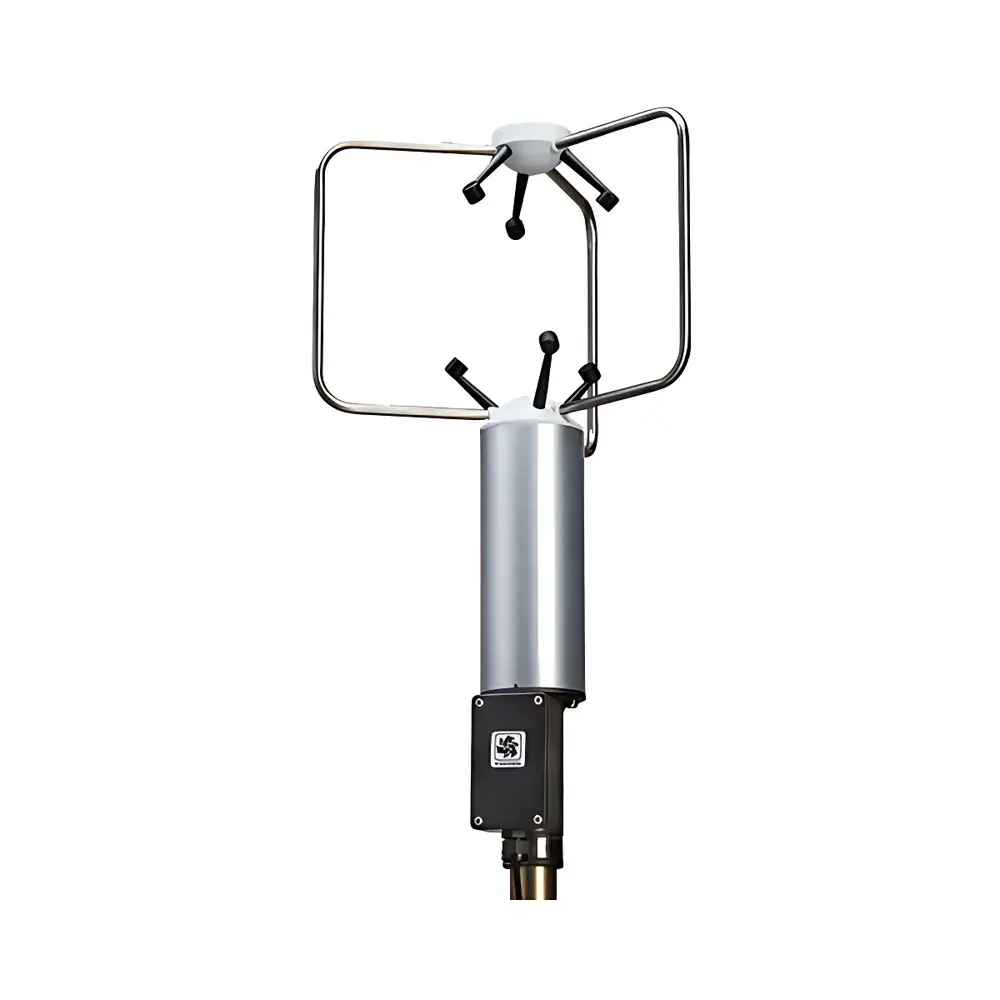
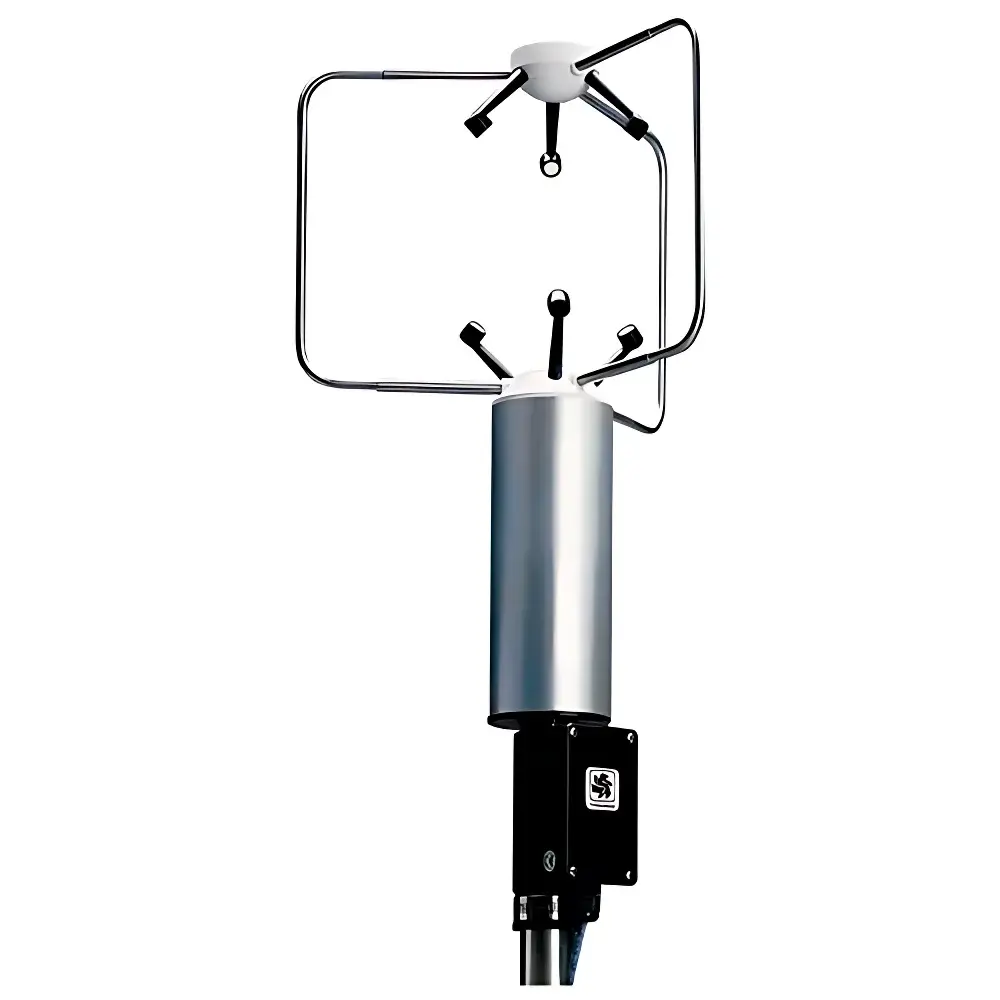
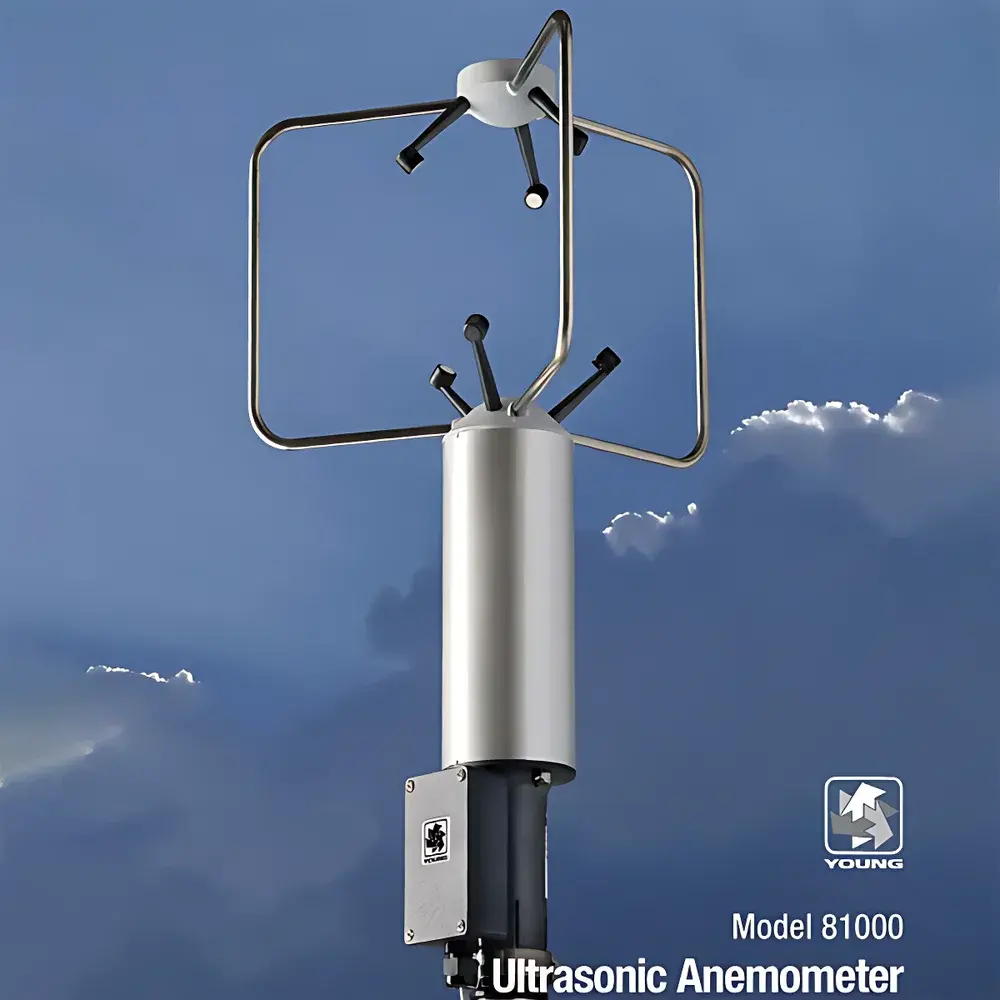
R.M. Young 81000V Three-Dimensional Ultrasonic Anemometer
| Brand | R.M. Young |
|---|---|
| Origin | USA |
| Model | 81000V |
| Instrument Type | Ultrasonic Anemometer |
| Resolution | 0.01 m/s |
| Wind Speed Range | 0–40 m/s |
| Accuracy | ±1% (0–30 m/s), ±3% (30–40 m/s) |
| Operating Temperature | −50°C to +50°C |
| Operating Humidity | 0–100% RH |
| Wind Direction Range | 0–360° |
| Elevation Angle Range | ±60° |
| Sonic Temperature Range | −50°C to +50°C |
| Output Options | RS-232 / RS-485 serial, 4-channel analog voltage input (81000V), sampling rate up to 160 Hz, user-selectable output frequency (4–32 Hz) |
Overview
The R.M. Young 81000V is a precision-engineered, three-dimensional ultrasonic anemometer designed for high-fidelity atmospheric turbulence measurement, eddy covariance flux studies, and boundary-layer meteorological monitoring. Unlike mechanical cup-and-vane or hot-wire anemometers, the 81000V employs time-of-flight ultrasonic transit-time principle across three orthogonal transducer pairs—measuring wind components (U, V, W) simultaneously without moving parts. This solid-state architecture eliminates mechanical wear, inertia-induced lag, and directional hysteresis, enabling true vector wind resolution at sub-second temporal scales. Each unit undergoes individual wind-tunnel calibration to quantify and compensate for structural wake effects induced by its stainless-steel support frame—a critical step for maintaining accuracy under real-world mounting conditions. The sensor’s compact, aerodynamically optimized geometry (55 cm height × 17 cm diameter, 1.7 kg mass) ensures minimal flow distortion while supporting robust deployment on standard 1-inch mounting pipes in unsheltered outdoor environments.
Key Features
- Three-axis ultrasonic wind measurement with simultaneous U/V/W component acquisition
- No moving parts: zero maintenance, no bearing wear, immunity to icing-induced failure
- High-speed sampling up to 160 Hz—supports spectral analysis of turbulent kinetic energy and Reynolds stress computation
- User-selectable output frequency from 4 Hz to 32 Hz via serial command; compatible with data loggers requiring deterministic timing
- Dual-mode interface: RS-232 and RS-485 digital outputs (9600–38400 baud); configurable ASCII data frames including wind vector, sonic temperature, azimuth, elevation, and derived parameters
- 81000V variant integrates four analog voltage input channels (V1–V4) with 12-bit effective resolution (1/4000), enabling synchronized acquisition of auxiliary sensors (e.g., CO₂ analyzers, IRGA signals, or radiation pyrometers)
- Onboard sonic temperature derivation from acoustic velocity measurements—calibrated against NIST-traceable standards per ISO 7726 and ASTM D5467
- Hermetically sealed, weatherproof junction box with IP66-rated cable entry for field reliability
Sample Compatibility & Compliance
The 81000V is validated for continuous operation across extreme environmental gradients: −50°C to +50°C ambient temperature and 0–100% relative humidity without condensation-induced signal drift. Its stainless-steel transducer housing and corrosion-resistant fasteners meet ASTM B117 salt-spray resistance requirements for coastal and industrial deployments. All firmware and calibration metadata are stored in non-volatile memory and retain traceability to NIST-certified wind tunnel procedures. While not inherently FDA-regulated, the device supports GLP-compliant data acquisition workflows when integrated with Part 11–compliant logging systems—enabling audit-ready timestamping, user authentication, and electronic signature capability through external host software. It conforms to IEC 61326-1 (EMC for measurement equipment) and CE marking directives for environmental instrumentation.
Software & Data Management
The 81000V operates without proprietary drivers; ASCII-formatted serial output enables direct ingestion into MATLAB, Python (via PySerial), LabVIEW, or CRBasic (Campbell Scientific). Standard output fields include U (m/s), V (m/s), W (m/s), sonic temperature (°C), speed of sound (m/s), wind direction (°), and vertical elevation angle (°)—all user-mappable to custom units (knots, mph, km/h, cm/s). Configuration is performed via simple AT-style commands over serial interface. Firmware updates are delivered as signed binary files with CRC-32 validation. For long-term networked deployments, the RS-485 option supports Modbus RTU protocol integration into SCADA architectures. Raw voltage inputs (V1–V4) are digitized internally at 16-bit resolution and reported alongside wind data in time-aligned packets—ensuring phase coherence essential for covariance calculations in eddy covariance systems.
Applications
- Eddy covariance flux towers for carbon, water vapor, and methane exchange quantification (aligned with AmeriFlux, ICOS, and FLUXNET protocols)
- Atmospheric boundary layer research, including turbulence intensity profiling and Monin–Obukhov similarity theory validation
- Wind resource assessment for small-scale turbine siting and microgrid integration studies
- Urban meteorology networks requiring spatially dense, low-power, maintenance-free sensing nodes
- Volcanic plume dispersion modeling where rapid response to transient wind shear events is critical
- Calibration reference for lower-cost ultrasonic or thermal anemometers in metrology labs
FAQ
How is the 81000V calibrated, and is calibration traceable to national standards?
Each unit undergoes individual calibration in an ISO/IEC 17025-accredited wind tunnel using NIST-traceable pitot-static references. Calibration coefficients—including wake correction matrices—are embedded in device firmware and accessible via serial query.
Can the 81000V be used in icing conditions?
Yes—the transducers operate continuously down to −50°C and feature self-heating capability when powered at ≥18 VDC. However, prolonged ice accumulation on transducer faces may attenuate signal amplitude; heated variants (e.g., 81000HS) are recommended for persistent icing environments.
What is the difference between the 81000 and 81000V models?
The 81000 provides four analog voltage outputs (U/V/W/sonic temperature); the 81000V replaces these with four high-impedance analog inputs, allowing synchronized acquisition of co-located environmental sensors without additional signal conditioning hardware.
Does the device support time synchronization with GPS or PTP?
The 81000V does not include built-in GPS or IEEE 1588 PTP hardware, but its serial output includes UTC timestamps when paired with a host logger equipped with GPS discipline (e.g., Campbell Scientific CR6 or Onset HOBO RX3000).
Is firmware update capability available in the field?
Yes—firmware updates are performed via ASCII-command-initiated binary upload over RS-232 or RS-485, with checksum verification and rollback support to ensure operational continuity.
Related Products







