
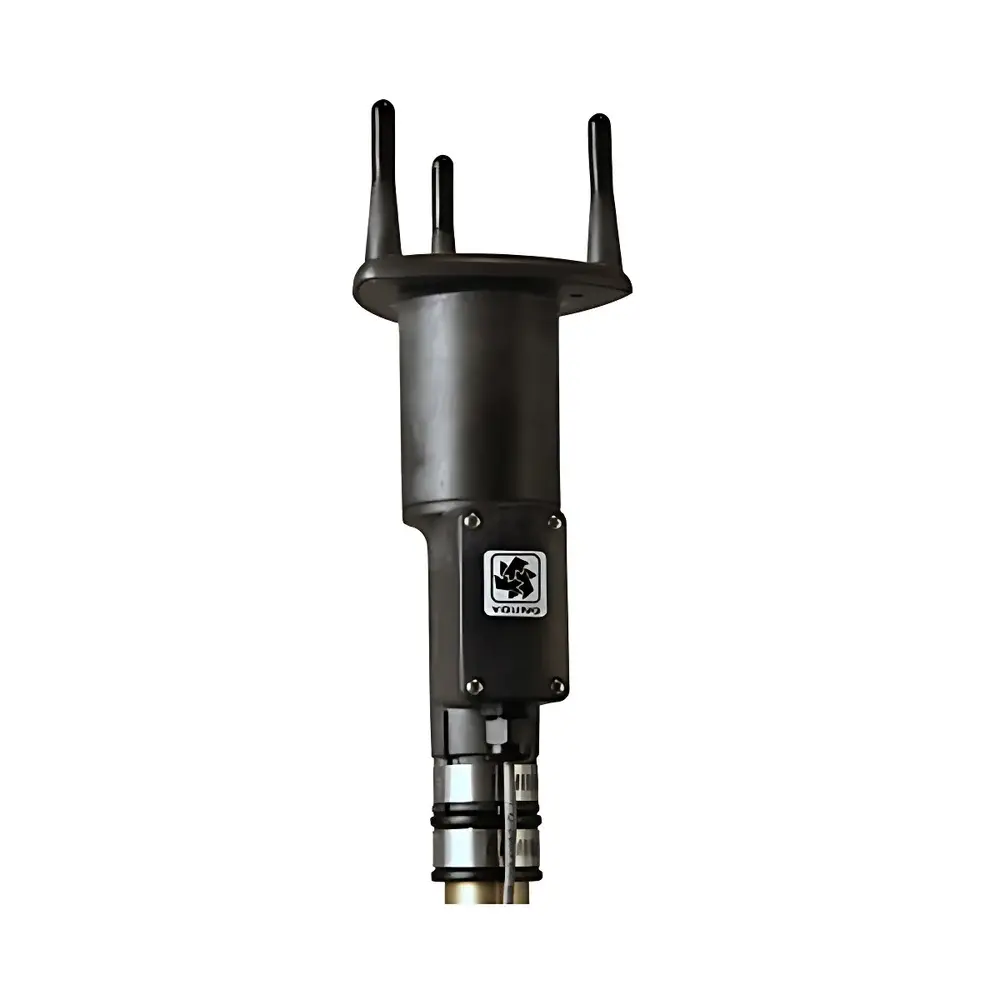
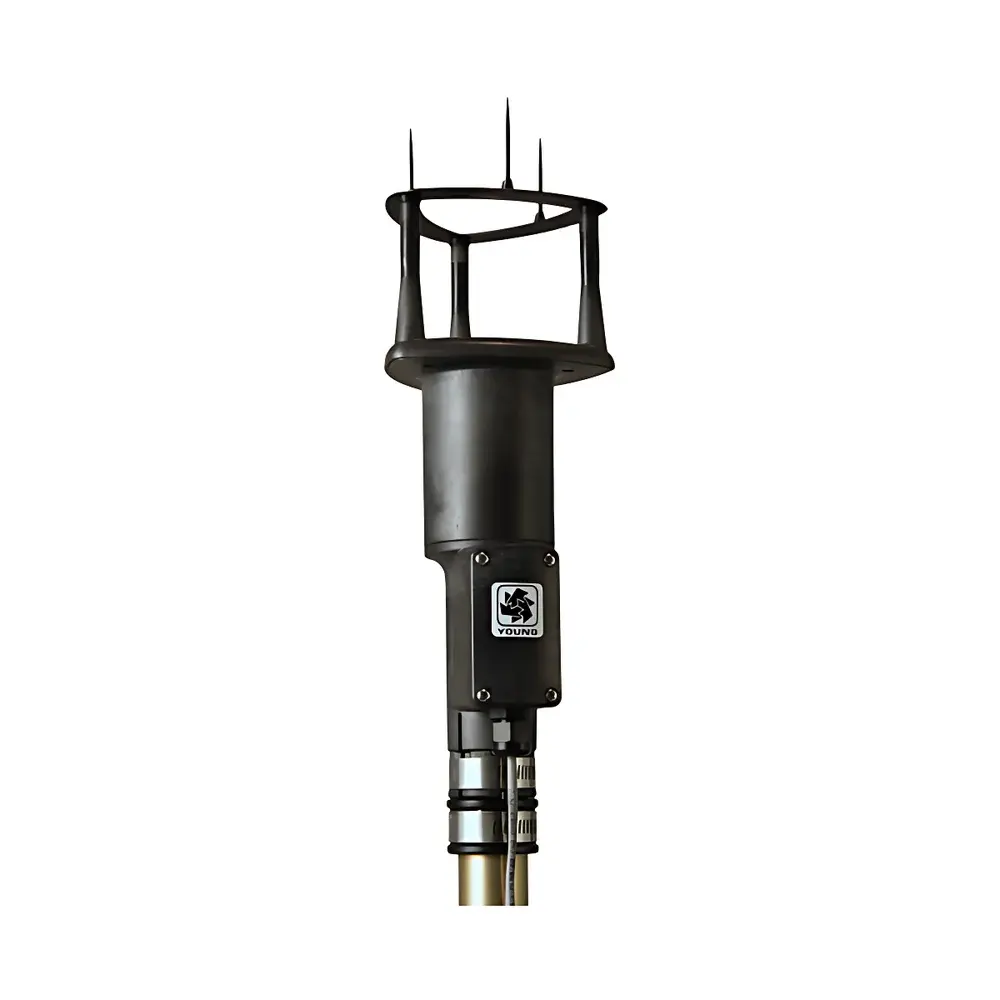
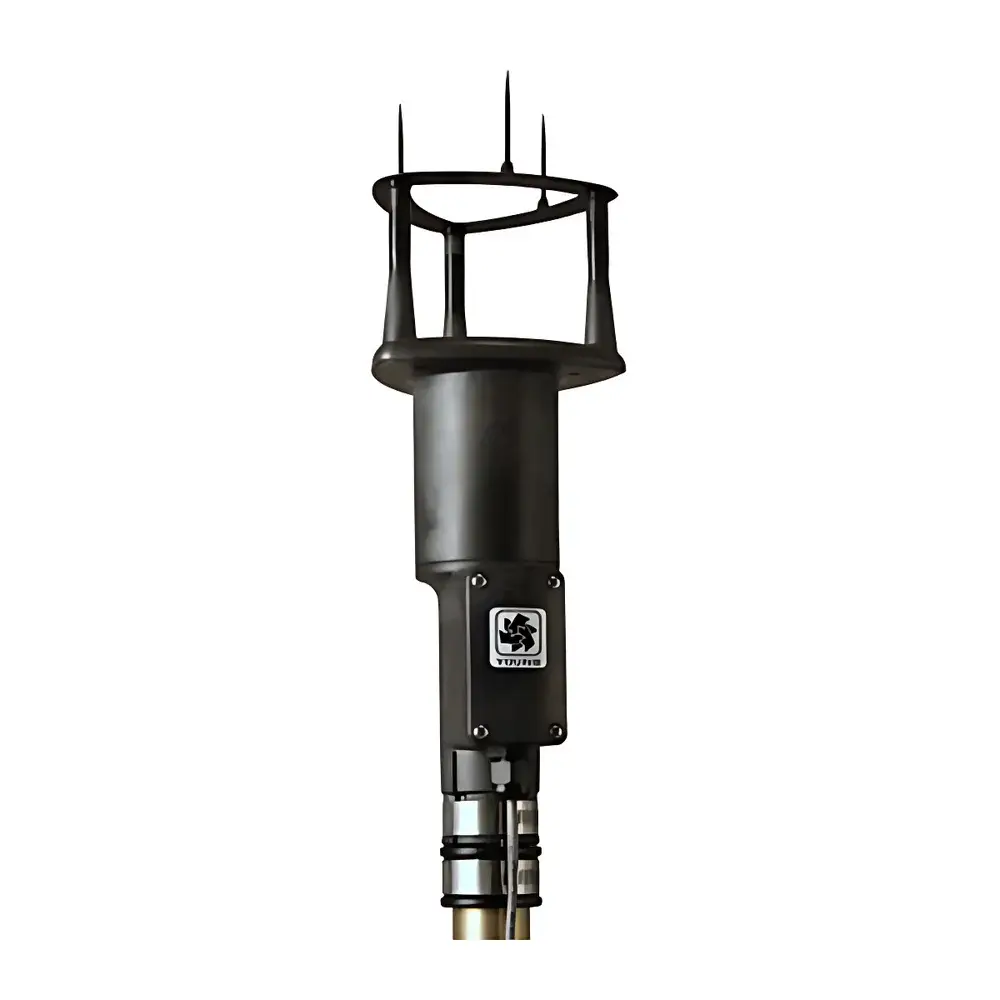
R.M. Young 86004 Heated Two-Dimensional Ultrasonic Anemometer
| Brand | R.M. Young |
|---|---|
| Origin | USA |
| Model | 86004 |
| Instrument Type | Ultrasonic Anemometer |
| Wind Speed Range | 0–75 m/s |
| Resolution | 0.01 m/s |
| Accuracy | ±2% (0–30 m/s), ±3% (30–70 m/s) |
| Wind Direction Range | 0–360° |
| Wind Direction Resolution | 0.1° |
| Wind Direction Accuracy | ±2° |
| Startup Wind Speed | 0.01 m/s |
| Response Time | <0.25 s |
| Operating Temperature | −40 to +60 °C |
| Relative Humidity | 0–100 %RH |
| Output Options | RS-232/RS-485, ASCII/RMYT/NMEA/SDI-12, 0–5 V / 4–20 mA |
| Analog Wind Speed Range | 0–100 m/s |
| Analog Wind Direction Range | 0–360° or 0–540° |
| Output Frequency | 0.1–20 Hz |
| Power Supply | 10–30 VDC (heater: 24 VDC, 2.5 A) |
| Current Draw | <20 mA (non-heating) |
| IP Rating | IP65 |
| Dimensions | 29 cm H × 11 cm W |
| Weight | 0.4 kg (unit), 1.6 kg (shipping) |
Overview
The R.M. Young 86004 is a heated, two-dimensional ultrasonic anemometer engineered for high-reliability wind measurement in extreme environmental conditions. It operates on the time-of-flight principle: precisely measuring the differential transit time of ultrasonic pulses between opposing transducer pairs along orthogonal axes (U and V). By calculating the reciprocal travel times of sound waves propagating with and against the wind vector, the instrument derives instantaneous horizontal wind speed and direction without mechanical moving parts. This solid-state architecture eliminates bearing wear, inertia lag, and icing-related failure modes—making it especially suitable for unattended, long-term deployments across meteorological networks, environmental research stations, industrial stack monitoring, and cold-climate infrastructure applications. The integrated thermostatically controlled heater (24 VDC, 2.5 A) prevents frost and condensation accumulation on transducer surfaces and housing, ensuring continuous operation down to −40 °C while maintaining metrological integrity under high-humidity and freezing fog conditions.
Key Features
- Heated transducer assembly with PID-controlled thermal regulation, enabling reliable operation in sub-zero and high-RH environments
- Compact, corrosion-resistant anodized aluminum housing (IP65-rated) with streamlined aerodynamic profile validated in certified wind tunnels
- Dual-output capability: simultaneous analog (0–5 V or 4–20 mA) and digital (RS-232/RS-485) interfaces with configurable baud rates (1200–38400 bps)
- Multi-protocol serial support: ASCII (polling/continuous), RMYT (compatible with Young display modules), NMEA-0183 (marine integration), and SDI-12 (for data logger compatibility)
- No moving parts—zero mechanical hysteresis, no calibration drift due to bearing degradation, and minimal maintenance requirements over service life
- Direct mounting to standard 1-inch IPS pipe; weatherproof junction box with screw-terminal connections eliminates need for proprietary cabling or adapters
- Fast dynamic response (<0.25 s) compliant with IEC 61000-4-3 immunity standards for electromagnetic environments typical of industrial sites
Sample Compatibility & Compliance
The 86004 is designed for open-air atmospheric sampling and does not require sample media or consumables. Its transducer geometry and signal processing are optimized for ambient air at standard pressure (80–110 kPa) and temperatures spanning −40 °C to +60 °C. The device meets IEC 60529 (IP65), RoHS Directive 2011/65/EU, and FCC Part 15 Subpart B Class B emission limits. While not certified to ISO/IEC 17025 as a standalone calibration standard, its factory calibration traceability aligns with NIST-traceable reference anemometers per ASTM D5096 and ISO 16622 procedures. For regulatory reporting (e.g., EPA Method 9, EN 15267), output data may be integrated into GLP-compliant data acquisition systems supporting audit trails and electronic signatures per FDA 21 CFR Part 11 when paired with validated software platforms.
Software & Data Management
The 86004 outputs time-synchronized U/V vector components and derived wind speed/direction values at user-selectable update intervals (0.1–20 Hz). Raw serial data supports real-time ingestion into SCADA systems, Campbell Scientific CR-series loggers, or custom Python/Matlab acquisition scripts via standard UART drivers. ASCII and NMEA formats include checksum validation and status flags for diagnostic monitoring (e.g., heater active, transducer fault, signal-to-noise ratio below threshold). When deployed with R.M. Young’s optional YDL-200 data logger or third-party platforms supporting SDI-12, the unit enables autonomous battery-powered operation with onboard memory buffering and scheduled transmission protocols. Firmware updates are performed via RS-232 using documented command sets; configuration parameters (output mode, units, averaging window) are retained through power cycles.
Applications
- Automated weather stations (AWS) in polar, alpine, and coastal regions where icing compromises cup-and-vane sensors
- Air quality monitoring networks requiring turbulence-resolving wind vectors for dispersion modeling (e.g., CALPUFF, AERMOD inputs)
- Wind resource assessment for small-scale turbine siting and microgrid optimization
- Industrial emissions compliance—stack exit velocity profiling and fugitive dust control verification
- Research-grade boundary layer studies, including eddy covariance flux measurements when synchronized with gas analyzers
- Oceanographic buoys and offshore platforms leveraging NMEA-0183 compatibility for integration with GPS and AIS systems
FAQ
Does the 86004 require periodic recalibration?
Field recalibration is not required under normal operating conditions. Factory calibration remains stable over time due to solid-state design; however, annual verification against a NIST-traceable reference anemometer is recommended for ISO/IEC 17025-aligned QA programs.
Can the heater be disabled remotely?
Yes—the heater control circuit accepts TTL-level enable/disable commands via RS-232 or RS-485, allowing conditional activation based on ambient temperature thresholds defined in host software.
What is the effect of heating on measurement accuracy at low wind speeds?
Heater-induced thermal gradients are minimized by symmetric transducer placement and low-power pulse modulation. Validation testing confirms no measurable bias (>0.01 m/s) in wind speed or direction accuracy across the full 0–75 m/s range when heater is active.
Is the 86004 compatible with Campbell Scientific dataloggers?
Yes—via SDI-12 interface (86000-SDI variant) or RS-232/RS-485 using custom serial instruction tables; full integration documentation is available in Campbell’s Device Configuration Utility (DCU) library.
How is ice accumulation prevented on the transducers during continuous operation?
The heater maintains transducer surface temperature ~5–10 °C above ambient during sub-zero conditions, preventing supercooled droplet adhesion and promoting rapid melt-off of light rime—validated per MIL-STD-810G Method 502.6 freeze-thaw cycling.







